
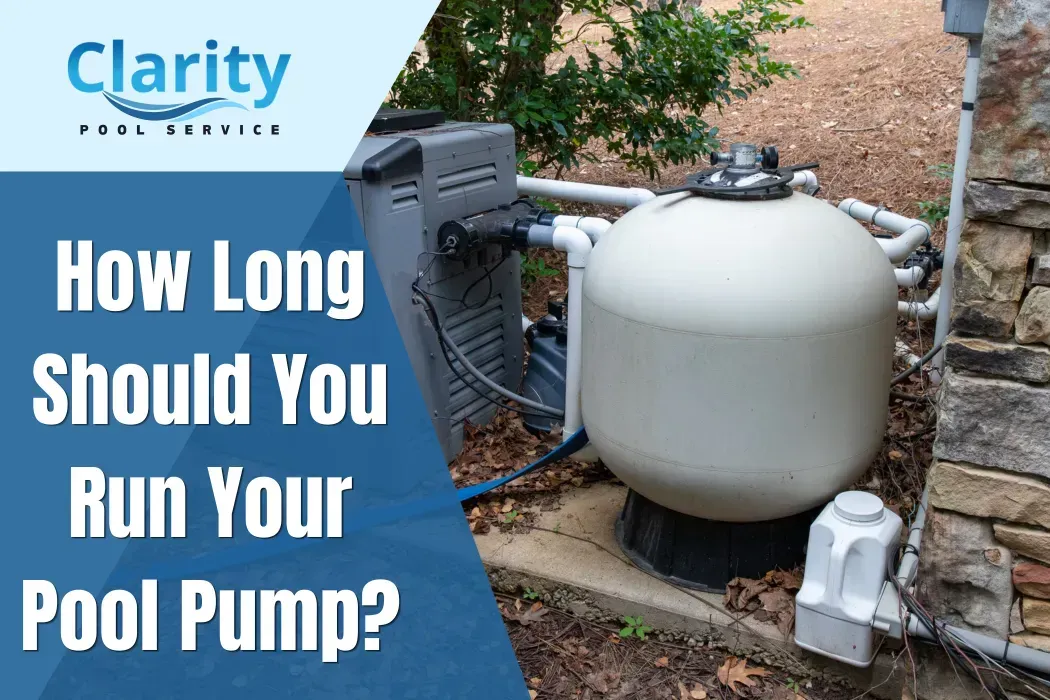
How Long Should You Run Your Pool Pump?
A Homeowner's Guide to Pool Pump Run Time, Circulation, and Energy Efficiency
One of the most common questions pool owners ask is:
How many hours a day should I run my pool pump?
You may hear answers like:
8 hours.
12 hours.
One hour for every 10 degrees of temperature.
Or:
Run it long enough to turn the water over once or twice per day.
The problem is that none of those rules works perfectly for every swimming pool.
A small pool with a properly programmed variable-speed pump has very different circulation needs from a large pool with an attached spa, water features, heater, or salt chlorine generator.
Pump speed matters too.
Running a variable-speed pump for 10 hours at a low speed isn't the same as running a pump for 10 hours at a high speed.
The better question isn't simply:
How many hours should my pump run?
It's:
How much circulation does my particular pool need to maintain clean, properly sanitized water while operating efficiently?
For homeowners throughout Santee, El Cajon, Lakeside, Rancho San Diego, Fletcher Hills, Mt. Helix, Spring Valley, Lemon Grove, San Carlos, Allied Gardens, Del Cerro, Casa de Oro, and East County San Diego, the answer can also change with the season.
Hot summer weather, strong sunlight, swimmer use, Santa Ana winds, debris, and pool equipment all influence circulation needs.
Quick Answer
Many residential pools operate their circulation systems for several hours each day, but there is no universal daily run time that's correct for every pool.
The appropriate schedule depends on:
Pool size
Pump type
Pump speed
Plumbing
Filter condition
Sanitizing system
Heater operation
Water features
Swimmer use
Weather
Water chemistry
Modern variable-speed pumps can often operate efficiently for longer periods at lower speeds, with higher speeds used when necessary for specific equipment or functions.
The goal is not to hit an arbitrary number of hours.
The goal is adequate circulation, filtration, sanitation, and equipment operation without wasting energy.
At a Glance
Why Your Pool Pump Needs to Run Every Day
The pump is responsible for moving water through the circulation system.
A simplified path looks like this:
Pool → Skimmers/Suction Lines → Pump → Filter → Additional Equipment → Return Jets → Pool
While the pump operates, several important things can happen.
Water moves through the filter.
Debris moves toward skimmers.
Sanitizer is distributed.
Heated water can circulate.
A salt chlorine generator can produce chlorine when operating conditions are appropriate.
Chemicals added to the pool can distribute more evenly.
Without adequate circulation, water may become more difficult to maintain.
But that doesn't mean:
More pump operation is always better.
The objective is enough circulation to support the pool's needs.
Why “8 Hours a Day” Isn't a Universal Rule
Eight hours is probably one of the most common recommendations homeowners hear.
It can be a reasonable starting point for some pools.
But it isn't a scientific requirement for every pool.
Consider two examples.
Pool A
A relatively small residential pool with:
Variable-speed pump
Minimal landscaping
Light swimmer use
Good filtration
Pool B
A larger pool with:
Attached spa
Salt system
Heater
Water features
Heavy summer use
Mature landscaping
Giving both pools the exact same pump schedule simply because “pools need eight hours” ignores major differences between the systems.
The pump schedule should fit the pool.
Variable-Speed Pumps Changed the Run-Time Conversation
Older single-speed pumps operate at one speed whenever they're turned on.
Modern variable-speed pumps can operate at different speeds for different purposes.
That changes how homeowners should think about run time.
A variable-speed pump may operate:
Longer at a lower speed
rather than:
Shorter at maximum speed.
Lower-speed operation can provide useful circulation while using substantially less power than running at maximum speed, depending on the system and programming.
Higher speeds may still be necessary for:
Certain cleaning functions
Spa operation
Some heaters
Water features
Priming
Other equipment requirements
The best schedule may therefore contain multiple speeds throughout the day, not simply one ON time and one OFF time.
Pump Run Time and Pool Turnover
You'll sometimes hear that the pump should run long enough to achieve a complete turnover of the pool water.
Turnover refers to moving a volume of water equivalent to the pool's total volume through the circulation system.
For example, if a pool contains 15,000 gallons and the system moves 50 gallons per minute:
50 gallons × 60 minutes = 3,000 gallons per hour.
15,000 ÷ 3,000 = approximately 5 hours.
That calculation can be useful for understanding flow.
But it shouldn't automatically become the only method used to determine residential pump schedules.
Real pool circulation isn't perfectly uniform.
Some water may pass through the equipment multiple times while other areas receive less movement.
Actual pool maintenance also depends on:
Sanitizer
Filtration
Debris
Return placement
Water chemistry
Equipment requirements
Think of turnover as useful information, not a magic run-time formula.
How Do You Know Whether Your Pump Is Running Long Enough?
The pool itself provides useful clues.
Look at:
Water Clarity
Is the water consistently clear?
Surface Skimming
Are skimmers effectively collecting floating debris?
Return Flow
Does circulation appear normal?
Water Chemistry
Is sanitizer remaining stable between maintenance visits?
Algae
Are certain areas repeatedly developing growth?
Filtration
Is the filter receiving enough circulation to maintain water clarity?
Salt System
If applicable, is the system receiving enough operating time and flow to maintain appropriate chlorine production?
If the pool consistently struggles in these areas, pump scheduling may deserve evaluation.
But remember:
Increasing pump run time doesn't fix every circulation or water-quality problem.
A dirty filter, blocked basket, chemistry problem, poor return configuration, or equipment issue may be the actual cause.
Summer Pump Run Time in East County San Diego
Summer places greater demands on many East County pools.
Higher temperatures and stronger sunlight can contribute to:
Increased chlorine demand
Greater swimmer use
More evaporation
Higher water temperatures
Increased algae pressure
That may justify adjusting circulation or sanitation schedules compared with cooler months.
This doesn't mean every East County pool needs to run at maximum speed all summer.
It means the pump schedule should respond to the pool's actual seasonal needs.
Winter Pump Run Time
Cooler weather may reduce some maintenance demands.
Pools often experience:
Lower swimmer use
Reduced chlorine demand
Cooler water
Depending on the system, pump programming may be adjusted seasonally.
But the circulation system still needs to support:
Filtration
Sanitation
Water chemistry
Equipment operation
Turning circulation down too aggressively simply because nobody is swimming can create unnecessary water-quality problems.
Pump Run Time After Santa Ana Winds
Strong winds can dramatically increase the amount of material entering an East County pool.
After a major wind event, you may have:
Leaves
Dust
Fine dirt
Organic debris
Full skimmer baskets
Additional circulation and filtration may sometimes be helpful after debris has been removed.
But don't simply increase pump speed while baskets are packed with leaves.
First:
Remove debris → Check baskets → Confirm filter condition → Then evaluate circulation.
Otherwise, you may be asking the pump to work against an already restricted system.
The Most Important Rule
Don't program your pump based solely on what your neighbor does.
Two pools next door to each other can have different:
Water volume
Pumps
Filters
Plumbing
Salt systems
Heaters
Landscaping
Usage
Your neighbor's six-hour schedule may work perfectly for their pool and poorly for yours.
The correct pump schedule is the one that supports your specific pool efficiently and consistently.
How to Set a Practical Pool Pump Schedule
The best pump schedule isn't necessarily the one that runs the fewest hours or moves the most water.
It's the schedule that allows the entire pool system to operate correctly without wasting energy.
That means considering more than circulation alone.
Your pump may also need to support:
Filtration
Surface skimming
Salt chlorine production
Heating
Automatic cleaners
Spa operation
Water features
Before changing an existing schedule, understand what the pump is currently controlling.
A speed that seems unnecessarily high may exist because another piece of equipment requires it.
Start With the Equipment You Have
The first question is:
What type of pump do you own?
Most homeowners will have either:
Single-Speed Pump
The pump operates at one fixed speed whenever it's running.
Variable-Speed Pump
The pump can operate at multiple programmed speeds throughout the day.
This distinction matters because run time and pump speed work together.
Ten hours of low-speed operation is very different from ten hours at maximum speed.
That's why comparing hours alone can be misleading.
A Better Approach for Variable-Speed Pumps
Variable-speed pumps allow homeowners to match pump operation to the task.
A schedule might use:
Lower Speeds
For routine circulation and filtration when the system can operate properly at those speeds.
Moderate Speeds
For increased skimming or equipment requiring additional flow.
Higher Speeds
When necessary for specific functions such as:
Spa operation
Certain water features
Some heating conditions
Priming
Specific cleaning functions
The exact speeds vary by pool.
There is no universal RPM schedule that should be copied from one pool to another.
Why Lower Pump Speeds Can Save Energy
This is one of the biggest advantages of variable-speed pumps.
Moving water faster requires substantially more power than moving it more slowly.
That means reducing pump speed can sometimes produce significant energy savings while still providing adequate circulation.
For example, instead of operating a pump at high speed for a short period, a pool may be able to circulate effectively using a lower speed for a longer period.
But there's an important limit:
The speed still needs to be high enough for the equipment to operate correctly.
If the flow becomes too low:
Skimming may become ineffective.
A heater may not operate.
A salt system may report inadequate flow.
Certain cleaners or water features may not function correctly.
Energy efficiency should never come at the expense of proper pool operation.
How Saltwater Pools Affect Pump Run Time
Saltwater pools deserve special attention because the salt chlorine generator typically produces chlorine only while the circulation system is operating under appropriate flow conditions.
Suppose the pump runs eight hours per day and the salt system operates at 50% output.
The system isn't necessarily producing chlorine for 12 hours simply because it's set to 50%.
Its production is tied to the period when the system is actually operating.
This means chlorine production depends on the relationship between:
Pump run time + Salt system output + Chlorine demand
If chlorine remains consistently low, simply increasing salt-system output isn't always the only answer.
You may need to evaluate:
Pump schedule
Salt concentration
Water flow
Cell condition
Water chemistry
Seasonal chlorine demand
Our Saltwater Pool Maintenance guide explains these relationships in greater detail.
How Heaters Affect Pump Scheduling
Pool heaters require water flow.
If flow is inadequate, many heaters won't operate properly.
That's why pump schedules and speeds should account for periods when heating is expected.
A homeowner may program a very low circulation speed for energy efficiency and then wonder why the heater won't start.
The heater may simply require more flow.
Don't assume a heater error automatically means the heater has failed.
Circulation should be evaluated first.
How Automatic Cleaners Affect Pump Scheduling
Some pool cleaners depend directly on the circulation system.
Depending on the cleaner, adequate pump operation may be necessary for:
Suction
Pressure
Debris collection
Robotic cleaners generally operate independently of the pool pump, while other cleaner types may depend more heavily on the circulation system.
If you're changing pump programming, consider whether the cleaner depends on a particular speed or operating period.
Should the Pump Run During the Day or at Night?
Either can work, but there are reasons to operate at least part of the circulation schedule during the day.
Daytime is when pools may experience:
Strong sunlight
Swimmer activity
Increased chlorine demand
Surface debris
Higher temperatures
Saltwater pools may also need circulation while chlorine production is required.
On the other hand, utility rate structures can sometimes make certain hours more economical for electricity use.
The best schedule may therefore combine operational needs with energy costs.
The pool's needs should come first.
Then optimize the timing where practical.
Should the Pump Run While People Are Swimming?
Generally, normal circulation can operate while the pool is being used when the system is properly configured and maintained.
Circulation during swimmer use can help:
Move water through filtration
Distribute sanitizer
Maintain water movement
However, individual equipment configurations differ, and any safety-related manufacturer instructions for the specific pool and equipment should always be followed.
Should You Run the Pump Longer After a Pool Party?
Heavy swimmer use can increase the workload on the pool.
Swimmers introduce:
Sunscreen
Body oils
Organic contaminants
Additional debris
After unusually heavy use, additional circulation and filtration may sometimes be beneficial.
More importantly, evaluate:
Water chemistry
Sanitizer
Debris
Baskets
Water clarity
Don't rely on extra pump hours alone to correct a chemistry problem.
Circulation supports water treatment. It doesn't replace it.
Can Running the Pump Too Little Cause Problems?
Potentially, yes.
Insufficient circulation may contribute to:
Poor surface skimming
Reduced filtration
Uneven sanitizer distribution
Poor salt chlorine production
Increased debris
Water-quality problems
However, these symptoms don't automatically prove that the pump needs more operating hours.
A dirty filter or restricted basket can create similar symptoms even when the pump schedule itself is adequate.
Diagnosis matters.
Can You Run a Pool Pump Too Long?
Running a properly operating pool pump longer isn't automatically harmful to the water.
The larger concern is often unnecessary energy use.
Once the pool's circulation, filtration, sanitation, and equipment requirements are being met, additional operation may provide diminishing benefits.
That is especially important with older single-speed pumps, which may use substantially more electricity than variable-speed equipment.
The objective isn't maximum run time.
It's effective run time.
Should You Run Your Pool Pump 24 Hours a Day?
Most normally maintained residential pools don't need continuous 24-hour operation under ordinary conditions.
There are situations where extended operation may temporarily make sense, such as:
Green pool recovery
Major water-quality treatment
Heavy contamination
Certain equipment or startup procedures
But continuous operation shouldn't automatically become the permanent solution to a pool that struggles to stay clear.
If a pool only remains healthy when the pump operates around the clock, investigate why.
Possible issues may involve:
Water chemistry
Filtration
Circulation
Sanitizer
Equipment
Maintenance
More run time can sometimes hide another problem rather than solve it.
How Do You Know If Your Schedule Is Working?
Don't judge the schedule by hours alone.
Look at the results.
A properly maintained pool should generally demonstrate:
Clear water
Healthy sanitizer levels
Effective surface skimming
Normal return flow
Proper equipment operation
Consistent filtration
No recurring algae pattern
If those conditions remain stable, the schedule may be doing its job.
If they don't, evaluate the complete system before simply adding more pump hours.
When Should You Change the Pump Schedule?
Consider reviewing the schedule when:
Seasons change
Water temperature rises significantly
Swimmer use increases
A salt system is added
A heater is installed
Equipment is replaced
Circulation changes
Algae repeatedly develops
Electricity use appears unusually high
The existing schedule isn't maintaining the pool effectively
Pump schedules aren't necessarily something homeowners should set once and never reconsider.
Pools change.
Equipment changes.
Seasonal demands change.
The schedule can change with them.
Before Changing Your Pump Programming
Take a picture of the existing settings.
This simple step can save a lot of frustration.
Record:
Start times
Stop times
Pump speeds
Equipment schedules
Then make changes intentionally.
If performance becomes worse, you'll know what the previous configuration was.
This is especially important for automated systems where one pump schedule may affect several other pieces of equipment.
Don't Optimize the Pump in Isolation
This is the most important concept when adjusting pump run time.
Your pump doesn't operate independently.
It supports:
Circulation → Filtration → Sanitation → Heating → Cleaning → Other Equipment
Changing pump speed or run time can affect several of those systems simultaneously.
The best schedule isn't simply the schedule with the lowest electricity use.
And it isn't the schedule with the most circulation.
It's the schedule that allows the entire pool to operate correctly and efficiently.
Common Pool Pump Run-Time Mistakes
Pool pump scheduling doesn't need to be complicated.
Most problems happen when homeowners rely on a generic rule without considering how their particular pool operates.
Here are some of the most common mistakes.
Mistake 1: Copying Someone Else's Pump Schedule
Your neighbor may have the same size backyard and a similar-looking pool.
That doesn't mean the same pump schedule will work for both pools.
Differences may include:
Pool volume
Pump model
Filter type
Plumbing
Salt system
Heater
Water features
Landscaping
Swimmer use
Use other schedules as reference points—not universal instructions.
Mistake 2: Running a Variable-Speed Pump at Maximum Speed All Day
One of the primary advantages of a variable-speed pump is the ability to match pump speed to the job.
Maximum speed may be appropriate for certain functions, but it usually isn't necessary for every hour of routine circulation.
A properly configured schedule may use lower speeds for routine filtration and higher speeds only when equipment or pool conditions require them.
This can help reduce unnecessary energy use while maintaining effective circulation.
Mistake 3: Setting the Speed Too Low
The opposite mistake also happens.
Homeowners sometimes reduce pump speed aggressively in an effort to save electricity.
But if flow becomes too low:
Surface skimming may decline
Salt chlorine generation may stop
Heaters may not operate
Certain cleaners may perform poorly
Filtration may become less effective
Energy efficiency matters only if the pool continues operating properly.
Mistake 4: Increasing Run Time to Fix Every Water Problem
Cloudy water?
Run the pump longer.
Algae?
Run the pump longer.
Low chlorine?
Run the pump longer.
Additional circulation may help in certain situations, but pump run time isn't a universal solution.
The actual problem may involve:
Water chemistry
Inadequate sanitizer
Dirty filter
Full baskets
Salt system performance
Developing algae
Equipment problems
More circulation can't compensate indefinitely for another system that isn't working correctly.
Mistake 5: Ignoring the Filter
Pump performance and filter condition are closely connected.
A pump can run for many hours, but if the filter is significantly restricted, circulation may still suffer.
Monitor:
Filter pressure
Return flow
Water clarity
Skimmer performance
If circulation changes, evaluate the filter before assuming the pump schedule needs to be increased.
Mistake 6: Ignoring Full Baskets
A skimmer or pump basket packed with debris can restrict water flow.
This becomes especially important after:
Santa Ana winds
Heavy leaf drop
Storms
Landscaping work
Increasing pump speed while the system is restricted doesn't address the underlying problem.
Clear the restriction first.
Then evaluate circulation.
Mistake 7: Forgetting About the Salt System
If your pool uses a salt chlorine generator, pump scheduling directly affects chlorine production.
Reducing pump run time may unintentionally reduce the amount of time available for chlorine generation.
If you change the pump schedule, monitor the water afterward.
Make sure sanitizer remains appropriate rather than assuming the salt system will automatically compensate.
Mistake 8: Never Adjusting for the Season
The schedule that works well during cooler months may not be ideal during summer.
East County pools can experience significant seasonal changes involving:
Temperature
Sunlight
Chlorine demand
Swimmer use
Debris
Evaporation
Pump programming should be reviewed when conditions change significantly.
That doesn't mean constantly adjusting the system.
It means recognizing that one permanent schedule may not always be optimal.
Frequently Asked Questions About Pool Pump Run Time
How many hours a day should I run my pool pump?
There isn't one correct number for every swimming pool.
Run time depends on the pump, pool size, speed, filtration, sanitation system, equipment, weather, and swimmer use.
The objective is enough circulation to maintain proper filtration, sanitation, and equipment operation without unnecessary energy use.
Is 8 hours a day enough for a pool pump?
It may be for some pools.
For others, it may be too much or too little.
An eight-hour recommendation doesn't account for pump speed, pool volume, equipment, or seasonal conditions.
Evaluate how the pool actually performs rather than relying only on a fixed number.
Is 12 hours too long to run a pool pump?
Not necessarily.
A variable-speed pump operating efficiently at lower speeds may run for extended periods as part of a properly designed schedule.
The better question is whether those hours are necessary and whether the pool is operating efficiently.
Should I run my pool pump 24 hours a day?
Most normally maintained residential pools don't require continuous operation under ordinary conditions.
Temporary 24-hour circulation may sometimes be appropriate during certain water treatments or recovery situations.
If continuous operation is permanently necessary just to keep the pool clear, the complete system should be evaluated.
What is the best time of day to run a pool pump?
There isn't one universal best time.
Daytime circulation can support skimming, sanitizer distribution, and salt chlorine production during periods of higher pool activity.
Electricity-rate schedules may also influence when homeowners choose to operate equipment.
The pool's operational needs should come first, followed by energy optimization where practical.
Should I run my pump during the hottest part of the day?
Some daytime circulation can be useful during periods of strong sunlight, high temperatures, and swimmer activity.
However, that doesn't mean the pump needs to run at maximum speed throughout the hottest hours.
The appropriate schedule depends on the complete system.
Should I run my pool pump at night?
Part of the schedule can run at night if that works with the pool's equipment and sanitation requirements.
However, don't move the entire schedule to nighttime simply for convenience or energy pricing without considering daytime skimming, salt chlorine production, heating, and swimmer use.
How long should I run a variable-speed pool pump?
Variable-speed pumps are better programmed according to speed and function, not hours alone.
A schedule may use longer periods at lower speeds and shorter periods at higher speeds when necessary.
The appropriate combination depends on the pool and connected equipment.
What RPM should my variable-speed pump run at?
There isn't one RPM setting that's correct for every pool.
The necessary speed depends on:
Plumbing
Filter
Salt system
Heater
Cleaner
Spa
Water features
Desired circulation
Use the lowest practical speed that still allows the required equipment and circulation functions to operate correctly, then adjust higher when specific functions require more flow.
Does a saltwater pool need the pump to run longer?
Possibly.
Salt chlorine generators generally produce chlorine while the circulation system is operating under appropriate flow conditions.
If pump run time is reduced significantly, chlorine production may also decline.
Saltwater pool scheduling should therefore consider both circulation and chlorine-generation needs.
Should I run the pump longer if my pool is cloudy?
Additional filtration may sometimes help, but cloudy water can have several causes.
Before simply extending pump operation, evaluate:
Water chemistry
Sanitizer
Filter condition
Circulation
Developing algae
Suspended debris
Treat the cause rather than assuming run time is the problem.
Should I run my pump longer after adding chemicals?
Many pool chemicals require adequate circulation for proper distribution, but exact procedures vary by product.
Follow the chemical manufacturer's instructions for application, circulation, waiting periods, and swimming.
Don't assume every chemical requires the same procedure.
Should I turn my pool pump off when adding chemicals?
That depends on the specific chemical and application instructions.
Some products require circulation during or after application, while procedures can differ for other treatments.
Follow the product label and appropriate professional guidance rather than using one rule for every pool chemical.
Does running the pool pump longer prevent algae?
Healthy circulation is one part of algae prevention.
But circulation alone cannot compensate for inadequate sanitizer or poorly balanced water.
Algae prevention depends on several systems working together:
Sanitation + Chemistry + Circulation + Filtration + Cleaning
Does running the pump longer make the pool cleaner?
Only to a point.
Longer operation can provide additional circulation and filtration, but it won't correct:
Full baskets
Severely restricted filters
Settled debris requiring vacuuming
Surfaces requiring brushing
Water chemistry problems
The pump supports pool maintenance.
It doesn't replace it.
How to Tell When Your Pump Schedule Needs Professional Review
You don't necessarily need professional help simply because you want to adjust your pump by an hour.
But a professional review may be useful when:
You don't understand the existing programming
Equipment repeatedly reports low-flow errors
The heater won't operate at programmed speeds
Salt chlorine production is inadequate
Circulation remains poor despite adequate run time
Algae repeatedly develops in the same areas
Energy consumption appears unusually high
New equipment has been installed
The pump or automation system has been replaced
The objective should be to understand why the schedule is configured the way it is before making major changes.
A Simple Pump Schedule Check for Homeowners
You don't need to calculate every gallon moving through the system to determine whether your schedule deserves attention.
Ask these questions:
Is the water consistently clear?
Is sanitizer remaining appropriate?
Are the skimmers working effectively?
Does return flow look normal?
Is the filter operating normally?
Is the salt system producing enough chlorine?
Does the heater operate when requested?
Are algae problems recurring?
Is the pump using more energy than necessary?
If the entire system is performing well, the schedule may already be appropriate.
If several answers indicate problems, evaluate the complete system rather than changing run time blindly.
Final Thoughts
There is no magic number of hours that every pool pump should run.
That's the most important takeaway.
A good pump schedule considers:
Pool size.
Pump speed.
Filtration.
Sanitation.
Equipment requirements.
Season.
Pool use.
Modern variable-speed pumps make it possible to provide effective circulation without simply running at maximum speed for a fixed number of hours.
The objective is not:
Run the pump as little as possible.
And it isn't:
Run the pump as much as possible.
It's:
Run the circulation system efficiently for long enough to support the needs of the entire pool.
If the water remains healthy, filtration works properly, skimming is effective, connected equipment operates correctly, and energy use is reasonable, you've probably found a schedule that works.
And when those conditions change, evaluate why before simply adding more hours.
Continue Exploring the Pool Owner Learning Center
For deeper information about the systems connected to your pool pump, continue with:
Pool Circulation Explained
Pool Equipment Owner's Guide
How Often Should a Pool Filter Be Cleaned?
Pool Water Chemistry Explained
Saltwater Pool Maintenance
The Complete Pool Maintenance Guide
Pool Equipment Repair vs. Replacement
Together, these guides explain how pump operation connects circulation, filtration, sanitation, chemistry, and equipment.