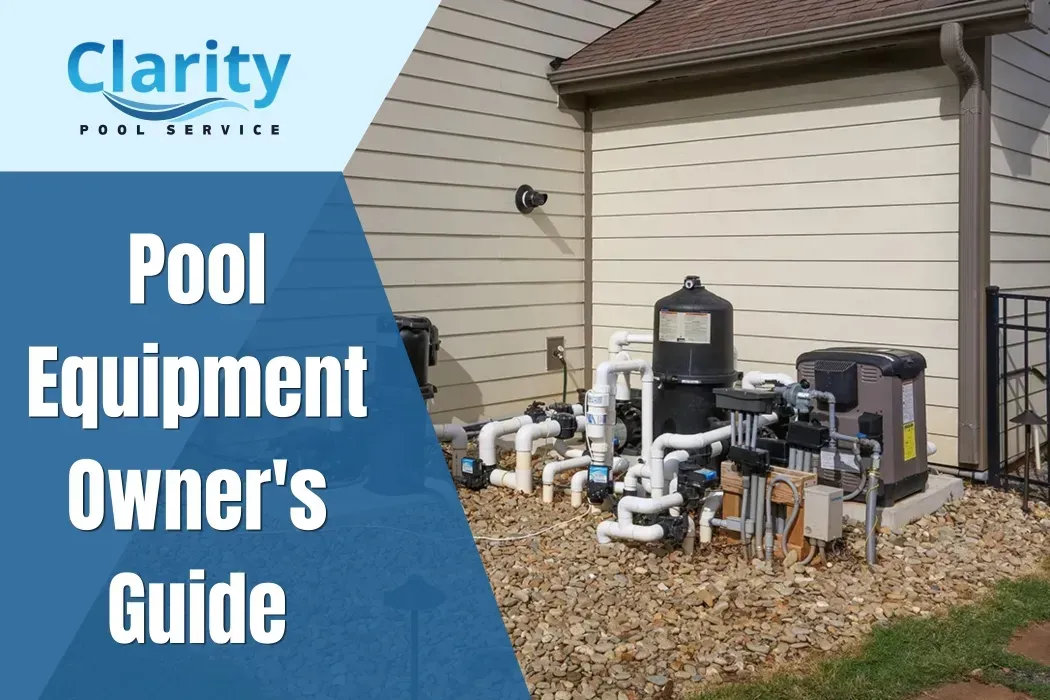
Pool Equipment Owner's Guide
A Complete Homeowner's Guide to Understanding and Protecting Your Pool Equipment in East County San Diego
Your swimming pool may look simple from the backyard, but behind the clear water is an entire mechanical system working every day.
Pumps move thousands of gallons of water through the circulation system. Filters remove dirt and contaminants. Heaters warm the water. Salt systems generate chlorine. Valves control water flow. Automation systems coordinate when everything operates.
When these components work together properly, most homeowners barely notice them.
When something stops working, however, a small equipment problem can quickly affect the entire pool.
Reduced circulation can contribute to cloudy water or algae. A dirty filter can increase resistance within the system. A leaking pump can lose prime or damage surrounding components. A malfunctioning salt system can reduce chlorine production.
That's why understanding the basics of your pool equipment is one of the most valuable things you can do as a homeowner.
You don't need to become a pool technician.
You simply need to understand what the major components do, what normal operation looks like, and which warning signs shouldn't be ignored.
Whether you own a pool in Santee, El Cajon, Lakeside, Rancho San Diego, Fletcher Hills, Mt. Helix, Spring Valley, Lemon Grove, San Carlos, Allied Gardens, Del Cerro, Casa de Oro, or elsewhere in East County San Diego, this guide will help you better understand the equipment protecting your pool every day.
In this guide you'll learn:
How your pool circulation system works
What the major pieces of pool equipment actually do
Which equipment should be inspected regularly
Common warning signs homeowners should recognize
How preventative maintenance can extend equipment life
When a problem may require professional attention
By the end of this guide, you'll be able to walk up to your equipment pad and have a much better understanding of what's happening there—and why it matters.
Quick Answer
Your pool equipment works as an interconnected system designed to circulate, filter, sanitize, and sometimes heat your water.
The major components typically include:
Pool pump
Pool filter
Heater, if equipped
Salt chlorine generator, if equipped
Valves and plumbing
Skimmers and drains
Return lines
Automation or control system
Additional equipment such as cleaners, water features, or booster pumps
The pump creates circulation, the filter removes contaminants, the sanitation system helps keep the water healthy, and the plumbing moves water between the pool and equipment.
Because these components depend on one another, a problem with one piece of equipment can affect the performance of the entire pool.
Regular inspections help identify small changes—such as leaks, unusual noises, rising filter pressure, reduced flow, or equipment warnings—before they develop into larger repairs.
At a Glance
Key Takeaways
✔ Your pool equipment operates as one interconnected system.
✔ The pump and filter are the foundation of healthy water circulation.
✔ Good water chemistry helps protect equipment from scale and corrosion.
✔ Small leaks, unusual noises, pressure changes, and reduced circulation should not be ignored.
✔ Routine equipment inspections can identify developing problems before complete failure occurs.
✔ Preventative maintenance is generally easier and less expensive than emergency equipment replacement.
✔ Homeowners don't need to repair equipment themselves to benefit from understanding how it works.
How Your Pool Equipment Works Together
The easiest way to understand pool equipment is to follow the water.
Although plumbing configurations vary, the basic circulation process is straightforward.
Water leaves the swimming pool through the skimmers and other suction-side plumbing.
The pump pulls that water toward the equipment pad.
From there, the water moves through the pump and into the filter, where dirt and suspended contaminants are removed.
Depending on the pool's equipment, the filtered water may then pass through additional components such as:
A heater
A salt chlorine generator
Other treatment or sanitation equipment
The water is then sent through the return plumbing and back into the swimming pool through the return jets.
The process repeats whenever the circulation system operates.
This constant movement performs several important jobs at once:
Distributes sanitizer
Moves contaminants toward the filter
Helps maintain consistent water chemistry
Supports surface skimming
Reduces stagnant areas
Allows heating and sanitation equipment to operate properly
When circulation suffers, several parts of the pool can begin experiencing problems at the same time.
That's why equipment performance and water quality are so closely connected.
The Pool Pump — The Heart of the Circulation System
If the circulation system had a heart, it would be the pool pump.
The pump creates the water movement that allows virtually every other part of the system to function.
Without adequate circulation:
Filtration suffers.
Sanitizer distribution becomes less effective.
Skimming performance decreases.
Heating becomes less efficient.
Salt chlorine generation may be affected.
Algae can become easier to establish in poorly circulated areas.
Modern residential pools often use variable-speed pumps, which can operate at different speeds depending on the task being performed.
This allows homeowners to operate circulation more efficiently than older single-speed systems when the equipment is properly configured.
Regardless of pump type, regular inspection is important.
Common warning signs include:
Unusual noises
Water leaking around the pump
Air visible inside the pump basket
Difficulty maintaining prime
Reduced water flow
Unexpected shutdowns
Error messages
Excessive vibration
A pump doesn't necessarily need replacement simply because one of these symptoms appears.
Many problems have smaller causes.
The important thing is recognizing that something has changed and investigating before the problem becomes worse.
The Pool Filter — Your Water's Cleaning System
If the pump moves the water, the filter cleans it.
As pool water passes through the filtration system, dirt and suspended contaminants are captured before the water returns to the pool.
The three most common residential filter types are:
Cartridge filters
DE filters
Sand filters
Each operates differently, but they share the same goal: remove contaminants while allowing healthy water flow through the circulation system.
As filters collect debris, resistance gradually increases.
That's why filter pressure and circulation should be monitored regularly.
A filter requiring maintenance may contribute to:
Reduced circulation
Weaker return flow
Poor skimming
Cloudy water
Increased equipment workload
The filter doesn't work independently from the rest of the pool.
Proper filtration supports water chemistry, sanitizer distribution, circulation, and overall equipment performance.
Why Equipment Problems Often Show Up in the Water First
One of the most useful things homeowners can learn is that a water-quality problem isn't always just a chemistry problem.
Suppose a pool repeatedly develops algae even though chemicals are being added correctly.
The underlying problem could involve:
Reduced pump performance
Restricted filtration
Poor circulation
Incorrect valve positioning
A salt system that isn't producing enough chlorine
Likewise, cloudy water may sometimes point toward filtration or circulation problems rather than simply needing more chemicals.
This is why experienced pool maintenance looks at the entire system instead of treating every symptom independently.
Water chemistry, circulation, filtration, sanitation, and equipment performance all influence one another.
What We Commonly See in East County Pool Equipment
East County swimming pools operate in an environment that can place significant seasonal demands on equipment.
Long periods of summer heat often mean:
Longer equipment operation
Increased chlorine demand
Greater evaporation
More frequent swimming
Spring pollen and landscaping debris increase the workload placed on filters.
Santa Ana wind events can introduce large amounts of dust and fine debris into pools over a short period.
Older East County homes may also have pool equipment that has been upgraded piece by piece over many years, creating equipment pads containing a combination of newer and older components.
None of these conditions automatically create equipment problems.
They do, however, make routine inspections and preventative maintenance especially valuable.
A small leak, unusual sound, changing pressure reading, or decline in circulation is much easier to address when it's discovered early.
Why Homeowners Should Understand Their Equipment
You don't need to know how to rebuild a pump motor or diagnose an automation circuit board.
But every pool owner should be able to answer a few basic questions:
Where is my pump?
Where is my filter?
What does normal filter pressure look like for my system?
Where are the main valves?
Does my pool have a heater or salt system?
What does the equipment normally sound like when operating correctly?
Knowing these basics gives you a reference point.
When something changes, you're much more likely to notice it.
That awareness alone can prevent a minor equipment issue from remaining unnoticed for weeks.
The Major Pieces of Pool Equipment Every Homeowner Should Understand
Once you understand how water moves through the circulation system, the equipment pad becomes much less intimidating.
Every pool is configured differently, but most residential systems rely on the same core components working together.
Understanding what each component does—and recognizing when its behavior changes—can help you identify developing problems before they affect the entire pool.
1. Pool Pump
The pool pump creates the circulation that moves water through the entire system.
Water is drawn from the pool through the suction-side plumbing, passes through the pump, moves through the filter and other equipment, and eventually returns to the pool.
Because so many systems depend on adequate water flow, pump performance affects:
Filtration
Surface skimming
Chemical distribution
Heating
Salt chlorine generation
Overall water circulation
A healthy pump should operate relatively consistently.
Changes such as unusual noises, leaks, air inside the pump basket, repeated loss of prime, reduced flow, or error messages deserve attention.
2. Pool Filter
The filter removes suspended contaminants from the water.
Depending on the system, your pool may use a:
Cartridge filter
DE filter
Sand filter
As contaminants accumulate, resistance through the filter increases.
Monitoring filter pressure and circulation helps determine when maintenance may be required.
A dirty or restricted filter can reduce water flow throughout the entire system, which is why filter maintenance affects much more than water clarity.
3. Pool Heater
Not every swimming pool has a heater, but those that do depend on proper water flow and balanced chemistry for reliable operation.
Common residential heating systems include:
Gas heaters
Electric heat pumps
Solar heating systems
Pool heaters contain components that can be affected by poor circulation, scale, corrosion, and improper water chemistry.
Warning signs may include:
Water not reaching the desired temperature
Heater shutting off unexpectedly
Error messages
Unusual noises
Visible leaks
Difficulty starting
Because heaters combine water, mechanical components, and—in some systems—gas or electricity, internal heater diagnosis and repair should generally be left to qualified professionals.
4. Salt Chlorine Generator
Saltwater pools use a salt chlorine generator to produce chlorine from dissolved salt in the pool water.
The system typically includes a control unit and salt cell.
Proper operation depends on several factors, including:
Adequate water flow
Correct salt concentration
Balanced water chemistry
Clean cell plates
Proper equipment operation
Warning signs may include:
Low chlorine readings
Salt system alerts
Flow warnings
Scale buildup
Reduced chlorine production
A salt system can automate chlorine production, but it still requires regular inspection and maintenance.
5. Pool Valves
Valves control where water moves throughout your pool system.
Depending on the plumbing configuration, valves may control water flowing to or from:
Skimmers
Main drains or other suction points
Spa
Pool returns
Water features
Heaters
Cleaning systems
Incorrect valve positions can dramatically affect circulation.
For example, a valve moved accidentally during maintenance may reduce skimming, interfere with spa operation, or restrict water flow through another part of the system.
Homeowners don't need to constantly adjust their valves, but understanding their basic purpose can be extremely helpful.
One simple habit is to take a clear photo of your equipment pad when everything is operating correctly. That gives you a visual reference if a valve is ever moved unexpectedly.
6. Skimmers
Skimmers are part of the circulation system even though they're located at the pool rather than the equipment pad.
They draw water from the surface where leaves, insects, pollen, sunscreen, and other floating contaminants accumulate.
Inside each skimmer is typically a basket designed to capture larger debris before it enters the plumbing.
When skimmer baskets become overloaded:
Surface cleaning becomes less effective.
Water flow may decrease.
The pump may receive less water.
Circulation can suffer.
Routine basket cleaning is one of the simplest ways to support healthy circulation.
7. Pump Basket
Before water enters the pump's impeller area, it typically passes through the pump strainer basket.
This basket catches debris that made it through the skimmer or other suction plumbing.
A full pump basket can restrict water flow and reduce system performance.
During routine service, the basket should be inspected and emptied as needed.
If a pump basket suddenly begins collecting much more debris than normal, it may also indicate changing environmental conditions such as heavy winds or increased leaf drop.
8. Return Jets
After water passes through the equipment system, it returns to the swimming pool through return jets.
These jets help distribute:
Filtered water
Sanitizer
Heat
Chemically balanced water
Proper return flow also helps reduce areas of poor circulation.
If return flow becomes noticeably weaker than normal, possible causes may include:
Dirty filter
Pump issue
Plumbing restriction
Incorrect valve position
Air entering the circulation system
Reduced return flow is often a useful early warning that something within the circulation system deserves attention.
9. Pool Automation and Control Systems
Modern swimming pools increasingly use automation to control equipment.
Depending on the system, homeowners may be able to manage:
Pump schedules
Pump speeds
Heater temperature
Spa operation
Water features
Lighting
Salt chlorine production
Cleaning systems
Some systems can also be controlled from a smartphone.
Automation provides convenience, but it adds another layer of equipment that should be monitored.
An incorrect schedule or setting can sometimes appear to be an equipment failure when the underlying problem is simply configuration.
Before assuming equipment has failed, it's often worth confirming that timers, schedules, and automation settings haven't changed.
10. Pressure Gauge
The small pressure gauge mounted on many pool filters provides valuable information about filtration conditions.
Rather than focusing on one universal pressure number, homeowners should become familiar with the normal clean operating pressure of their own system.
As the filter collects debris, pressure may gradually increase.
A meaningful change from normal operating conditions can indicate that the filtration system needs attention.
Pressure readings should be evaluated alongside:
Water flow
Filter condition
Pump performance
Water clarity
The trend is often more useful than a single number.
How to Recognize Normal vs. Abnormal Equipment Operation
One of the best diagnostic tools available to homeowners costs nothing:
Familiarity.
When you regularly see and hear your equipment operating correctly, changes become easier to recognize.
Seven Equipment Warning Signs Homeowners Should Never Ignore
Some changes deserve quicker attention than others.
1. Water Leaking Around Equipment
A few drops after opening equipment for maintenance may be harmless.
A persistent leak is different.
Leaks can develop around:
Pump seals
Plumbing connections
Filter components
Valves
Heaters
Water and pool equipment aren't a combination to ignore, especially when electrical components are nearby.
2. New or Unusual Noises
Homeowners become accustomed to the normal sound of their pool equipment.
A new:
Grinding
Screeching
Rattling
Humming
Excessive vibration
can indicate that something has changed mechanically.
Don't assume a louder pump is simply getting older.
3. Air in the Pump Basket
A properly operating pump basket is generally filled with water while the system is running.
Persistent air may indicate a suction-side issue or another circulation problem.
Small amounts of air can have several causes, so diagnosis is important before replacing equipment unnecessarily.
4. Reduced Return Flow
If water returning to the pool suddenly feels weaker than normal, the system may be experiencing restricted circulation.
Possible causes include:
Dirty filter
Full baskets
Pump performance problems
Valve position
Plumbing restriction
Reduced flow can affect filtration, heating, sanitation, and overall water quality.
5. Significant Filter Pressure Changes
A gradual increase in pressure may indicate normal filter loading.
A sudden or unusual change deserves investigation.
Pressure should always be considered relative to the normal operating conditions of that specific system.
6. Equipment Error Messages
Modern pumps, heaters, salt systems, and automation controllers can display diagnostic codes or warning lights.
Don't automatically reset or ignore recurring warnings.
An error message is information.
Recording the exact code or taking a photo can make professional diagnosis much easier.
7. Equipment Repeatedly Turning Off
Equipment that unexpectedly shuts down and restarts may be responding to a protective condition, programming issue, electrical problem, loss of flow, overheating, or another fault.
Repeated shutdowns shouldn't simply be treated by continuously restarting the equipment.
The underlying cause should be identified.
What We Commonly See in East County Equipment Pads
East County has a wide variety of residential pools.
Some equipment pads are relatively new and highly automated.
Others have been upgraded gradually over many years.
It's not unusual to see a newer variable-speed pump connected to an older filter, heater, or plumbing configuration.
That doesn't automatically mean the system needs replacement.
It simply makes understanding how the components interact especially important.
Seasonal conditions also affect equipment.
During periods of summer heat, equipment may operate longer and sanitizer demand increases.
Following heavy winds, baskets and filters may load with debris much faster than usual.
The important lesson is that equipment should be evaluated as a system.
A circulation problem shouldn't automatically result in replacing a pump.
Cloudy water shouldn't automatically result in adding more chemicals.
A low chlorine reading on a saltwater pool doesn't automatically mean the salt cell has failed.
Good diagnosis begins by understanding how all of the components are working together.
Why Early Diagnosis Can Save Homeowners Money
Pool equipment problems frequently begin small.
A minor leak may require a seal.
Reduced circulation may be caused by a dirty filter.
Low salt chlorine production may result from scale or water chemistry rather than a failed cell.
A heater error may be related to insufficient water flow rather than the heater itself.
The earlier these symptoms are investigated, the greater the chance that the solution remains relatively simple.
That's one of the most valuable benefits of routine equipment inspections.
The goal isn't to find something wrong every week.
It's to notice when something changes.
Preventative Pool Equipment Maintenance
Most pool equipment doesn't fail without warning.
Pumps, filters, heaters, valves, salt systems, and automation equipment often show small signs of trouble before a complete failure occurs.
The challenge is noticing those signs early.
Preventative maintenance isn't about constantly repairing or replacing equipment. It's about keeping the system operating correctly, monitoring changes, and addressing small problems before they become larger ones.
For homeowners, that can mean:
Fewer unexpected equipment failures
More consistent water circulation
Better filtration
More reliable sanitation
Longer equipment life
Fewer emergency repairs
The most effective equipment maintenance usually happens long before something stops working.
A Simple Pool Equipment Inspection Checklist
Homeowners don't need specialized training to perform a basic visual inspection of their equipment pad.
A quick inspection can help identify obvious changes that deserve further attention.
The purpose isn't to diagnose every problem yourself.
It's to establish what normal looks like so changes are easier to recognize.
Common Pool Equipment Mistakes Homeowners Make
Many expensive equipment problems begin with relatively small issues.
These are some of the most common mistakes homeowners can avoid.
Ignoring Small Leaks
A small drip around the equipment pad may not seem urgent.
But leaks rarely improve on their own.
Depending on the source, continued leaking can:
Waste water
Introduce air into the system
Damage surrounding equipment
Contribute to corrosion
Become progressively worse
Catching a leaking seal or plumbing connection early can be much simpler than addressing the damage after months of neglect.
Ignoring New Equipment Noises
Pool equipment has a normal operating sound.
Once you've heard your pump run hundreds of times, you naturally become familiar with it.
That's useful.
A new grinding, screeching, rattling, humming, or vibrating sound deserves attention.
The sound itself doesn't tell you exactly what's wrong, but it tells you that something has changed.
Running Equipment With Restricted Water Flow
Pool equipment depends on adequate water circulation.
Restricted flow may result from:
Dirty filters
Full baskets
Incorrect valve positions
Plumbing restrictions
Pump problems
Reduced flow can affect more than the pump.
It can also interfere with:
Filtration
Heating
Salt chlorine production
Sanitizer distribution
Overall water quality
Correcting circulation problems early helps protect the entire system.
Assuming Every Problem Requires New Equipment
This is an important one.
A pool pump that isn't performing correctly doesn't automatically need replacement.
A salt system producing insufficient chlorine doesn't automatically need a new salt cell.
A heater displaying an error doesn't automatically mean the heater has failed.
Sometimes the underlying problem is much simpler:
Dirty filter
Poor water flow
Scale buildup
Water chemistry imbalance
Incorrect settings
A worn seal
A sensor or control issue
Proper diagnosis should come before expensive equipment replacement.
Changing Several Settings Without Recording Them
Modern pool equipment provides homeowners with considerable control.
You may be able to adjust:
Pump speeds
Operating schedules
Heater settings
Spa modes
Water features
Chlorine production
Changing several settings at once can make troubleshooting difficult.
If you're experimenting with equipment settings, record the original configuration first.
Taking a photo before making changes is one of the easiest ways to create a reference.
Ignoring Error Codes
An error message isn't something to cover with tape or repeatedly reset without investigation.
Modern equipment uses diagnostic codes to communicate potential problems.
When an error appears:
Record the exact code.
Take a photo if possible.
Check the manufacturer's documentation.
Contact a qualified professional when appropriate.
That information can significantly improve diagnosis.
DIY Pool Equipment Maintenance vs. Professional Service
Homeowners can perform many basic equipment inspections themselves.
However, there's an important difference between monitoring equipment and repairing equipment.
Understanding your equipment doesn't mean you should attempt every repair.
Some components involve electricity, pressurized systems, gas, heat, and complex controls.
Knowing when not to DIY is an important part of responsible pool ownership.
When Should You Call a Pool Professional?
Some equipment changes can be monitored.
Others deserve prompt professional attention.
Consider scheduling an inspection if you notice:
Persistent water leaks
Pump repeatedly losing prime
Significant reduction in circulation
Grinding or screeching noises
Filter pressure behaving abnormally
Equipment repeatedly shutting down
Persistent heater errors
Salt system repeatedly failing to produce adequate chlorine
Automation systems behaving unpredictably
Visible equipment damage
Recurring electrical or control warnings
The goal isn't to assume the worst.
It's to identify the cause before continued operation creates additional problems.
Repair or Replace?
Eventually, every piece of pool equipment reaches the end of its useful life.
But determining whether to repair or replace equipment isn't always straightforward.
Several factors should be considered:
Equipment age
Overall condition
Repair cost
Availability of replacement parts
Energy efficiency
Frequency of previous repairs
Compatibility with existing equipment
Expected remaining service life
For example, replacing an inexpensive seal on an otherwise healthy pump may make perfect sense.
Repeatedly repairing an older piece of equipment experiencing multiple failures may not.
The best decision considers total long-term value, not simply today's repair bill.
Why Equipment Age Doesn't Tell the Whole Story
Homeowners often ask:
"How long should my pool equipment last?"
There isn't one universal answer.
Equipment lifespan depends heavily on:
Installation quality
Water chemistry
Operating conditions
Maintenance
Environment
Equipment workload
Manufacturer and model
Two identical pumps installed at the same time can experience very different service lives if one operates with balanced water and healthy circulation while the other repeatedly operates under stressful conditions.
Age matters—but condition and maintenance history matter too.
How Water Chemistry Affects Pool Equipment
One of the most important connections in pool ownership is the relationship between water chemistry and equipment life.
Improperly balanced water can contribute to:
Scale buildup
Corrosion
Heater damage
Salt cell scaling
Reduced equipment efficiency
Premature component wear
This is why equipment maintenance and water chemistry shouldn't be treated as separate topics.
A perfectly maintained pump can't protect a heater from aggressive water chemistry.
A clean salt cell can't perform efficiently if the water itself is badly out of balance.
Protecting equipment begins with maintaining the entire pool system correctly.
How Filtration Affects Pool Equipment
Filtration plays an equally important role.
As filters collect contaminants, resistance through the circulation system increases.
If filter maintenance is delayed, reduced flow can affect:
Pump performance
Heating
Salt chlorine generation
Water circulation
Sanitizer distribution
This is another example of why pool equipment should be viewed as a connected system.
A dirty filter may appear to be a simple maintenance issue, but its effects can extend throughout the equipment pad.
Seasonal Equipment Care in East County San Diego
Pool equipment operates year-round, but seasonal conditions change the demands placed on the system.
Spring
Spring pollen, blossoms, and landscaping debris can increase filtration demands.
Homeowners should pay particular attention to:
Filter pressure
Basket accumulation
Water circulation
Equipment operation
Summer
Summer often creates the greatest workload.
Higher temperatures and increased pool use can mean:
Longer circulation schedules
Greater sanitizer demand
Increased heater or spa use depending on the property
More frequent filtration demands
Equipment inspections become especially valuable during periods of prolonged heat.
Fall
Falling leaves and organic debris can quickly fill skimmer and pump baskets.
Pools surrounded by mature landscaping may experience substantial changes in circulation if baskets aren't monitored.
Winter
Pools may receive less attention during cooler months, but equipment still requires monitoring.
Rain and storms can introduce debris, while pumps, filters, automation, and sanitation systems continue operating.
Year-round inspections help prevent small winter problems from becoming springtime surprises.
What We Commonly See: The Problem Isn't Always the Part You Expect
One of the most valuable lessons in pool equipment care is that the obvious symptom isn't always the actual cause.
For example:
Weak return flow
may be caused by a dirty filter rather than a failing pump.
Low chlorine in a saltwater pool
may involve water chemistry or inadequate flow rather than a failed salt cell.
A heater that won't operate
may be responding to a circulation problem rather than an internal heater failure.
Cloudy water
may involve filtration rather than simply insufficient chemicals.
This is why good pool equipment diagnosis starts with the entire system.
Replacing parts without identifying the underlying cause can waste money and leave the original problem unresolved.
Why Preventative Equipment Inspections Provide Real Value
A professional equipment inspection isn't valuable because something needs to be repaired every week.
Quite the opposite.
The best outcome is usually:
Everything is operating normally.
But regular inspections establish a baseline.
That makes changes easier to recognize.
Over months and years, this approach can help identify:
Small leaks
Changing filter pressure
Reduced circulation
Developing pump problems
Salt system issues
Heater warnings
Automation problems
before they become complete equipment failures.
Preventative maintenance doesn't eliminate every repair.
It improves the odds that problems are discovered while there are still more—and often less expensive—options available.
Continue Learning
Understanding your equipment is one part of becoming a more informed pool owner.
Continue with these related guides:
Pool Service Cost in East County San Diego
What Does Weekly Pool Service Include?
Why Do Pools Turn Green?
Saltwater Pool Maintenance Guide
How Often Should a Pool Filter Be Cleaned?
Pool Water Chemistry Explained
Complete Pool Owner Learning Center
Together, these guides explain how water chemistry, filtration, circulation, sanitation, and equipment work as one connected system to keep your swimming pool healthy.
Frequently Asked Questions About Pool Equipment
Pool equipment can seem complicated because several different systems work together behind the scenes.
Fortunately, homeowners don't need to understand every mechanical detail to recognize when something may need attention.
Below are answers to some of the most common questions homeowners have about residential pool equipment.
What are the main pieces of pool equipment?
Most residential swimming pools rely on several core components, including:
Pool pump
Pool filter
Skimmers
Plumbing and valves
Return jets
Heater, if equipped
Salt chlorine generator, if equipped
Automation or control system
Some pools also have additional equipment for spas, cleaners, waterfalls, fountains, solar heating, or other features.
Although each component performs a different job, they work together as one circulation and water-treatment system.
What is the most important piece of pool equipment?
It's difficult to identify one component as the most important because the major systems depend on one another.
The pump creates circulation.
The filter removes contaminants.
The sanitation system helps maintain healthy water.
The plumbing carries water between these components.
If any major part of the system stops working correctly, overall pool performance can suffer.
How do I know if my pool pump is working properly?
A properly operating pump should generally provide consistent circulation without unusual noises, persistent air, leaks, or unexpected shutdowns.
Warning signs that deserve attention include:
Grinding or screeching noises
Excessive vibration
Water leaking around the pump
Persistent air inside the pump basket
Repeated loss of prime
Weak return flow
Error messages
Unexpected shutdowns
A warning sign doesn't necessarily mean the pump needs replacement. Proper diagnosis should come first.
Why is there air inside my pool pump?
Persistent air inside the pump basket may indicate that air is entering the circulation system somewhere on the suction side.
Possible causes vary and should be diagnosed before assuming the pump itself has failed.
If the pump repeatedly loses prime or contains significantly more air than normal, the circulation system should be inspected.
Why is water flow from my return jets weaker than normal?
Reduced return flow can have several causes, including:
Dirty filter
Full skimmer or pump baskets
Incorrect valve positions
Pump performance problems
Air entering the system
Plumbing restrictions
Because several components can create the same symptom, identifying the actual cause is more important than immediately replacing equipment.
How do I know when my pool filter needs cleaning?
Filter maintenance should be based on the type of filter, manufacturer guidance, operating conditions, filter pressure, circulation, and actual condition of the system.
Common warning signs include:
Increasing filter pressure
Reduced circulation
Weaker return flow
Poor skimming
Declining water clarity
Regular pressure monitoring helps establish what's normal for your specific filtration system.
Why does my pool equipment make noise?
All pool equipment creates some sound during normal operation.
What's more important is recognizing a new or unusual sound.
Grinding, screeching, rattling, humming, or excessive vibration may indicate that something has changed mechanically.
If your equipment suddenly sounds different from normal, it's worth investigating rather than waiting for complete failure.
Is a small equipment leak a big problem?
Not every drop of water means there's a serious equipment failure.
However, a persistent leak shouldn't be ignored.
Leaks can occur around:
Pump seals
Filter components
Valves
Plumbing connections
Heaters
Catching a leak early may prevent water loss, equipment damage, corrosion, or a larger repair later.
How often should pool equipment be inspected?
Basic equipment operation should be observed regularly.
For pools receiving professional weekly service, the equipment pad should generally receive a visual inspection as part of routine maintenance.
Homeowners can also become familiar with normal:
Pump sounds
Filter pressure
Return flow
Equipment schedules
Control panel status
The goal is to recognize changes quickly.
How long does pool equipment last?
There isn't one universal lifespan for pool equipment.
Service life depends on factors such as:
Equipment type
Manufacturer and model
Installation quality
Water chemistry
Maintenance
Operating conditions
Usage
Environment
Age is useful information, but the actual condition and maintenance history of the equipment are often just as important.
Should I repair or replace old pool equipment?
The answer depends on the specific situation.
Factors to consider include:
Age
Overall condition
Repair cost
Replacement cost
Parts availability
Energy efficiency
Previous repair history
Compatibility with existing equipment
Expected remaining service life
An inexpensive repair may make sense for otherwise healthy equipment.
Repeatedly repairing an aging component with multiple problems may not.
The best decision considers long-term value rather than simply the immediate repair cost.
Does water chemistry really affect pool equipment?
Yes.
Water chemistry and equipment health are closely connected.
Improperly balanced water may contribute to:
Scale buildup
Corrosion
Heater damage
Salt cell scaling
Reduced equipment efficiency
Premature wear
Maintaining balanced water helps protect both pool surfaces and expensive equipment.
Can a dirty pool filter damage other equipment?
A restricted filter can reduce water flow throughout the circulation system and increase the workload placed on other components.
Reduced circulation may affect:
Pump performance
Heating
Salt chlorine generation
Sanitizer distribution
Overall water quality
This is why filter maintenance should be viewed as part of overall equipment care.
Why won't my pool heater turn on?
A heater that won't operate doesn't automatically have a failed heating component.
Depending on the system, possible causes may involve:
Inadequate water flow
Equipment settings
Automation
Sensors
Internal heater faults
Other operating conditions
Because heaters may involve gas, electricity, heat, and pressurized water, diagnosis and repair should generally be performed by an appropriately qualified professional.
Why isn't my salt system producing enough chlorine?
Low chlorine production can result from several different conditions, including:
Incorrect salt concentration
Scale on the salt cell
Reduced water flow
Water chemistry problems
Equipment settings
Increased chlorine demand
Aging or malfunctioning equipment
A low chlorine reading alone doesn't prove that the salt cell needs replacement.
The complete system should be evaluated first.
Can I maintain pool equipment myself?
Homeowners can perform many basic maintenance and monitoring tasks, such as:
Emptying baskets
Observing filter pressure
Checking for visible leaks
Monitoring return flow
Reviewing equipment schedules
Recording error codes
Keeping the equipment area clear
Complex repairs involving electricity, gas, pressurized equipment, internal heater components, or major plumbing should be left to qualified professionals.
Knowing your equipment doesn't mean you need to repair everything yourself.
What should I do if my pool equipment displays an error code?
Don't immediately assume the equipment needs replacement.
Instead:
Record the exact error code.
Take a photo of the display.
Note what the equipment was doing when the error occurred.
Consult the manufacturer's documentation when appropriate.
Have the system professionally evaluated if the warning persists or involves a safety concern.
Diagnostic information can make troubleshooting much more efficient.
Final Thoughts
Your pool equipment is the mechanical foundation that keeps your swimming pool operating.
The pump moves the water.
The filter removes contaminants.
The sanitation system helps maintain healthy water.
The heater provides comfort.
The valves, plumbing, and automation systems allow everything to work together.
When one component begins performing poorly, the effects can spread throughout the entire pool.
That's why one of the most important lessons for homeowners is to stop thinking of pool equipment as a collection of unrelated parts.
It's one connected system.
A dirty filter can reduce circulation.
Reduced circulation can affect chlorine distribution.
Poor circulation can interfere with a heater or salt system.
Water chemistry can affect equipment life.
Equipment problems can eventually appear as water-quality problems.
Understanding those relationships helps homeowners make better maintenance decisions and avoid replacing equipment simply because it appears to be responsible for a symptom.
You don't need to become a pool technician.
Learn what normal operation looks like, pay attention when something changes, maintain the system consistently, and have developing problems properly diagnosed before they become larger repairs.
That basic approach can go a long way toward protecting some of the most expensive components of your swimming pool.
Continue Exploring the Pool Owner Learning Center
Continue building your understanding of how your swimming pool works with these related guides:
Pool Service Cost in East County San Diego
What Does Weekly Pool Service Include?
Why Do Pools Turn Green?
Saltwater Pool Maintenance Guide
How Often Should a Pool Filter Be Cleaned?
Pool Water Chemistry Explained
Complete Pool Owner Learning Center
Together, these resources explain how maintenance, chemistry, filtration, circulation, sanitation, and equipment work together to protect your swimming pool.
Protect Your Pool Equipment Before Problems Become Repairs
Pool equipment represents a significant part of the investment you've made in your swimming pool.
Protecting that equipment doesn't require waiting for something to break.
Consistent water chemistry, proper filtration, healthy circulation, routine inspections, and early diagnosis all help reduce unnecessary wear while giving homeowners an opportunity to address problems before complete equipment failure.
At Clarity Pool Service, we believe great pool care includes paying attention to what's happening both inside the pool and at the equipment pad.
Our goal is to help East County San Diego homeowners understand their pools well enough to recognize problems early, make informed maintenance decisions, and protect their equipment for the long term.
Whether you're trying to understand an unfamiliar sound, concerned about changing circulation, or simply want preventative eyes on your equipment during weekly service, the best place to start is understanding how the entire system works together.