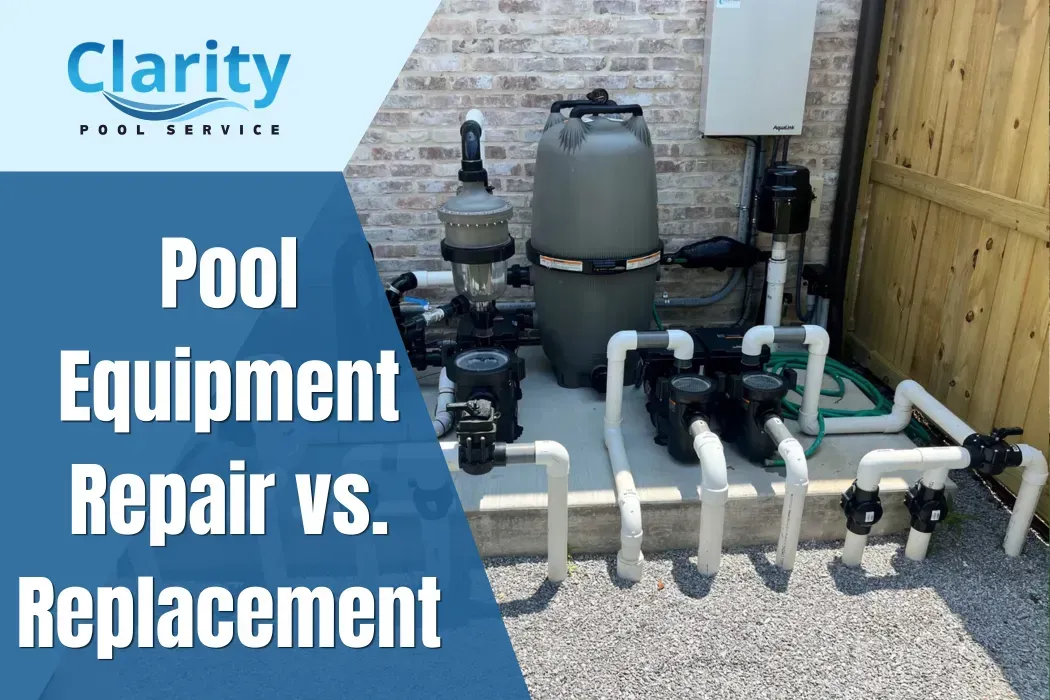
Pool Equipment Repair vs. Replacement
A Complete Homeowner's Guide to Deciding Whether to Fix or Replace Pool Equipment
When pool equipment stops working correctly, homeowners are often faced with an expensive question:
Should I repair it—or replace it?
Sometimes the answer is easy.
A relatively new pump with a leaking seal may only need a straightforward repair.
Other times, an older piece of equipment may have already required several repairs, replacement parts may be difficult to find, and a newer system could provide better reliability and efficiency.
The difficult situations are the ones in between.
A technician recommends a repair that costs several hundred dollars, but replacement costs considerably more.
Do you spend less today and hope the equipment lasts?
Or invest more now and avoid another repair six months later?
There isn't one answer that works for every situation.
The best decision depends on several factors working together:
Equipment age
Overall condition
Type of failure
Repair cost
Replacement cost
Previous repair history
Availability of parts
Energy efficiency
Compatibility with existing equipment
Expected remaining service life
Understanding these factors can help homeowners make better decisions without automatically choosing either the cheapest repair or the most expensive replacement.
Whether you own a pool in Santee, El Cajon, Lakeside, Rancho San Diego, Fletcher Hills, Mt. Helix, Spring Valley, Lemon Grove, San Carlos, Allied Gardens, Del Cerro, Casa de Oro, or elsewhere in East County San Diego, this guide will help you evaluate pool equipment problems from a long-term ownership perspective.
In this guide you'll learn:
When repairing pool equipment usually makes sense
When replacement may provide better long-term value
How equipment age affects the decision
Why repair history matters
How efficiency should factor into replacement decisions
Why proper diagnosis should always come before replacement
Questions to ask before approving a major pool equipment repair
By the end, you'll have a much clearer framework for deciding when to repair equipment—and when it may be time to move on.
Quick Answer
Pool equipment should generally be repaired when the problem is isolated, the equipment is otherwise in good condition, parts are readily available, and the repair provides reasonable remaining service life.
Replacement becomes more attractive when:
Equipment is approaching the end of its useful life
Major components have failed
Repairs are becoming frequent
Replacement parts are difficult to obtain
Repair costs represent a significant portion of replacement cost
Existing equipment is inefficient or outdated
New equipment provides meaningful operational benefits
However, age alone shouldn't determine the decision.
A well-maintained older pump may still justify a relatively inexpensive repair, while a newer piece of equipment experiencing repeated failures may not.
The most important step is identifying what actually failed and why before deciding whether to repair or replace anything.
At a Glance
Key Takeaways
✔ Not every equipment problem requires replacement.
✔ Proper diagnosis should happen before deciding between repair and replacement.
✔ Equipment age matters, but condition and maintenance history matter too.
✔ Repeated repairs can eventually make replacement more economical.
✔ A cheap repair isn't necessarily the least expensive long-term choice.
✔ Newer equipment may provide efficiency, automation, or performance benefits—but replacement should solve a real problem, not simply follow a sales recommendation.
✔ The best decision considers both today's cost and the expected cost of ownership over the next several years.
Why Pool Equipment Repair Decisions Can Be Difficult
Most homeowners don't think about their pool equipment until something stops working.
Then suddenly they're being asked to make a decision involving hundreds—or sometimes thousands—of dollars.
That creates pressure.
The easiest response is often one of two extremes:
"Just repair it. That's cheaper."
or:
"It's old. Replace everything."
Neither approach is automatically correct.
Suppose an older pump develops a small leak caused by a replaceable seal.
Replacing the entire pump solely because of age may be unnecessary.
Now consider an older pump that has already required several repairs and experiences a major motor or drive failure.
Another repair may technically be possible—but replacement could provide better long-term value.
The goal isn't to always repair.
And it isn't to always replace.
The goal is to make the decision that makes the most financial and operational sense for that specific piece of equipment.
The Seven Factors That Should Drive the Decision
Before approving a major repair or replacement, evaluate these seven factors.
1. Equipment Age
Age provides useful context.
As equipment gets older, the probability of additional component failures generally increases.
But age alone doesn't prove equipment needs replacement.
Maintenance history, operating conditions, installation quality, and water chemistry all influence how equipment ages.
2. Type of Failure
A minor seal leak and a major internal component failure shouldn't be evaluated the same way.
Ask:
What exactly failed?
Is the failed component replaceable?
Did something else cause the failure?
Understanding the specific problem is essential before deciding whether replacement makes sense.
3. Repair Cost
The repair price should be compared with the value of the equipment after the repair—not just the cost of buying something new.
A modest repair that restores reliable operation may provide excellent value.
A costly repair on equipment likely to experience another major failure soon may not.
4. Replacement Cost
Replacement involves more than the price of the equipment itself.
Depending on the project, costs may include:
New equipment
Installation labor
Plumbing modifications
Electrical work
Automation integration
Additional components required for compatibility
Homeowners should compare realistic installed replacement cost with the repair option.
5. Repair History
One of the most useful questions is:
"How many times have we already repaired this?"
An isolated repair is very different from equipment requiring attention every few months.
Repeated failures often indicate that the economics are beginning to shift toward replacement.
6. Parts Availability
Older equipment may remain repairable in theory while becoming difficult or expensive to support.
Replacement parts may be:
Discontinued
Backordered
Expensive
Available only through limited sources
Parts availability should be considered when evaluating the long-term practicality of another repair.
7. Efficiency and Modern Features
Newer equipment may offer improvements such as:
Variable-speed operation
Improved energy efficiency
Quieter performance
Better automation integration
Modern controls
Improved diagnostics
These benefits can strengthen the case for replacement—but they shouldn't automatically justify replacing equipment that still performs its job reliably.
Why Proper Diagnosis Comes Before Repair vs. Replacement
This may be the most important principle in the entire guide.
Don't decide whether to repair or replace equipment until you know what's actually wrong.
Weak return flow doesn't automatically mean the pump has failed.
A heater that won't start doesn't automatically need replacement.
Low chlorine production doesn't automatically mean the salt cell is dead.
Cloudy water doesn't automatically indicate a filtration failure.
As we've covered throughout the Learning Center, several pool systems interact with one another.
A dirty filter may reduce circulation.
Reduced circulation may prevent a heater from operating.
Poor water chemistry may contribute to salt cell scaling.
An incorrect valve position may make pump performance appear weak.
Replacing equipment without diagnosing the underlying cause can become one of the most expensive mistakes a pool owner makes.
What We Commonly See in East County Pool Systems
Many East County homes have swimming pools that have been maintained and upgraded over decades.
That often means the equipment pad contains a mixture of generations.
A homeowner may have:
A newer variable-speed pump
An older filter
An aging heater
Updated automation
Original plumbing in some areas
A mixed-age equipment system isn't automatically a problem.
In many cases, replacing individual components as they reach the end of their useful lives is perfectly reasonable.
The important thing is maintaining compatibility and understanding how each replacement affects the rest of the system.
This is another reason homeowners benefit from evaluating the entire equipment pad, rather than looking at one component in isolation.
The Question Homeowners Should Really Ask
Instead of asking:
"Can this equipment be repaired?"
ask:
"Does repairing this equipment provide good long-term value?"
Almost anything can sometimes be repaired if enough money is spent.
That doesn't mean it should be.
Likewise, equipment shouldn't be replaced simply because something minor failed.
The best decision considers:
Cost today + expected reliability + future repair risk + efficiency + remaining service life.
That's the framework we'll use throughout the rest of this guide.
When Does Repairing Pool Equipment Make Sense?
Repair is often the right choice when the equipment is fundamentally healthy and the failure is limited to a specific component.
The fact that something stopped working doesn't automatically mean the entire piece of equipment has reached the end of its useful life.
In many cases, replacing a relatively inexpensive component can restore reliable operation for years.
The key is determining whether you're repairing a good piece of equipment with a bad part or repeatedly investing money into equipment that is steadily deteriorating.
1. The Problem Is Isolated
An isolated failure is generally more favorable for repair.
Examples may include:
Worn seals
Damaged O-rings
Certain sensors
Switches or controls
Replaceable valves
Minor plumbing connections
Other serviceable components
If the rest of the equipment remains in good condition, replacing the failed component may provide excellent value.
The important question is whether the repair addresses the actual problem rather than temporarily masking a larger one.
2. The Equipment Is Otherwise Reliable
Consider how the equipment performed before the current problem developed.
Was it:
Operating consistently?
Maintaining normal circulation?
Free from repeated leaks?
Quiet during normal operation?
Free from recurring error messages?
Requiring very few previous repairs?
If so, repairing one failed component may be a sensible decision.
A single failure doesn't necessarily indicate that the rest of the equipment is deteriorating.
3. Replacement Parts Are Readily Available
Parts availability plays an important role in repair decisions.
Equipment that is still actively supported by the manufacturer may have readily available replacement components.
That makes repair easier and often more economical.
Older equipment can become more difficult to support when:
Parts are discontinued
Components become expensive
Replacement inventory becomes limited
Technicians can no longer easily source compatible parts
A repair that makes sense today should also be considered in the context of future serviceability.
4. Repair Cost Is Reasonable Compared With Replacement
Homeowners naturally compare the cost of repairing equipment with the cost of replacing it.
That's useful—but the comparison should include the complete installed replacement cost.
For example, replacement may involve:
Equipment purchase
Installation labor
Plumbing modifications
Electrical work
Automation integration
Additional fittings or components
A relatively modest repair may look even more attractive once the true replacement cost is understood.
However, repair cost shouldn't be considered alone.
The expected condition of the equipment after the repair matters just as much.
When Does Pool Equipment Replacement Make More Sense?
Eventually, continued repairs stop providing good value.
Replacement becomes increasingly attractive when several warning signs begin appearing together.
1. Repairs Are Becoming Frequent
One repair doesn't necessarily mean equipment is failing.
Repeated repairs are different.
Suppose equipment requires:
One repair this year
Another several months later
Another major component soon afterward
At some point, homeowners begin spending money simply to keep aging equipment alive.
This is where looking at total repair history becomes extremely valuable.
Instead of asking:
"Is this repair cheaper than replacement?"
ask:
"How much have I spent repairing this equipment over the last several years, and what am I likely to spend next?"
That provides a much clearer financial picture.
2. A Major Component Has Failed
Some failures are significantly more expensive than others.
When a major internal component fails, the economics may shift toward replacement—particularly if the equipment is already older.
The decision depends on:
Equipment age
Overall condition
Cost of the major repair
Availability of parts
Warranty on the repair
Cost of replacement
Expected remaining life
A major failure doesn't automatically require replacement, but it deserves a broader evaluation than a minor repair.
3. Parts Are Becoming Difficult to Find
Equipment can remain mechanically repairable long after practical support begins disappearing.
When replacement parts become difficult to obtain, homeowners may experience:
Longer repair delays
Higher component costs
Limited repair options
Greater risk of future downtime
At that point, replacement may provide more predictable long-term ownership.
4. Equipment Is Significantly Less Efficient Than Modern Alternatives
Efficiency shouldn't be used as an excuse to replace functioning equipment unnecessarily.
But when major repairs are already required, efficiency becomes an important part of the decision.
This is especially relevant with pool pumps.
Modern variable-speed pumps can operate at different speeds depending on the task, allowing the circulation system to run more efficiently than older single-speed configurations when properly selected and programmed.
If an older pump requires an expensive major repair, the potential operating advantages of a modern replacement deserve consideration.
5. Reliability Has Become a Problem
There is value in equipment simply working when it's supposed to.
Repeated equipment problems can create secondary issues such as:
Poor circulation
Reduced filtration
Heater downtime
Salt chlorine production problems
Water-quality issues
Even when individual repairs seem manageable, unreliable equipment can create additional maintenance costs elsewhere in the pool.
Reliability should therefore be part of the financial calculation.
6. Existing Equipment No Longer Fits the Pool System
Swimming pools evolve over time.
Homeowners may add:
Spas
Water features
Salt systems
Automation
New heaters
Updated filtration
Variable-speed pumps
Older equipment may still operate but no longer integrate efficiently with the rest of the system.
When replacement is already being considered, compatibility with current and future equipment should be evaluated.
Repair vs. Replacement by Equipment Type
Different pieces of pool equipment present different repair decisions.
Pool Pump: Repair or Replace?
Pool pumps are one of the most common pieces of equipment homeowners eventually have to evaluate.
Repair may make sense when:
The problem is isolated.
The equipment has been reliable.
Repair parts remain readily available.
The overall condition is good.
The repair cost is modest.
Replacement may become more attractive when:
Major components have failed.
Problems repeatedly return.
The pump is significantly outdated.
Parts are becoming difficult to source.
A modern variable-speed pump would provide meaningful operational benefits.
The important thing is not to confuse a circulation problem with a pump failure.
Dirty filters, full baskets, valve positions, plumbing restrictions, and air entering the system can all affect pump performance.
Diagnosis comes first.
Pool Filter: Repair or Replace?
Pool filters generally contain fewer mechanical components than pumps, but they still require maintenance and eventually age.
Minor issues may involve:
Pressure gauge
Air relief components
O-rings
Valves
Replaceable internal components
Replacement may deserve consideration when the filter develops significant structural damage, parts become difficult to obtain, or the system no longer meets the needs of the pool.
A dirty filter should never be confused with a failed filter.
Maintenance should always be considered before replacement.
Pool Heater: Repair or Replace?
Heaters can present some of the most difficult repair-versus-replacement decisions because major repairs may become expensive.
Before assuming the heater itself has failed, technicians should verify that operating conditions are appropriate.
For example, inadequate water flow can prevent some heaters from operating correctly.
If an internal heater problem is confirmed, consider:
Heater age
Type of failure
Condition of internal components
Evidence of corrosion or scale
Repair history
Parts availability
Replacement cost
Because pool heaters can involve gas, electricity, combustion, high temperatures, and pressurized water, internal diagnosis and repairs should be performed by appropriately qualified professionals.
Salt System: Repair or Replace?
A saltwater pool with low chlorine doesn't automatically need a new salt cell.
Before replacing components, evaluate:
Salt concentration
Water chemistry
Cell cleanliness
Water flow
System settings
Error messages
Chlorine demand
If the cell or control equipment is actually reaching the end of its service life, replacement may be appropriate.
But proper diagnosis prevents homeowners from replacing expensive salt equipment when the underlying problem exists elsewhere.
The Hidden Cost of Repeated Repairs
Small repairs don't always feel expensive individually.
That's why homeowners sometimes lose track of the total amount invested in aging equipment.
Imagine spending:
$200 on one repair
$300 several months later
$250 the following year
Another $400 when a different component fails
Individually, every repair may have seemed cheaper than replacement.
Collectively, the decision looks different.
This doesn't mean the first repair was a mistake.
It means repair history should influence the next decision.
Keeping basic records of equipment repairs helps homeowners recognize when the financial balance begins shifting toward replacement.
Don't Forget the Cost of Downtime
Repair-versus-replacement decisions aren't purely about equipment invoices.
Equipment downtime can create other costs.
A failed circulation system during hot weather may contribute to:
Algae
Cloudy water
Additional chemical demand
Green pool cleanup
Additional service visits
A failed salt system may require temporary manual chlorination.
An unreliable heater may repeatedly interrupt pool or spa use.
Reliability has economic value even when it doesn't appear as a line item on the repair estimate.
What We Commonly See in East County
East County's mix of older and newer homes means pool equipment age varies significantly from property to property.
Some pools have been upgraded systematically.
Others contain equipment installed across several different decades.
That makes blanket rules such as:
"Replace everything after X years"
far less useful than they sound.
Two pieces of equipment of the same age can have dramatically different conditions depending on:
Water chemistry
Installation quality
Maintenance
Operating hours
Environmental exposure
Previous repairs
The equipment itself should tell the story.
Age provides context.
Condition determines the decision.
The Best Repair Is the One That Solves the Actual Problem
A successful repair should address the cause—not simply make the symptom disappear temporarily.
If a component failed because another condition created excessive stress, replacing that component without correcting the underlying problem may result in another failure.
That's why good equipment diagnosis asks:
What failed?
Why did it fail?
Is anything else contributing to the problem?
What condition will the equipment be in after the repair?
Those questions lead to better decisions than simply asking whether something can technically be fixed.
How to Make a Smart Repair vs. Replacement Decision
When pool equipment fails, homeowners often feel pressure to make a decision quickly.
The pool may not be circulating.
The heater may not be working.
The salt system may have stopped producing chlorine.
And when equipment downtime can eventually affect water quality, waiting indefinitely isn't practical.
But urgency shouldn't replace good decision-making.
Before approving a significant repair or replacement, step back and evaluate the entire situation.
A good decision should answer three questions:
What actually failed?
What will it cost to restore reliable operation?
Which option provides the better long-term value?
That framework helps remove emotion from what can otherwise become an expensive decision.
Start With Diagnosis — Not Replacement
The first step should always be identifying the actual problem.
Symptoms can be misleading.
For example:
Weak return flow could involve a pump problem—but it could also result from a dirty filter, full basket, valve position, air entering the system, or a plumbing restriction.
A heater that won't start may have an internal problem—or it may be responding to inadequate water flow or another operating condition.
Low chlorine in a saltwater pool may indicate an aging salt cell—or the problem may involve water chemistry, scale, circulation, or system settings.
Before discussing replacement, homeowners should understand:
What component failed
What caused the failure
Whether other components contributed
Whether the failed part can be repaired
What condition the equipment will be in afterward
Without that information, repair-versus-replacement decisions become guesswork.
The Five Questions to Ask Before Approving a Major Repair
When you're presented with a significant repair estimate, ask these questions.
1. What Exactly Failed?
Avoid vague explanations such as:
"The pump is bad."
Instead, understand which component actually failed.
A seal problem is very different from a major motor or drive problem.
Specific diagnosis makes it easier to evaluate whether repair makes sense.
2. Why Did It Fail?
This question can be just as important as identifying the failed part.
Some equipment failures are simply the result of normal wear.
Others may be influenced by:
Poor circulation
Improper water chemistry
Scale buildup
Installation issues
Electrical conditions
Deferred maintenance
If an underlying condition contributed to the failure, repairing or replacing the component without correcting that condition may lead to another problem later.
3. What Will the Equipment's Condition Be After the Repair?
A successful repair doesn't make old equipment new.
Ask whether the repair is expected to restore reliable operation or whether other major components are already showing significant wear.
This helps distinguish between:
A repair that extends useful life
and
A repair that simply delays replacement.
4. What Does Replacement Cost Installed?
Don't compare the repair estimate with the price of equipment found online.
A complete replacement may involve:
Equipment
Labor
Plumbing
Electrical work
Automation integration
Programming
Additional fittings or components
Compare the repair price with the real installed replacement cost.
5. What Would You Do If This Were Your Pool?
This can be a useful question when working with a professional you trust.
A good answer should explain the reasoning.
For example:
"I'd repair it because the rest of the equipment is in excellent condition and this is an isolated failure."
or:
"I'd replace it because this would be the third major repair and replacement parts are becoming difficult to obtain."
The explanation matters more than the recommendation.
A Practical Repair vs. Replacement Framework
Homeowners can use this simple framework when evaluating equipment decisions.
Common Mistakes Homeowners Make
Repair-versus-replacement decisions become expensive when they're based on assumptions instead of evidence.
These are some of the most common mistakes to avoid.
Replacing Equipment Based Only on Age
Old equipment isn't automatically bad equipment.
Age should influence the decision, but it shouldn't make the decision by itself.
If older equipment has been reliable and needs a relatively inexpensive repair, continuing to use it may still make sense.
Condition matters.
Repairing Equipment Forever Because Each Repair Is Cheaper
This is the opposite mistake.
A $300 repair will almost always look cheaper than a $2,000 replacement when viewed individually.
But if that $300 repair is the fourth significant expense in a short period, the economics have changed.
Look at cumulative repair history—not just today's invoice.
Replacing Parts Before Diagnosing the System
Parts swapping is not diagnosis.
Replacing the pump because circulation is weak doesn't help if the filter is actually restricted.
Replacing a salt cell doesn't solve low chlorine if water chemistry is the underlying issue.
Replacing heater components won't correct inadequate circulation.
Identify the cause first.
Choosing Replacement Only for Energy Savings
Efficiency matters, especially with equipment such as variable-speed pumps.
But replacing healthy equipment solely because something newer may consume less energy requires a real financial comparison.
Consider:
Replacement cost
Installation cost
Expected energy savings
Expected ownership period
Existing equipment condition
Efficiency should strengthen a replacement decision—not substitute for one.
Ignoring Compatibility
New equipment has to work with the rest of the pool.
Before replacement, consider compatibility with:
Existing plumbing
Automation
Electrical service
Heater
Salt system
Other connected equipment
The best individual component isn't necessarily the best choice for the entire system.
Repairing One Component vs. Updating the Entire Equipment Pad
Sometimes homeowners with older pools wonder whether they should replace several pieces of equipment at once.
There can be advantages to coordinated upgrades when multiple components are already approaching replacement.
Potential benefits may include:
Better system compatibility
Cleaner plumbing configuration
Improved automation
Greater efficiency
Fewer separate installation projects
However, replacing an entire equipment pad isn't automatically the smartest choice simply because one component failed.
If the filter, heater, automation, and other systems remain healthy, replacing only the equipment that actually needs replacement may provide better value.
The condition of each component should drive the decision.
When an Upgrade Can Make Sense
Replacement doesn't always have to be a like-for-like swap.
If equipment already needs replacement, homeowners have an opportunity to evaluate whether newer technology provides meaningful benefits.
Possible upgrades include:
Variable-speed pumps
Updated automation
Modern salt chlorine systems
More appropriately sized filtration
More efficient heating options
The key phrase is:
meaningful benefits.
New technology should solve a real need—better efficiency, reliability, control, compatibility, or performance.
Buying features you'll never use doesn't necessarily create value.
Don't Overlook Installation Quality
Even excellent equipment can perform poorly if it's installed incorrectly.
Installation affects:
Water flow
Plumbing efficiency
Equipment accessibility
Electrical reliability
Automation compatibility
Future maintenance
When comparing replacement estimates, don't evaluate equipment price alone.
Ask what's included in the installation and whether the new configuration will be easy to maintain and service in the future.
A thoughtful installation can affect equipment performance for years.
How Preventative Maintenance Changes the Repair vs. Replacement Equation
The best repair-versus-replacement decision is sometimes the one you never have to make.
Routine maintenance helps reduce unnecessary equipment stress.
That includes:
Maintaining balanced water chemistry
Cleaning filters when necessary
Keeping baskets clear
Maintaining healthy circulation
Inspecting for leaks
Responding to unusual noises
Addressing warning messages
Monitoring equipment performance
Preventative maintenance doesn't make equipment last forever.
But it can help homeowners receive more useful life from the equipment they already own.
How Water Chemistry Can Shorten Equipment Life
Equipment and water chemistry are directly connected.
Poorly balanced water may contribute to:
Corrosion
Scale
Heater damage
Salt cell scaling
Reduced equipment efficiency
Premature wear
This matters when evaluating repeated failures.
If equipment keeps developing scale-related problems, replacing the equipment without correcting the chemistry may simply expose the new equipment to the same conditions.
Repair decisions should therefore include the question:
Why did this happen?
How Poor Circulation Can Create Misleading Equipment Symptoms
Circulation problems can make healthy equipment appear defective.
For example:
A restricted filter may create weak return flow.
Low water flow may prevent a heater from operating.
A flow problem may interfere with salt chlorine generation.
That's why the concepts covered throughout this Learning Center connect directly to repair decisions.
Before replacing equipment, evaluate:
Circulation → Filtration → Chemistry → Equipment
as one connected system.
What We Commonly See in Older East County Pools
One of the most common situations in East County isn't an entirely old equipment pad or an entirely new one.
It's a mixture.
A pool may have:
Newer pump
Older filter
Older heater
Updated salt system
Original plumbing
New automation
That's perfectly workable when the components are compatible and operating properly.
It also means equipment replacement decisions should often happen one component at a time, based on actual condition.
There's no reason to replace reliable equipment simply because another component has reached the end of its useful life.
Keep a Simple Equipment History
One of the easiest ways homeowners can improve future decisions is to maintain a basic record of major pool equipment.
Record:
Equipment type
Manufacturer and model
Approximate installation date
Major repairs
Replacement parts
Warranty information
Significant recurring problems
You don't need a complicated spreadsheet.
Even a simple digital note can help.
Several years from now, instead of wondering:
"Didn't we repair this before?"
you'll know.
That history can make the next repair-versus-replacement decision much easier.
Continue Learning
Pool equipment decisions become easier when you understand how the entire system works.
Continue with these related homeowner guides:
Pool Service Cost in East County San Diego
What Does Weekly Pool Service Include?
Why Do Pools Turn Green?
Saltwater Pool Maintenance Guide
How Often Should a Pool Filter Be Cleaned?
Pool Water Chemistry Explained
Pool Equipment Owner's Guide
Pool Circulation Explained
Complete Pool Owner Learning Center
Together, these guides explain how maintenance, circulation, filtration, chemistry, sanitation, and equipment interact—giving homeowners the information they need to make smarter long-term pool ownership decisions.
Frequently Asked Questions About Pool Equipment Repair vs. Replacement
Deciding whether to repair or replace pool equipment isn't always straightforward.
The lowest-cost option today isn't necessarily the least expensive option over the next several years—and older equipment doesn't automatically need replacement simply because something failed.
Below are answers to some of the most common questions homeowners have when making pool equipment decisions.
Is it better to repair or replace pool equipment?
It depends on the specific equipment and failure.
Repair often makes sense when:
The problem is isolated
The equipment is otherwise reliable
Replacement parts are readily available
Repair cost is reasonable
The repair is expected to provide meaningful additional service life
Replacement becomes more attractive when:
Repairs are becoming frequent
Major components are failing
Parts are difficult to obtain
Reliability has declined
Repair costs are becoming difficult to justify
New equipment offers meaningful efficiency or performance improvements
The decision should be based on the equipment's overall condition—not one factor alone.
Is old pool equipment worth repairing?
Sometimes.
Age provides useful context, but it shouldn't automatically determine whether equipment is replaced.
An older piece of equipment that has been reliable and develops one relatively minor problem may still be worth repairing.
On the other hand, older equipment requiring repeated major repairs may no longer provide good long-term value.
Condition and repair history matter just as much as age.
How old is too old for pool equipment?
There isn't one age at which every pump, filter, heater, or salt system should automatically be replaced.
Equipment life varies based on:
Manufacturer and model
Installation quality
Water chemistry
Maintenance
Operating conditions
Usage
Environment
Previous repairs
Rather than replacing equipment solely because of its age, evaluate its current condition, reliability, parts availability, and expected remaining service life.
How much should I spend repairing old pool equipment?
There isn't a universal percentage or dollar amount that applies to every repair.
Instead, compare:
Repair cost
Complete installed replacement cost
Equipment condition after repair
Previous repair expenses
Expected remaining life
Reliability
Efficiency differences
A relatively expensive repair can still make sense on otherwise excellent equipment.
A smaller repair may be difficult to justify if it's one of many recurring failures.
Should I replace my pool pump if it starts leaking?
Not necessarily.
A pump leak can have several causes, some of which may involve serviceable components.
The pump should be properly diagnosed before replacement is recommended.
Consider the pump's:
Age
Overall condition
Type of leak
Repair history
Parts availability
Efficiency
A leaking pump isn't automatically a failed pump.
Should I replace my pool pump if the water flow is weak?
Not until the cause of the weak flow has been identified.
Reduced circulation can result from:
Dirty filter
Full skimmer basket
Full pump basket
Incorrect valve position
Air entering the system
Plumbing restriction
Pump problem
Replacing the pump won't correct a circulation problem caused somewhere else in the system.
Diagnosis should come first.
Is a variable-speed pump worth considering when replacing an old pump?
Often, yes—especially when replacement is already necessary.
Variable-speed pumps allow different operating speeds for different circulation requirements and may provide meaningful efficiency and control advantages compared with older single-speed configurations.
However, the replacement pump should be properly selected for the pool's:
Plumbing
Filtration
Water features
Heater
Sanitation equipment
Automation
The goal isn't simply buying newer technology.
It's choosing equipment that works correctly with the entire system.
Should I repair or replace a pool filter?
Minor filter problems may involve serviceable components such as:
O-rings
Pressure gauges
Air relief components
Valves
Certain internal parts
Replacement becomes more likely when the filter develops significant structural damage, parts become unavailable, or the system no longer adequately serves the pool.
A dirty filter isn't a failed filter.
Maintenance should always be evaluated before replacement.
Should I repair or replace my pool heater?
Heater decisions depend heavily on the specific failure.
Before assuming the heater itself needs replacement, proper water flow and other operating conditions should be verified.
If an internal failure is confirmed, consider:
Heater age
Repair cost
Overall condition
Corrosion
Previous repair history
Parts availability
Replacement cost
Because pool heaters may involve gas, electricity, combustion, high temperatures, and pressurized water, internal diagnosis and repair should be handled by appropriately qualified professionals.
Should I replace my salt cell if chlorine is low?
Not automatically.
Low chlorine in a saltwater pool can result from several conditions, including:
Incorrect salt concentration
Scale on the cell
Poor water chemistry
Reduced circulation
System settings
Increased chlorine demand
Aging equipment
The salt system and overall pool conditions should be evaluated before replacing the cell.
Does better energy efficiency justify replacing working equipment?
Sometimes—but the numbers should make sense.
When evaluating replacement primarily for efficiency, consider:
Equipment and installation cost
Expected operating savings
Current equipment condition
How long you expect to own the pool
Other benefits of the new equipment
If existing equipment already needs a major repair, efficiency improvements can strengthen the case for replacement.
Replacing healthy equipment purely for potential savings deserves a more careful financial comparison.
Should I replace several pieces of pool equipment at the same time?
Not necessarily.
If several components are aging and approaching replacement, coordinating upgrades may offer advantages such as:
Better compatibility
Cleaner plumbing configuration
Improved automation
Fewer separate installation projects
However, there's usually no reason to replace healthy equipment solely because another component has failed.
Each piece should be evaluated based on its actual condition.
How do I know if a repair is just delaying the inevitable?
Look at the pattern.
Warning signs may include:
Increasing repair frequency
Multiple major components showing wear
Difficulty finding replacement parts
Declining reliability
Increasing repair costs
Recurring problems shortly after repairs
One repair isn't necessarily concerning.
A pattern of repairs tells a different story.
Can poor maintenance shorten pool equipment life?
Yes.
Equipment longevity can be affected by:
Improper water chemistry
Scale
Corrosion
Dirty filters
Restricted circulation
Full baskets
Unresolved leaks
Operating problems
Preventative maintenance doesn't eliminate normal wear, but it can help reduce unnecessary stress on equipment.
Can poor water chemistry damage new equipment too?
Absolutely.
New equipment isn't protected from poor operating conditions simply because it's new.
Unbalanced water can contribute to:
Scale
Corrosion
Heater damage
Salt cell scaling
Reduced efficiency
If water chemistry contributed to the failure of old equipment, that issue should be corrected before exposing new equipment to the same conditions.
Should I get a second opinion before replacing expensive pool equipment?
For a significant replacement, getting another professional opinion can be reasonable—especially when the diagnosis is unclear or the recommendation involves replacing multiple major components.
The second opinion should focus on:
Confirming the failure
Identifying the underlying cause
Evaluating repairability
Comparing realistic repair and replacement options
The purpose isn't necessarily to find the cheapest recommendation.
It's to make sure the diagnosis and proposed solution make sense.
Final Thoughts
Pool equipment eventually wears out.
Pumps fail.
Filters age.
Heaters develop problems.
Salt cells reach the end of their useful lives.
Automation systems become outdated.
That's normal.
But equipment failure doesn't mean homeowners should automatically choose either repair or replacement.
The better approach is to understand the complete situation.
Start with diagnosis.
Determine exactly what failed and why.
Then evaluate:
Age.
Condition.
Repair history.
Repair cost.
Replacement cost.
Parts availability.
Efficiency.
Expected remaining life.
Sometimes the smartest decision is a $200 repair that provides several more years of reliable service.
Other times, continuing to repair aging equipment simply postpones a replacement while adding hundreds of dollars in additional costs.
Neither repair nor replacement is automatically better.
The best option is the one that provides the strongest long-term value for that specific pool and that specific piece of equipment.
Continue Exploring the Pool Owner Learning Center
Continue building your understanding of your swimming pool with these related homeowner guides:
Pool Service Cost in East County San Diego
What Does Weekly Pool Service Include?
Why Do Pools Turn Green?
Saltwater Pool Maintenance Guide
How Often Should a Pool Filter Be Cleaned?
Pool Water Chemistry Explained
Pool Equipment Owner's Guide
Pool Circulation Explained
Complete Pool Owner Learning Center
Together, these guides explain how maintenance, chemistry, filtration, circulation, sanitation, and equipment interact—giving homeowners the knowledge they need to make more informed pool ownership decisions.
Make the Decision Based on the Equipment — Not the Sales Pitch
Major pool equipment decisions can involve thousands of dollars.
Homeowners deserve more than:
"It's old. Replace it."
They also deserve more than:
"We can probably keep fixing it."
A good recommendation should explain:
What failed
Why it failed
Whether repair is practical
What condition the equipment will be in afterward
What replacement would realistically cost
Why one option provides better long-term value
At Clarity Pool Service, we believe homeowners should understand the reasoning behind major maintenance and equipment recommendations.
Our goal is not simply to identify a problem. It's to help homeowners throughout East County San Diego understand their options so they can make an informed decision about protecting their pool.
Sometimes that means repairing equipment.
Sometimes it means replacing it.
And sometimes it means discovering that the equipment you thought had failed wasn't actually the source of the problem.
Good diagnosis comes first. The repair-or-replace decision comes second.