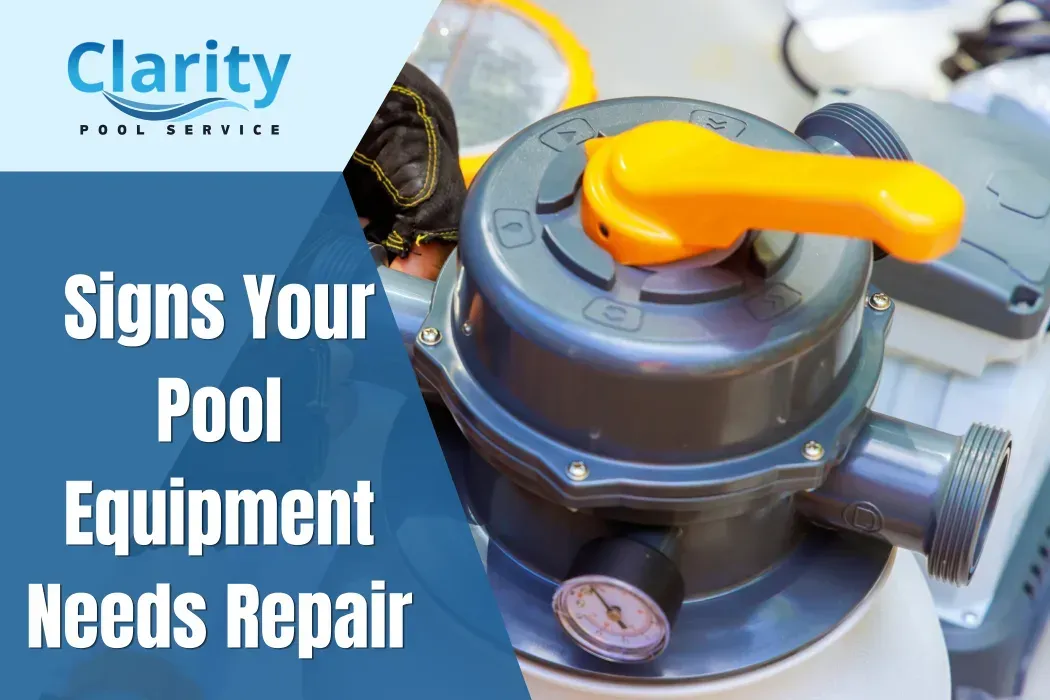
Signs Your Pool Equipment Needs Repair
How to Recognize Pool Equipment Problems Before They Become Expensive Failures
Pool equipment doesn't always stop working without warning.
Often, something changes first.
The pump starts making a different sound.
Return flow becomes weaker.
A small leak appears around the equipment pad.
Air begins collecting inside the pump basket.
The heater displays an error.
The salt system stops producing as much chlorine as expected.
Some of these symptoms indicate relatively simple maintenance problems.
Others may signal that equipment needs repair.
The important thing is recognizing the change early.
You don't need to diagnose every mechanical problem yourself.
You simply need to know:
What does normal operation look like—and what warning signs shouldn't be ignored?
Quick Answer
Common signs that pool equipment may need maintenance, diagnosis, or repair include:
New or unusual pump noises
Persistent water leaks
Weak or changing return flow
Air inside the pump basket
Pump repeatedly losing prime
Unexpected filter-pressure changes
Equipment repeatedly shutting down
Heater error messages
Salt-system warnings
Automation problems
Unexplained increases in energy use
Recurring water-quality problems despite normal maintenance
One warning sign doesn't automatically mean equipment needs replacement.
Many symptoms can have several causes.
Recognize the symptom first. Diagnose the cause second. Repair or replace only after you understand what's actually wrong.
1. Your Pool Pump Sounds Different
One of the easiest equipment changes to recognize is sound.
A properly operating pump normally develops a consistent sound.
Pay attention if you begin hearing:
Grinding
Screeching
Rattling
Humming
Clicking
Excessive vibration
A new sound doesn't tell you exactly what's wrong.
But it tells you something has changed.
Possible causes range from debris and vibration to worn mechanical or electrical components.
Don't wait until the pump completely stops before investigating a persistent new noise.
2. Water Is Leaking Around the Equipment Pad
A small amount of water around pool equipment is easy to dismiss.
Persistent leaking deserves attention.
Look for water around:
Pump
Filter
Valves
Plumbing connections
Heater
Other fittings
Some leaks may involve relatively simple seals, O-rings, or connections.
Others may indicate more significant equipment problems.
The important distinction is between:
An occasional drop
and
a persistent leak that keeps returning.
Catching a leak early may provide more repair options and help prevent water from damaging surrounding equipment.
3. Return Flow Is Weaker Than Normal
Weak return jets are often blamed immediately on the pump.
But reduced circulation can have several causes.
Before assuming the pump needs repair, check:
Skimmer baskets
Pump basket
Filter condition
Valve positions
Water level
If those conditions appear normal and circulation remains significantly weaker than usual, the system may need further diagnosis.
Possible problems can involve the pump, plumbing, filter, or other components.
Weak return flow is a symptom—not a pump diagnosis.
4. The Pump Keeps Losing Prime
The pump should generally remain filled with water while operating normally.
If it repeatedly loses prime or struggles to establish normal circulation, something deserves attention.
You may notice:
Large amounts of air inside the pump basket
Bubbles from return jets
Irregular water movement
Pump struggling after startup
Possible causes vary.
They may involve:
Water level
Suction-side air intrusion
Plumbing
Valves
Pump components
Repeatedly restarting the pump without identifying why it loses prime isn't a long-term solution.
5. There Is Persistent Air Inside the Pump Basket
Some small air pockets can occur under certain operating conditions.
But a pump basket that suddenly contains significantly more air than normal can indicate a circulation problem.
Look for related symptoms such as:
Bubbles from return jets
Changing pump sound
Reduced water flow
Difficulty maintaining prime
Air entering the system doesn't automatically mean the pump itself has failed.
The suction side of the circulation system should be evaluated.
6. Filter Pressure Has Changed Significantly
Your filter-pressure gauge can provide useful information about the circulation system.
The important reference isn't another homeowner's pressure.
It's your own system's normal clean operating pressure.
A significant change from that baseline may indicate:
Filter loading
Flow restriction
Pump or circulation changes
Valve changes
Other system conditions
Filter pressure alone doesn't identify the problem.
Consider it together with:
Return flow
Water clarity
Pump operation
Filter condition
Sometimes the solution is normal filter maintenance rather than equipment repair.
7. The Pump Shuts Down Unexpectedly
A pump that repeatedly turns off outside its normal schedule should be investigated.
Possible symptoms include:
Unexpected shutdowns
Failure to restart
Error messages
Intermittent operation
Don't repeatedly reset equipment indefinitely without understanding why it's shutting down.
Modern variable-speed pumps may provide error information that can help with diagnosis.
Record the message or take a photo before resetting the system.
That information can be valuable to whoever evaluates the equipment.
8. Your Heater Won't Start
A heater that won't operate doesn't automatically need repair or replacement.
Pool heaters depend on proper operating conditions.
One important factor is adequate water flow.
Before assuming the heater itself has failed, consider:
Pump operation
Circulation
Filter condition
Heater settings
Error messages
If normal operating conditions are present and the heater still won't function, further diagnosis may be necessary.
Because heaters may involve gas, electricity, combustion, heat, and pressurized water, internal heater work should be performed by appropriately qualified professionals.
9. Your Salt System Shows Warnings
Salt chlorine generators can provide warning lights or error messages when operating conditions aren't correct.
Depending on the system, issues may involve:
Salt concentration
Water flow
Cell condition
Scale
Sensors
Electronics
Low chlorine doesn't automatically prove the salt cell has failed.
Before replacing the cell, evaluate:
Water chemistry → Salt level → Flow → System settings → Cell condition
Salt cells eventually wear out, but expensive replacement should follow diagnosis.
10. Your Pool Equipment Is Repeatedly Tripping a Breaker
Electrical problems deserve particular caution.
If pool equipment repeatedly trips a breaker, shuts down unexpectedly, smells overheated, or shows other electrical warning signs, don't repeatedly reset the system and continue operating it.
Pool equipment combines water and electricity, making electrical problems inappropriate for casual troubleshooting.
Stop using affected equipment when appropriate and have the problem evaluated by a qualified professional.
11. Automation Stops Controlling Equipment Correctly
Automation systems may control:
Pump schedules
Pump speeds
Heater
Spa mode
Salt system
Lights
Water features
Warning signs may include:
Equipment not following schedules
Controls not responding
Incorrect pump speeds
Communication errors
Equipment unexpectedly turning on or off
Before assuming the automation hardware has failed, verify that settings haven't simply been changed.
If the configuration appears correct and the problem persists, further diagnosis may be necessary.
12. Water Problems Keep Returning Despite Proper Maintenance
Sometimes the first sign of an equipment problem appears in the pool rather than at the equipment pad.
Examples include:
Recurring algae
Persistent cloudiness
Inadequate chlorine production
Repeated circulation problems
These symptoms don't automatically mean equipment is failing.
But if water chemistry and routine maintenance are appropriate and the same problem continues returning, equipment performance should become part of the investigation.
A pool is an interconnected system.
Sometimes a water-quality problem is actually the first visible symptom of a mechanical problem.
The Most Important Rule: Know What's Normal
Homeowners don't need to memorize every pump specification or heater error code.
Instead, learn your pool's normal baseline.
Know:
How the pump normally sounds
What normal return flow looks like
Normal filter pressure
Normal pump-basket appearance
Typical equipment schedules
What control panels normally display
Take photographs of:
Equipment labels
Valve positions
Pump schedules
Control settings
Once you know what normal looks like, equipment changes become much easier to recognize.
And early recognition is often the difference between:
a problem that can be investigated conveniently
and
an equipment failure that suddenly stops the pool from operating.
What to Do When You Notice an Equipment Warning Sign
Finding a leak, hearing an unusual noise, or seeing an equipment error doesn't automatically mean you're facing an expensive replacement.
Start by documenting what changed.
Take a photo or video when useful.
Record:
Error messages
Where a leak appears
When the problem occurs
Whether circulation changed
Whether the equipment still operates
Any unusual sounds
This information can make diagnosis much easier.
Then avoid changing multiple settings or replacing parts until the cause is understood.
A good process is:
Observe → Diagnose → Repair or Replace
Maintenance Problem or Equipment Failure?
Some symptoms that look like equipment failures are actually routine maintenance problems.
Symptom | Possible Maintenance Issue | Possible Equipment Issue |
Weak return flow | Full basket or dirty filter | Pump or plumbing problem |
Low saltwater chlorine | Chemistry or low salt | Cell or control problem |
Heater won't start | Inadequate flow | Heater component problem |
High filter pressure | Dirty filter | Filter or circulation problem |
Air in pump | Low water level | Air leak or pump issue |
Cloudy water | Chemistry or dirty filter | Circulation/equipment problem |
This is why diagnosis matters.
Replacing equipment before checking simpler causes can become expensive very quickly.
When Does Equipment Actually Need Repair?
Repair becomes more likely when a specific mechanical, electrical, plumbing, or control problem has been identified.
Examples might include:
Failed seals
Worn bearings
Damaged valves
Failed sensors
Plumbing leaks
Control problems
Other serviceable components
The exact repair depends on the equipment.
The important distinction is that a repair recommendation should identify what failed, not simply say:
“Your equipment is old.”
Age is useful information.
It isn't a diagnosis.
Repair or Replace?
Once a failure has been confirmed, the next question is whether repairing the equipment makes financial sense.
Repair may be attractive when:
The problem is isolated
The rest of the equipment is in good condition
Parts remain available
The equipment has otherwise been reliable
Repair cost is reasonable
Replacement becomes more attractive when:
Major components are failing
Repairs are becoming frequent
Parts are obsolete or difficult to obtain
Reliability has declined significantly
Repair cost is difficult to justify
Our Pool Equipment Repair vs. Replacement guide covers that decision in depth.
Don't Ignore Repair History
One repair doesn't necessarily mean equipment is unreliable.
Repeated repairs tell a different story.
Keep basic records of:
Equipment model
Approximate age
Repairs performed
Parts replaced
Warranty information
This becomes particularly useful when deciding whether to approve another repair several years later.
Instead of asking:
“Didn't we fix this before?”
you'll know exactly what was repaired.
When Should You Stop Using Pool Equipment?
Some warning signs deserve more caution than others.
Stop or avoid operating affected equipment when appropriate if you notice conditions such as:
Electrical burning smell
Smoke
Repeated breaker trips
Severe equipment leak affecting electrical components
Significant overheating
Other obvious electrical or safety concerns
Don't open electrical panels or attempt internal electrical repairs unless you're appropriately qualified.
Pool equipment combines water, electricity, pressure, heat, and sometimes gas.
Some repairs are not DIY projects.
Why Early Repair Can Matter
A small equipment problem may sometimes affect other parts of the pool.
For example:
A circulation problem can reduce filtration.
Reduced filtration can contribute to cloudy water.
Poor water movement may interfere with salt chlorine production.
A prolonged equipment shutdown during hot weather may contribute to algae.
That's why equipment problems aren't always isolated mechanical inconveniences.
They can eventually become water-maintenance problems too.
Can Weekly Pool Service Catch Equipment Problems Early?
It can help.
A technician who sees the same equipment regularly may notice changes such as:
New leaks
Changing pump sounds
Filter-pressure differences
Air in the circulation system
Equipment warnings
Weekly service isn't a complete mechanical inspection.
But repeated observation creates a useful baseline.
A small change can be easier to recognize when someone already knows how the equipment normally behaves.
Common Equipment Mistakes Homeowners Make
Ignoring a Small Leak for Months
A minor leak may remain minor—or it may worsen.
Persistent leaks deserve evaluation rather than becoming accepted as normal.
Repeatedly Resetting Equipment
If a pump, heater, or automation system repeatedly displays an error or shuts down, resetting it over and over doesn't identify why the problem is occurring.
Record the error and investigate the cause.
Replacing Parts Based on Symptoms Alone
Weak flow doesn't prove the pump is bad.
Low chlorine doesn't prove the salt cell is bad.
An error code doesn't necessarily mean the entire piece of equipment needs replacement.
Diagnose before buying parts.
Changing Several Settings at Once
Changing pump speeds, valve positions, automation schedules, and salt output simultaneously makes troubleshooting much harder.
Document the original configuration before making changes.
Waiting for Complete Failure
Some failures happen suddenly.
Others provide warning signs for weeks or months.
Leaks, unusual noises, changing performance, and recurring errors deserve attention while the equipment is still operating.
Frequently Asked Questions
How do I know if my pool pump needs repair?
Warning signs may include:
New noises
Leaks
Repeated loss of prime
Unexpected shutdowns
Persistent air
Reduced performance
However, circulation problems can also be caused by baskets, filters, valves, or plumbing.
Diagnosis should come first.
Does weak water flow mean my pump is failing?
Not necessarily.
Check simpler causes such as full baskets, filter condition, valve positions, and water level before assuming the pump has failed.
Is a leaking pool pump serious?
Persistent leaks should be evaluated.
Some may involve relatively simple serviceable components, while others can indicate larger problems.
Early diagnosis is generally better than waiting for the leak to worsen.
How do I know if my salt cell is bad?
Low chlorine alone doesn't prove the cell has failed.
Check:
Water chemistry
Salt level
Flow
System warnings
Cell condition
before replacing the cell.
Why won't my pool heater turn on?
Possible causes include inadequate water flow, settings, equipment errors, or internal heater problems.
Because heater repair may involve gas and electrical systems, internal diagnosis should be handled by appropriately qualified professionals.
Should I repair old pool equipment?
Sometimes.
Older equipment can still be worth repairing when the problem is isolated and the rest of the system remains reliable.
Age alone shouldn't determine the decision.
When should pool equipment be replaced instead?
Replacement becomes more attractive when repairs are frequent, major components are failing, parts are difficult to obtain, or repair cost no longer makes sense relative to replacement.
When to Call a Professional
Professional diagnosis is appropriate when:
A problem keeps returning
Equipment repeatedly shuts down
A leak is worsening
Circulation remains poor after basic maintenance checks
Electrical problems appear
Heater problems develop
You can't identify the source of an equipment error
You're considering an expensive repair or replacement
For major equipment decisions, asking for a clear diagnosis before approving work is reasonable.
You should understand:
What failed?
Why did it fail?
Can it be repaired?
What will the equipment's condition be afterward?
Why does replacement make more sense if it's being recommended?
Final Thoughts
The best time to notice a pool equipment problem is usually before the equipment stops completely.
Learn what normal looks like.
Pay attention to:
Leaks.
Sounds.
Flow.
Pressure.
Air.
Warnings.
Shutdowns.
Then investigate meaningful changes.
Don't assume every warning sign means expensive replacement.
But don't ignore repeated symptoms until the equipment fails either.
Good preventative maintenance sits between those two extremes:
Recognize the change → Identify the cause → Make the appropriate repair decision.
Continue Exploring the Pool Owner Learning Center
For deeper information about pool equipment and the systems connected to it, continue with:
Pool Equipment Owner's Guide
Pool Equipment Repair vs. Replacement
Pool Circulation Explained
How Often Should a Pool Filter Be Cleaned?
How Long Should You Run Your Pool Pump?
Pool Water Chemistry Explained
Together, these guides help homeowners understand equipment operation, recognize problems, and make better repair decisions.