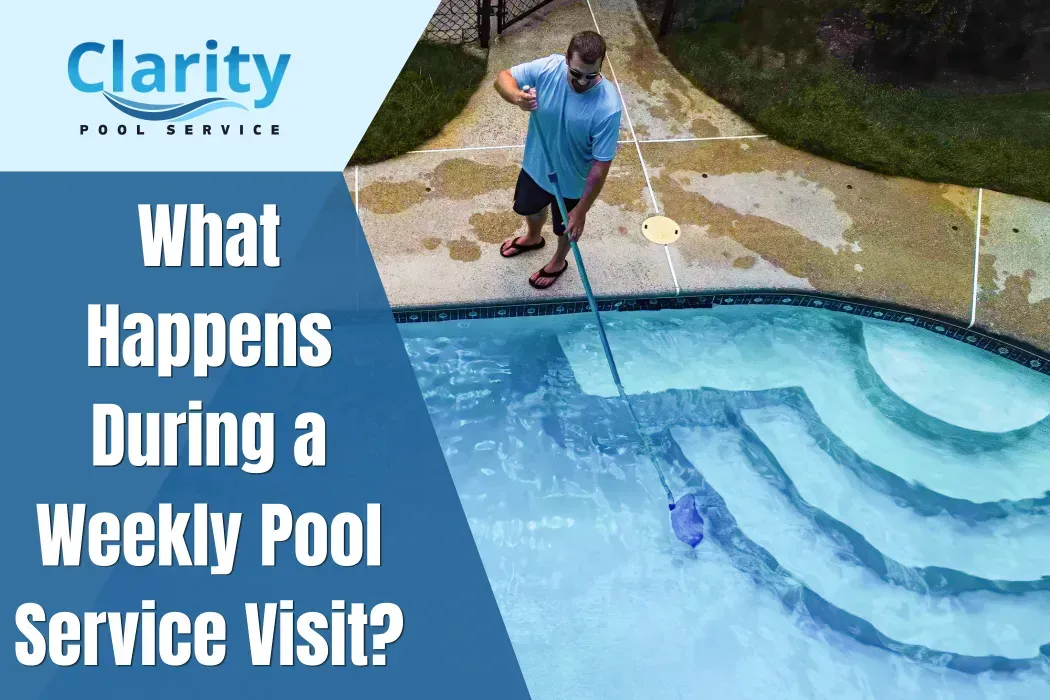
What Happens During a Weekly Pool Service Visit?
A Complete Homeowner's Guide to What Professional Pool Technicians Should Check Every Week
For many homeowners, weekly pool service happens almost entirely behind the scenes.
A technician arrives.
The pool gets cleaned.
Chemicals may be added.
Then the technician leaves.
But what should actually happen during that visit?
Professional weekly pool service should involve much more than skimming leaves and adding chlorine.
A comprehensive service visit is an opportunity to evaluate the entire swimming pool system.
That includes:
Water chemistry
Pool surfaces
Debris
Circulation
Filtration
Equipment operation
Developing maintenance problems
Some weeks require very little correction.
Other weeks may require more brushing, additional debris removal, larger chemistry adjustments, or closer equipment attention.
That's because professional maintenance shouldn't be based on performing the exact same checklist mechanically every seven days.
The technician should evaluate the condition of the pool and provide the maintenance it actually needs.
Whether you own a pool in Santee, El Cajon, Lakeside, Rancho San Diego, Fletcher Hills, Mt. Helix, Spring Valley, Lemon Grove, San Carlos, Allied Gardens, Del Cerro, Casa de Oro, or elsewhere in East County San Diego, understanding what happens during a weekly service visit makes it easier to evaluate the quality of the maintenance you're receiving.
In this guide you'll learn:
What technicians should evaluate when they arrive
How water chemistry is tested and balanced
Why brushing and debris removal matter
How baskets and filtration are monitored
What equipment should be inspected
Why every weekly visit isn't identical
What homeowners should expect after service
How to recognize the difference between basic cleaning and comprehensive pool maintenance
By the end, you'll have a much clearer understanding of what you're actually paying for during professional weekly pool service.
Quick Answer
A comprehensive weekly pool service visit should generally include four major areas of maintenance:
1. Water Care
Test water chemistry
Evaluate sanitizer
Adjust chemistry as needed
2. Physical Cleaning
Skim debris
Brush surfaces
Vacuum when necessary
Empty baskets
3. System Monitoring
Observe circulation
Monitor filter pressure
Check water level and flow conditions
Inspect equipment operation
4. Documentation and Communication
Record completed service when provided
Document chemistry readings
Report equipment concerns
Recommend additional maintenance when necessary
The exact work may vary from one week to the next.
The goal is not to perform unnecessary tasks simply because they're on a checklist.
The goal is to leave the pool clean, properly balanced, circulating normally, and evaluated for developing problems.
At a Glance
Key Takeaways
✔ Professional weekly service should involve more than cleaning visible debris.
✔ Water should be tested before chemical adjustments are made.
✔ Not every pool requires the same amount of maintenance every week.
✔ Brushing is preventative even when pool surfaces look clean.
✔ Basket and filter monitoring help protect circulation.
✔ Equipment inspection provides an opportunity to identify problems before complete failure.
✔ A technician shouldn't replace or recommend expensive equipment solely because one symptom appears.
✔ Good weekly service evaluates the entire pool—not just the appearance of the water.
Step 1: Evaluate the Pool Before Doing Anything
A good service visit begins with observation.
Before immediately adding chemicals or starting to clean, the technician should look at the condition of the pool.
Useful observations include:
Water clarity
Water color
Surface debris
Debris on the floor
Areas of visible algae
Water level
Return flow
Skimmer activity
Equipment operation
This initial evaluation provides context for everything that follows.
For example, cloudy water combined with weak circulation tells a different story than cloudy water with strong circulation.
Heavy debris after a wind event creates different maintenance needs than a clean pool during calm weather.
Good maintenance begins by asking:
What's different about this pool today?
Step 2: Inspect Basic Equipment Operation
The equipment pad can provide valuable information before the cleaning process even begins.
A routine visual inspection may include observing:
Pool pump
Filter pressure
Visible plumbing
Valves
Heater, if equipped
Salt system, if equipped
Automation or control system
The technician should become familiar with normal operation over time.
That makes changes easier to recognize.
Examples include:
New pump noise
Persistent air inside the pump basket
Small leak
Unexpected pressure change
Salt system warning
Heater error
Equipment running differently than usual
The purpose isn't to perform a complete mechanical diagnosis during every weekly service visit.
It's to notice when something changes.
Step 3: Test the Water
Water testing should guide chemical treatment.
Professional pool maintenance shouldn't be:
"Add chlorine because it's Tuesday."
Instead, the technician evaluates what the water actually needs.
Depending on the pool and maintenance program, routine testing may include:
Free chlorine
pH
Total alkalinity
Other chemistry measurements as appropriate
Salt concentration for saltwater pools when needed
Some chemistry measurements require more frequent attention than others.
The important principle is:
Test first. Adjust second.
Step 4: Balance the Water
Once the water has been evaluated, chemical adjustments can be made based on actual conditions.
The goal is maintaining water that supports:
Effective sanitation
Swimmer comfort
Equipment protection
Surface protection
Consistent clarity
Not every pool needs every chemical during every visit.
Some weeks may require very small adjustments.
Other weeks—especially after extreme heat, heavy swimmer use, rain, or unusual environmental conditions—may require more attention.
A professional maintenance program should respond to the pool rather than follow an identical chemical routine regardless of test results.
Step 5: Remove Surface Debris
Leaves, insects, blossoms, pollen, and other floating debris should be removed before they sink or begin decomposing.
Surface skimming provides several benefits:
Improves appearance
Reduces organic contamination
Reduces sanitizer demand
Prevents some debris from reaching baskets and filters
Helps keep the pool ready to use
During calm weather, this may be straightforward.
After Santa Ana winds or heavy leaf drop, surface cleaning may become a much larger portion of the service visit.
Step 6: Brush Pool Surfaces
Brushing is one of the most important preventative tasks that homeowners don't always notice.
Pool surfaces can begin accumulating:
Early algae growth
Biofilm
Dirt
Fine debris
Developing deposits
before those problems become obvious.
Particular attention may be needed around:
Steps
Corners
Benches
Tanning ledges
Behind ladders
Areas with weaker circulation
Brushing helps loosen contaminants so sanitized water and filtration can do their jobs more effectively.
Step 7: Vacuum When Conditions Require It
Not every pool requires the same amount of vacuuming during every visit.
Some pools collect very little debris on the floor.
Others may accumulate:
Dust
Sand
Leaves
Fine organic debris
much more quickly.
A professional technician should evaluate the actual condition of the pool rather than vacuuming unnecessarily—or ignoring settled debris because it isn't part of a rigid routine.
The maintenance should fit the pool.
Why Every Weekly Service Visit Shouldn't Look Identical
This is one of the most important concepts for homeowners to understand.
Professional pool maintenance should be consistent without being robotic.
Consider the same pool during four different weeks:
Week 1
Calm weather, stable chemistry, minimal debris.
Week 2
Extreme heat and heavy swimmer use.
Week 3
Santa Ana winds cover the pool with dust and leaves.
Week 4
Filter pressure begins increasing and a small equipment leak appears.
It would make little sense to perform exactly the same maintenance during all four visits.
The weekly schedule provides consistency.
The technician's job is to adapt the maintenance to the conditions present during each visit.
What We Commonly See During East County Service Visits
East County pool conditions can change significantly with weather and season.
During summer, technicians may encounter:
Increased sanitizer demand
Greater evaporation
More swimmer-related contamination
Spring may bring:
Pollen
Blossoms
Fine organic debris
Fall often means:
Leaves
Increased basket accumulation
Greater filter loading
And Santa Ana winds can change pool conditions dramatically between visits.
That's why the first few minutes of a professional service visit matter.
The technician isn't simply seeing what needs to be cleaned.
They're evaluating what happened to the pool since the last visit.
That information helps determine what maintenance should happen next.
Step 8: Empty the Skimmer Baskets
Skimmer baskets collect larger debris before it enters the pool's plumbing system.
During a typical service visit, technicians should inspect and empty the baskets as needed.
Common debris includes:
Leaves
Insects
Blossoms
Grass
Seed pods
Other organic material
This may seem like a small maintenance task, but full skimmer baskets can restrict water flow.
As flow through the skimmer decreases, several things may happen:
Surface skimming becomes less effective.
Debris remains in the pool longer.
Circulation may decline.
The pump may receive less water.
During periods of heavy leaf drop or strong winds, baskets can fill much faster than normal.
That's why basket maintenance should respond to actual conditions rather than assuming every week will look the same.
Step 9: Inspect and Empty the Pump Basket
The pump basket provides another layer of protection for the circulation system.
Debris that travels beyond the skimmer or enters through other suction-side plumbing may eventually collect inside the pump basket.
During service, the technician should inspect the basket and clean it when necessary.
A restricted pump basket can reduce water movement through the system and affect:
Filtration
Circulation
Return flow
Heating
Salt chlorine generation
The technician should also observe what the pump looks like while operating.
Persistent air inside the pump basket, unusual water movement, or difficulty maintaining prime may indicate a circulation issue that deserves further attention.
Step 10: Check Filter Pressure and Filtration Conditions
Your pool filter continuously removes contaminants whenever the circulation system operates.
As debris accumulates, conditions inside the filter gradually change.
A professional technician should become familiar with the normal operating pressure of the specific filtration system.
During weekly service, filter pressure can be compared with that baseline.
A significant change may indicate that the filtration system needs attention.
However, filter pressure should never be interpreted completely by itself.
Technicians should also consider:
Return flow
Water clarity
Pump operation
Filter condition
Recent debris levels
The goal isn't to clean the filter every week.
It's to recognize when filter maintenance is becoming necessary.
Step 11: Observe Water Circulation
Healthy circulation connects nearly every part of pool maintenance.
During weekly service, technicians should observe whether water appears to be moving normally throughout the system.
Useful observations include:
Return jet strength
Surface movement
Skimmer performance
Pump operation
Air inside the system
Filter pressure
If circulation has changed significantly since the previous visit, the technician should investigate rather than simply continuing the normal maintenance routine.
Weak return flow, for example, could result from:
Full baskets
Dirty filter
Incorrect valve position
Air entering the system
Pump performance problems
Plumbing restrictions
The symptom doesn't automatically identify the cause.
It tells the technician that something has changed.
Step 12: Inspect the Equipment Pad
One of the most valuable parts of professional weekly service may happen several feet away from the swimming pool.
The equipment pad should receive a basic visual inspection.
Depending on the pool, this may include:
Pump
Filter
Heater
Salt chlorine generator
Valves
Visible plumbing
Automation equipment
The technician should look and listen for changes such as:
Water leaks
Unusual noises
Excessive vibration
Air inside the pump
Equipment warning lights
Error messages
Unexpected shutdowns
Changes in circulation
Weekly service isn't a complete equipment diagnostic appointment.
The value comes from repeatedly seeing the same equipment and recognizing when something looks or sounds different.
Why Equipment Familiarity Matters
Imagine a technician sees the same pool every week.
Over time, they become familiar with:
Normal pump sound
Typical filter pressure
Normal return flow
Equipment schedules
Typical chlorine demand
Seasonal debris patterns
Then one week, something changes.
The pump develops a slight new sound.
Filter pressure rises faster than usual.
A small leak appears beneath a fitting.
The salt system displays a warning that wasn't there before.
Those changes may be much easier to recognize because the technician has a baseline.
This is one of the advantages of consistent weekly service that isn't always obvious to homeowners.
Step 13: Check the Salt System When Applicable
If the pool uses a salt chlorine generator, the system should be monitored as part of routine maintenance.
Depending on the equipment and conditions, technicians may observe:
System status
Salt readings
Chlorine production
Flow warnings
Error messages
Visible cell condition when appropriate
A saltwater pool still requires normal water testing and balancing.
The salt system automates chlorine production.
It doesn't replace weekly maintenance.
If chlorine production appears lower than expected, the technician should consider the complete system before assuming the salt cell has failed.
Possible contributing factors include:
Water chemistry
Salt concentration
Water flow
Scale
Equipment settings
Increased chlorine demand
Cell condition
Proper diagnosis comes before replacement.
Step 14: Check Heater Operation When Applicable
Not every pool has a heater, and a weekly service visit doesn't require running or internally inspecting the heater every time.
However, visible heater condition and obvious operating problems should not be ignored.
Technicians may notice:
Error messages
Visible leaks
Unusual sounds
Signs of poor water flow
Unexpected equipment behavior
If the homeowner reports that the heater isn't working, circulation should be considered as part of the initial evaluation.
Some heater problems are actually related to inadequate water flow rather than a failed heating component.
Because heaters may involve gas, electricity, combustion, heat, and pressurized water, internal diagnosis and repairs should be performed by appropriately qualified professionals.
Step 15: Look for Developing Problems
A quality weekly service visit isn't only about completing maintenance tasks.
It's also an opportunity to ask:
Is anything beginning to change?
Developing problems may include:
Small leaks
Changing equipment sounds
Reduced circulation
Increasing filter pressure
Recurring algae in one area
Increasing chlorine demand
Water level changes
Equipment warnings
Unusual debris patterns
Not every observation requires immediate repair.
Sometimes the appropriate action is simply to monitor the condition.
But documenting a small change today can provide valuable context if the issue becomes more significant later.
What Should Happen When a Technician Finds a Problem?
Finding a problem during weekly service doesn't automatically mean work should be performed without homeowner approval.
A good process generally looks like this:
Identify the concern.
Document what was observed.
Determine whether additional diagnosis is needed.
Communicate the issue clearly to the homeowner.
Explain available options when known.
Obtain approval before performing separate repair work when appropriate.
Homeowners should understand the difference between:
Routine maintenance
and
additional repair or specialty service.
Transparency helps prevent surprise charges and allows homeowners to make informed decisions.
Step 16: Perform a Final Pool Check
Before leaving the property, the technician should take another look at the pool and equipment.
The final check helps confirm that:
Necessary cleaning has been completed.
Water has been treated appropriately.
Baskets are clear.
Circulation appears normal.
Equipment is operating as expected.
No obvious maintenance issue has been overlooked.
This doesn't need to be complicated.
It's simply a final opportunity to verify that the pool is being left in proper operating condition.
Step 17: Document the Service
Many professional pool companies now provide digital service reports.
Depending on the maintenance program, a report may include:
Date and time of service
Water chemistry readings
Chemicals added
Cleaning performed
Equipment observations
Photos
Maintenance recommendations
Repair concerns
For homeowners, these reports provide transparency.
But they also serve another important purpose:
They create a maintenance history.
Over time, that history can reveal patterns.
Perhaps chlorine demand gradually increases.
Filter pressure begins changing more quickly.
The same equipment warning appears repeatedly.
A small leak slowly becomes more significant.
Individual service reports are useful.
A year of reports can become valuable diagnostic information.
What Should a Weekly Pool Service Report Tell You?
A useful service report should help answer basic questions such as:
Was my pool serviced?
What was checked?
What chemicals were added?
Were any problems observed?
Does anything require my attention?
A report doesn't need to overwhelm homeowners with technical information.
Its purpose is to create useful communication between the technician and homeowner.
What Isn't Usually Included in a Normal Weekly Service Visit?
This is an important distinction.
Weekly maintenance is designed to maintain a normally operating swimming pool.
Some services require additional time, materials, specialized skills, or separate appointments.
These may include:
Major filter cleaning
Green pool recovery
Significant algae treatment
Leak detection
Pump repair
Heater repair
Salt system repair
Automation repair
Plumbing repair
Equipment replacement
Electrical work
Exactly what's included varies by company and maintenance plan.
Homeowners should understand these boundaries before service begins.
Routine Maintenance vs. Specialty Service
The purpose of weekly service is prevention and routine maintenance.
Specialty service addresses conditions outside normal weekly care.
Why a Technician Shouldn't Automatically Repair Everything They Find
This is important for homeowner trust.
Suppose a technician notices a small equipment leak.
The correct response isn't necessarily:
"Replace the pump."
The technician should first determine what can reasonably be observed during routine service and whether further diagnosis is required.
Likewise:
Weak circulation doesn't automatically mean pump replacement.
Low saltwater chlorine doesn't automatically mean salt cell replacement.
A heater error doesn't automatically mean a new heater.
Cloudy water doesn't automatically mean additional chemicals are the only answer.
Good professional service separates:
Observation → Diagnosis → Recommendation → Approval → Repair
rather than jumping directly from symptom to expensive solution.
What Makes a Great Weekly Service Visit?
A great service visit isn't necessarily the longest one.
And it isn't necessarily the visit where the most chemicals are added.
The best service visits are the ones where the technician accurately evaluates what the pool needs and completes that work consistently.
That means:
Testing instead of guessing
Cleaning what needs cleaning
Brushing preventatively
Monitoring filtration
Observing circulation
Inspecting equipment
Communicating problems
Avoiding unnecessary repairs
Sometimes the best weekly service visit is uneventful.
The chemistry is stable.
The equipment is healthy.
The filter pressure is normal.
The pool needs routine cleaning and very little correction.
That's not a lack of service.
That's what successful preventative maintenance often looks like.
What We Commonly See After Extreme East County Weather
Weekly service becomes especially valuable when conditions change rapidly.
After prolonged summer heat, technicians may find:
Higher chlorine demand
Increased evaporation
More swimmer-related contamination
After Santa Ana winds:
Full skimmer baskets
Heavy surface debris
Dust on the pool floor
Increased filter loading
After rain:
Additional debris
Changed water conditions
Different water level
Increased cleaning needs
The weekly service process remains consistent:
Observe → Test → Clean → Adjust → Inspect
But the amount of work within each step changes according to conditions.
The Goal of a Weekly Service Visit
The goal isn't simply:
"Make the pool look good before leaving."
The better goal is:
Leave the pool cleaner, properly balanced, circulating normally, and evaluated for developing problems.
That distinction separates comprehensive pool maintenance from basic pool cleaning.
A clean pool matters.
But a clean pool supported by healthy chemistry, circulation, filtration, and equipment is what homeowners are really paying to maintain.
How to Evaluate the Quality of Weekly Pool Service
Most homeowners aren't standing beside the technician during every service visit.
Nor should they need to.
Professional pool service should provide enough consistency and communication that homeowners can feel confident the pool is being maintained properly without supervising every task.
But that raises an important question:
How can you tell whether you're receiving good weekly pool service?
The answer isn't simply how blue the water looks after the technician leaves.
Quality service should produce consistent results across several areas:
Water chemistry
Pool cleanliness
Circulation
Filtration
Equipment observation
Communication
Reliability
Over time, those patterns tell you much more about service quality than any single visit.
A Clean Pool Is Important — But It Isn't the Whole Story
The appearance of the swimming pool matters.
Homeowners should reasonably expect:
Clear water
Clean surfaces
Minimal debris
Clean steps and ledges
A pool that's ready to enjoy
But appearance only tells part of the story.
A pool can look beautiful while:
Sanitizer is declining.
pH is drifting.
Filter pressure is increasing.
A small equipment leak is developing.
Circulation is becoming restricted.
That's why comprehensive maintenance evaluates what homeowners can see and what they can't.
Signs of Quality Weekly Pool Service
Over time, good maintenance should create a predictable pattern.
Homeowners should generally see:
Consistently clear water
Stable water conditions
Clean pool surfaces
Regular debris removal
Healthy circulation
Equipment concerns communicated early
Fewer preventable water problems
Reliable service documentation when provided
No pool remains perfect every day.
Weather happens.
Equipment fails.
Heavy swimmer use changes water conditions.
The goal isn't perfection.
The goal is consistent management of changing conditions.
Reliability Matters
A good maintenance program depends on regular service.
If visits are frequently:
Missed
Delayed
Rescheduled without communication
Performed inconsistently
the pool loses much of the benefit of a predictable maintenance rhythm.
Professional service doesn't have to happen at the exact same minute every week.
But homeowners should be able to depend on consistent maintenance without wondering whether anyone serviced the pool.
Communication Matters
Some of the most valuable information from a weekly service visit may have nothing to do with cleaning.
For example:
"I noticed a small leak near the pump today."
or:
"Filter pressure is beginning to increase. We should monitor it."
or:
"Your salt system displayed a flow warning during today's visit."
That communication allows homeowners to make decisions before small concerns become larger problems.
A quality technician shouldn't create unnecessary alarm.
They should simply explain:
What was observed.
Why it may matter.
What should happen next.
Transparency Matters
Homeowners should understand what their maintenance plan includes.
That means knowing:
Which routine services are included
Whether balancing chemicals are included
How filter cleaning is handled
What services cost extra
How repairs are approved
How equipment concerns are communicated
Transparent service reduces misunderstandings.
It also makes comparing companies much easier.
Consistency Matters More Than Perfection
A swimming pool is an outdoor environment.
Leaves fall.
Wind blows.
Rain changes water conditions.
People swim.
Equipment ages.
Even a perfectly maintained pool may occasionally experience an unusual condition.
The better measure of service quality is what happens next.
Does the technician recognize the change?
Does the maintenance adapt?
Does the homeowner receive useful communication?
Does the pool return to stable conditions?
Professional maintenance is about managing a changing system—not pretending conditions never change.
Red Flags Homeowners Should Watch For
No single issue automatically means a pool company provides poor service.
But repeated patterns deserve attention.
Possible warning signs include:
Pool repeatedly turning green
Persistent cloudy water
Baskets regularly left full
Visible debris repeatedly ignored
Equipment leaks never mentioned
Recurring chemistry problems without explanation
No communication about developing equipment concerns
Frequent missed service visits
Surprise charges for services that weren't clearly explained
Expensive replacement recommendations without adequate diagnosis
The key word is pattern.
One difficult week after extreme weather is very different from the same problem occurring repeatedly.
Should the Technician Add Chemicals Every Week?
Not necessarily every chemical, every week.
Professional pool care should be based on testing.
Some chemical adjustments may be required frequently.
Others are needed only when testing indicates a reason.
The goal isn't to demonstrate service by pouring products into the pool.
The goal is to maintain properly balanced water.
More chemicals don't automatically mean better service.
Correct chemicals, in appropriate amounts, based on actual conditions are what matter.
Should the Technician Vacuum Every Week?
Not every swimming pool requires the same amount of vacuuming during every visit.
A pool with very little settled debris may not need extensive vacuuming.
Another pool exposed to:
Strong winds
Nearby construction
Mature landscaping
Fine dust
may require significantly more attention.
The better question isn't:
"Did the technician vacuum for a certain number of minutes?"
It's:
"Was settled debris properly addressed?"
Maintenance should respond to actual conditions.
Should the Pool Be Brushed Even If It Looks Clean?
Yes, routine brushing remains an important preventative task.
Brushing helps disrupt early buildup before it becomes obvious.
Particular attention should be given to:
Steps
Corners
Benches
Tanning ledges
Areas with weaker circulation
Waiting until visible algae appears means the task has shifted from preventative maintenance toward corrective cleaning.
Should the Equipment Be Checked Every Week?
A basic visual equipment inspection should be part of comprehensive weekly service.
That doesn't mean disassembling pumps, heaters, filters, or automation systems every week.
Instead, technicians should observe normal operation and watch for changes.
That may include:
Pump sound
Filter pressure
Visible leaks
Air in the system
Equipment warnings
Salt system status
Circulation
Repeated observation creates familiarity.
Familiarity makes unusual conditions easier to recognize.
What Should Happen When Your Pool Needs Extra Work?
Sometimes the condition of a pool falls outside normal weekly maintenance.
Examples may include:
Green pool recovery
Severe algae
Major filter cleaning
Equipment repair
Leak detection
Major chemistry correction
Storm cleanup beyond normal service
When this happens, the homeowner should generally receive a clear explanation of:
What's wrong
Why routine maintenance isn't sufficient
What additional service is recommended
What the additional service will cost
Whether approval is required before work begins
This separation between routine maintenance and additional work protects both the homeowner and the service company.
Common Homeowner Mistakes When Evaluating Pool Service
Homeowners understandably want to know whether they're receiving good value.
But some common ways of evaluating service can be misleading.
Judging Service Only by Time on Site
A longer visit isn't automatically better.
A shorter visit isn't automatically worse.
A well-maintained pool during calm weather may require less corrective work than the same pool after a storm.
Evaluate the completed maintenance—not the stopwatch.
Judging Service Only by How Much Chlorine Was Added
Chemical quantity isn't a measure of service quality.
A stable pool may need relatively little adjustment.
A pool requiring large chemical additions every week may actually indicate that something deserves further investigation.
Testing should determine treatment.
Assuming Every Equipment Recommendation Is an Upsell
Homeowners should absolutely ask questions before approving expensive repairs.
But legitimate equipment problems do occur.
The better approach isn't automatically accepting or rejecting the recommendation.
Ask:
What was observed?
What failed?
Why is repair recommended?
Are there alternatives?
Is immediate action necessary?
Can the problem be monitored?
Good recommendations should survive reasonable questions.
Assuming the Cheapest Service Provides the Best Value
Monthly price matters.
But two companies charging different prices may provide very different maintenance programs.
One may include:
Chemicals
Equipment observation
Digital reports
Preventative communication
while another provides more limited cleaning.
Compare the complete service—not simply the invoice.
DIY Maintenance vs. Professional Weekly Service
Some homeowners prefer maintaining their own pools.
Others prefer professional care.
Both can work when maintenance is performed consistently and correctly.
What Homeowners Should Do Between Weekly Visits
Professional weekly service doesn't mean ignoring the swimming pool for the other six days.
Basic homeowner awareness is valuable.
Between visits, pay attention to:
Water level
Major debris accumulation
Equipment shutdowns
Significant leaks
Rapid water loss
Green or cloudy water
Unusual pump noises
Major circulation changes
After strong winds, homeowners may also need to empty heavily loaded skimmer baskets before the next service visit.
You don't need to duplicate the technician's entire maintenance routine.
Simply recognize conditions that shouldn't wait several days.
When Should You Contact Your Pool Company Before the Next Visit?
Don't wait for normal service day if you notice:
Pump has stopped operating
Significant equipment leak
Rapid unexplained water loss
Water suddenly turning green
Major loss of circulation
Persistent equipment error
Heater or equipment safety concern
Unusual electrical condition
Early communication allows the service company to determine whether the issue can wait or needs faster attention.
The Value of a Consistent Technician
When possible, having the same technician regularly service the pool can provide meaningful benefits.
Over time, the technician becomes familiar with:
Normal filter pressure
Typical chemistry
Pump sound
Equipment condition
Seasonal debris patterns
Areas prone to algae
Previous maintenance concerns
That knowledge provides context.
Instead of seeing a single snapshot, the technician sees a pattern over time.
That can improve preventative maintenance and communication.
Why Service History Becomes More Valuable Over Time
A single service report tells you what happened today.
A year of reports may tell you much more.
Patterns can reveal:
Increasing chlorine demand
Changing filter behavior
Recurring equipment errors
Repeated algae in one area
Gradual circulation changes
Increasing repair frequency
This is why documentation can become more valuable as the maintenance relationship continues.
It creates a record of how the pool behaves.
Questions to Ask Before Hiring a Weekly Pool Service Company
Before choosing a provider, ask:
What exactly is included in weekly service?
Are routine balancing chemicals included?
How do you monitor filter condition?
How are filter cleanings handled?
Do you inspect equipment during service?
How do you communicate equipment concerns?
Do you provide service reports?
What services cost extra?
How are repairs approved?
Will I usually have the same technician?
Clear answers make it much easier to compare companies fairly.
What a Homeowner Should Expect After Service
After a normal weekly maintenance visit, homeowners should reasonably expect:
Water that has been evaluated and treated appropriately
Necessary debris removal
Brushed surfaces
Baskets serviced as needed
Filtration and circulation observed
Equipment visually checked
Significant concerns communicated
Service documentation when included
You shouldn't need to wonder whether anyone actually came.
Professional service should create confidence through consistent results and communication.
The Best Weekly Service Often Looks Uneventful
This may sound strange, but it's important.
The technician arrives.
The water is clear.
Chemistry requires only minor adjustment.
The equipment sounds normal.
Filter pressure is stable.
The pool receives routine cleaning.
Nothing is broken.
Nothing dramatic happens.
That's not an unproductive visit.
That's often evidence that preventative maintenance is working.
The purpose of weekly service isn't to discover a crisis every seven days.
It's to keep the pool stable enough that crises become less common.
Continue Learning
Understanding what happens during a weekly service visit connects directly with the other major topics in the Pool Owner Learning Center:
Pool Service Cost in East County San Diego
What Does Weekly Pool Service Include?
Why Do Pools Turn Green?
Saltwater Pool Maintenance Guide
How Often Should a Pool Filter Be Cleaned?
Pool Water Chemistry Explained
Pool Equipment Owner's Guide
Pool Circulation Explained
Pool Equipment Repair vs. Replacement
New Pool Owner Guide
Why Weekly Pool Service Matters
Complete Pool Owner Learning Center
Together, these guides explain not just what professional maintenance includes, but how each part of the service helps protect the entire swimming pool system.
Frequently Asked Questions About Weekly Pool Service Visits
Homeowners shouldn't need to follow their pool technician around the backyard to know whether their swimming pool is receiving proper maintenance.
But understanding what should happen during a professional service visit makes it much easier to evaluate the quality and value of the service you're receiving.
Below are answers to some of the most common questions homeowners have about weekly pool service visits.
What should a pool technician do every week?
A comprehensive weekly service visit typically includes:
Evaluating the condition of the pool
Testing water chemistry
Balancing chemicals as needed
Skimming surface debris
Brushing pool surfaces
Vacuuming when necessary
Emptying skimmer baskets
Checking the pump basket
Monitoring filter pressure
Observing circulation
Visually inspecting equipment
Reporting developing problems
The exact work may change depending on the condition of the pool that week.
Should my pool water be tested every week?
For most residential swimming pools, regular weekly water testing is an important part of routine maintenance.
Pool chemistry changes continuously because of:
Sunlight
Temperature
Swimmer use
Evaporation
Rain
Organic debris
Chemical consumption
Testing allows the technician to make adjustments based on actual water conditions rather than guessing.
Should chemicals be added during every service visit?
Not necessarily every chemical, every week.
Chemical additions should be based on water testing and actual pool conditions.
Some measurements may require frequent adjustment, while others may remain stable for longer periods.
The goal isn't to add as many chemicals as possible.
It's to maintain properly balanced water using appropriate adjustments.
Should the technician brush my pool every week?
Routine brushing is an important part of preventative maintenance.
Brushing helps disturb:
Early algae growth
Biofilm
Fine dirt
Organic buildup
Developing deposits
Areas with reduced circulation, such as steps, corners, benches, and tanning ledges, may deserve particular attention.
A pool doesn't need to look dirty for brushing to provide value.
Should my pool be vacuumed every week?
Vacuuming should be performed according to the actual condition of the pool.
Some swimming pools accumulate significant settled debris each week.
Others remain relatively clean.
The important question isn't whether a vacuum was used during every single visit.
It's whether debris on the pool floor was properly addressed.
Should skimmer baskets be emptied every week?
Skimmer baskets should be inspected during routine service and emptied when necessary.
A basket filled with leaves or debris can restrict water flow and reduce surface skimming.
During heavy leaf drop or strong winds, homeowners may also need to empty baskets between professional visits.
Should the pump basket be checked during service?
Yes.
The pump basket helps protect important pump components from larger debris.
A restricted basket can reduce water flow through the circulation system.
The technician should also notice unusual conditions such as persistent air inside the pump basket or difficulty maintaining normal circulation.
Should filter pressure be checked every week?
Monitoring filter pressure is a useful part of weekly service.
There isn't one correct pressure reading for every swimming pool.
Instead, technicians should become familiar with the normal operating pressure of the specific system and watch for meaningful changes.
Filter pressure should also be considered alongside circulation, water clarity, and return flow.
Should my filter be cleaned every week?
No.
Filter cleaning and filter monitoring are different things.
The filter should be monitored regularly, but cleaning frequency depends on factors such as:
Filter type
Filter condition
Pressure
Pool usage
Landscaping
Seasonal debris
Manufacturer recommendations
Cleaning a filter simply because another week has passed isn't necessary.
Should pool equipment be inspected every week?
A basic visual equipment inspection should be part of comprehensive weekly maintenance.
The technician may observe:
Pump operation
Filter pressure
Visible leaks
Equipment sounds
Salt system status
Heater or automation warnings
General circulation
This doesn't mean disassembling equipment every week.
It means watching for changes from normal operation.
What happens if the technician finds an equipment problem?
The concern should generally be documented and communicated to the homeowner.
Depending on the issue, additional diagnosis may be necessary before a repair recommendation can be made.
A good process separates:
Observation → Diagnosis → Recommendation → Approval → Repair
rather than automatically performing additional work or recommending expensive replacement based on one symptom.
Is equipment repair included with weekly pool service?
Usually not.
Weekly maintenance and equipment repair are different services.
Routine service may identify an equipment concern, but repairs involving pumps, heaters, salt systems, automation, plumbing, or electrical components generally require separate approval and may involve additional charges.
Your service agreement should clearly explain what's included.
Is filter cleaning included with weekly pool service?
That varies by company.
Some maintenance plans may include periodic filter cleaning, while others treat it as a separate service.
Because filter cleaning requires additional time and depends on filter type and condition, homeowners should ask specifically how their service company handles it.
Are chemicals included in weekly pool service?
That also depends on the maintenance plan.
Some companies include routine balancing chemicals in the monthly price.
Others charge separately for some or all chemical products.
Before comparing pool service prices, ask:
Which routine chemicals are included?
Which chemicals cost extra?
Are specialty treatments separate?
A lower monthly price may not represent a lower total cost if routine maintenance products are billed separately.
How long should a weekly pool service visit take?
There isn't one correct amount of time.
Visit length varies based on:
Pool size
Water condition
Debris
Landscaping
Equipment
Weather
Seasonal conditions
Maintenance required that week
A stable pool during calm weather may require less time than the same pool after strong winds or unusually heavy use.
The better measure is whether the necessary maintenance was completed correctly.
Is a 15-minute pool service visit too short?
Not automatically.
A well-maintained pool may sometimes require relatively little corrective work.
Likewise, spending 45 minutes at a property doesn't automatically guarantee high-quality maintenance.
Instead of evaluating service only by time, consider whether the technician properly addressed:
Water chemistry
Cleaning
Brushing
Baskets
Filtration
Circulation
Equipment condition
Quality is measured by the work the pool required—not simply time on site.
Should I receive a report after every pool service?
Not every pool company provides digital reports, but they can be valuable.
A useful report may document:
Service completion
Water chemistry
Chemicals added
Maintenance performed
Equipment observations
Photos
Recommendations
Over time, these reports can also create a useful maintenance history.
What should I do if my pool looks dirty after service?
First determine what you're seeing.
A few leaves may enter the pool immediately after the technician leaves.
Brushing can also temporarily place fine material into suspension before filtration removes it.
However, repeatedly finding significant debris, dirty surfaces, full baskets, or obviously incomplete maintenance after service deserves a conversation with the provider.
Evaluate the pattern rather than one isolated condition.
Why does my pool sometimes look cloudy immediately after service?
Depending on the maintenance performed, brushing or other cleaning can temporarily suspend fine particles in the water.
The filtration system should gradually remove those contaminants.
Persistent cloudiness, however, may indicate another issue involving:
Water chemistry
Filtration
Circulation
Algae
Fine debris
If clarity doesn't improve, the underlying cause should be evaluated.
Should the same technician service my pool every week?
It's not always possible, but technician consistency can be valuable.
A technician familiar with your pool learns its:
Normal filter pressure
Equipment sounds
Chemistry patterns
Circulation
Seasonal debris
Problem areas
Maintenance history
That familiarity can make changes easier to recognize.
What should I do between weekly service visits?
You don't need to perform another complete service.
Basic homeowner awareness is usually enough.
Watch for:
Major debris after storms
Low water level
Significant equipment leaks
Pump shutdown
Green or cloudy water
Rapid water loss
Unusual equipment sounds
Major circulation changes
During heavy leaf drop or wind events, emptying overloaded skimmer baskets can help maintain circulation until the next visit.
What should I do if something breaks before my next service day?
Contact your pool service company rather than automatically waiting for the next scheduled visit.
This is particularly important if you notice:
Pump failure
Major water leak
Significant loss of circulation
Rapid water loss
Electrical concern
Serious heater problem
Water rapidly deteriorating
The provider can help determine whether the problem requires immediate attention or can safely wait.
How do I know whether I'm receiving good weekly pool service?
Don't judge the service based on one isolated visit.
Look at the pattern over time.
A well-maintained pool should generally demonstrate:
Consistent water clarity
Stable chemistry
Clean surfaces
Healthy circulation
Properly monitored filtration
Equipment concerns identified early
Reliable communication
Consistent service
The strongest evidence of good preventative maintenance is often the absence of repeated preventable problems.
Final Thoughts
A weekly pool service visit should accomplish much more than making the water look clean.
Professional maintenance should evaluate the swimming pool as an interconnected system.
That means considering:
Water chemistry.
Cleaning.
Circulation.
Filtration.
Equipment.
Communication.
The technician begins by observing the pool.
The water is tested before adjustments are made.
Debris is removed.
Surfaces are brushed.
Baskets are maintained.
Filter conditions and circulation are monitored.
Equipment is observed for developing problems.
Then the pool receives a final check and, when provided, the service is documented.
Some weeks that process is straightforward.
Other weeks require significantly more attention.
That's normal.
The purpose of professional weekly service isn't to perform the exact same motions every seven days.
It's to consistently evaluate what the swimming pool needs and respond appropriately.
The best service visit isn't necessarily the longest.
It isn't the one where the most chemicals are added.
And it isn't the one where something expensive is repaired.
Sometimes the best service visit is the one where:
The water is balanced.
The equipment is healthy.
The circulation is normal.
The pool receives routine preventative care.
And nothing dramatic happens.
That's exactly what good preventative maintenance is designed to accomplish.
Continue Exploring the Pool Owner Learning Center
Continue building your understanding of professional pool maintenance with these related homeowner guides:
Pool Service Cost in East County San Diego
What Does Weekly Pool Service Include?
Why Do Pools Turn Green?
Saltwater Pool Maintenance Guide
How Often Should a Pool Filter Be Cleaned?
Pool Water Chemistry Explained
Pool Equipment Owner's Guide
Pool Circulation Explained
Pool Equipment Repair vs. Replacement
New Pool Owner Guide
Why Weekly Pool Service Matters
Complete Pool Owner Learning Center
Together, these guides explain what professional pool maintenance includes, why each task matters, and how chemistry, filtration, circulation, equipment, and cleaning work together.
Know What You're Paying For
Homeowners should never have to wonder what professional weekly pool service actually does.
At Clarity Pool Service, we believe good maintenance should be understandable.
That means testing instead of guessing.
Preventing instead of constantly reacting.
Looking at the equipment as well as the water.
And explaining developing problems before recommending expensive solutions.
For homeowners throughout East County San Diego, weekly service should provide more than a clean-looking pool on service day.
It should provide consistent preventative care for the entire swimming pool system.
When you understand what happens during each visit, you're in a much better position to evaluate the service you're receiving, ask better questions, and protect your pool over the long term.