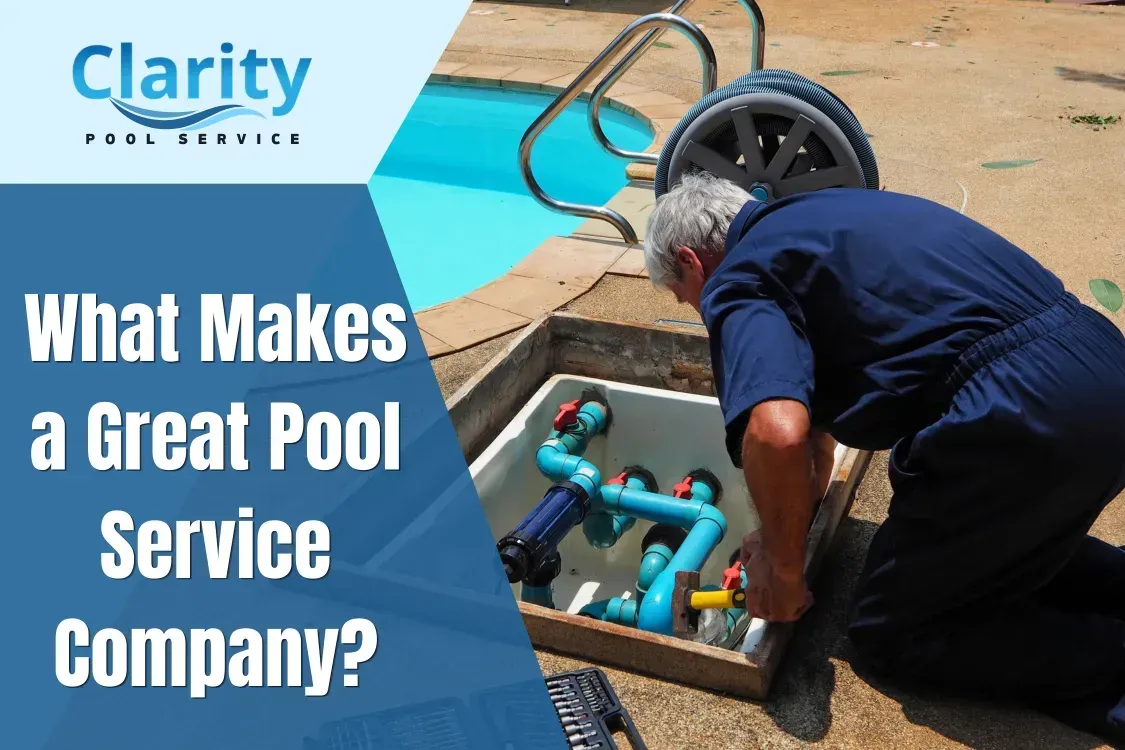
What Makes a Great Pool Service Company?
The Qualities That Separate Excellent Pool Service From Basic Pool Cleaning
Most pool service companies can make a swimming pool look clean on service day.
Great pool service goes further.
It keeps water chemistry stable.
It maintains consistent service.
It notices changes in circulation and equipment.
It communicates when something needs attention.
And it helps prevent small problems from becoming expensive ones.
That's the difference between simply cleaning a pool and professionally maintaining a pool.
For homeowners, the best pool service often isn't the company making the biggest promises.
It's the company that quietly gets the fundamentals right week after week.
Quick Answer
A great pool service company should provide:
Consistent, reliable service
Accurate water testing
Appropriate chemical balancing
Thorough cleaning and brushing
Circulation and filter monitoring
Basic equipment observation
Clear communication
Transparent pricing
Honest repair recommendations
Reliable service documentation when provided
Local knowledge
Preventative rather than purely reactive maintenance
The goal should be simple:
Keep the pool clean, balanced, circulating properly, and identify developing problems early.
1. Great Pool Service Is Consistent
Consistency is probably the most important quality in professional pool maintenance.
Swimming pools change every day.
Chlorine is consumed.
Debris enters the water.
Filters collect contaminants.
Equipment continues operating.
A great service company creates a dependable maintenance rhythm.
Homeowners should generally know:
When their pool will be serviced
What the service includes
How schedule changes are handled
How they'll know the visit occurred
The homeowner shouldn't have to repeatedly ask:
“Did anyone service my pool this week?”
Reliability is part of the service.
2. Great Technicians Test Before They Treat
Professional water care should be based on actual water conditions.
A technician shouldn't simply add the same chemicals every week because that's what was added last week.
Water chemistry changes with:
Temperature
Sunlight
Swimmer use
Organic debris
Rain
Evaporation
Good maintenance follows a simple principle:
Test → Evaluate → Adjust
Some weeks may require more correction.
Other weeks may require very little.
The chemicals should respond to the pool—not the calendar.
3. Great Service Looks Beyond Water Appearance
Clear water matters.
But clear water doesn't automatically mean the pool is properly maintained.
A great technician also pays attention to:
Sanitizer
Water balance
Circulation
Filter pressure
Baskets
Equipment operation
Developing leaks
A pool can look beautiful while a filter is becoming restricted or a small equipment leak is developing.
Preventative maintenance considers what homeowners can't immediately see as well as what they can.
4. Great Service Includes Preventative Brushing and Cleaning
A clean-looking pool can still benefit from brushing.
Routine brushing helps disturb:
Early algae growth
Biofilm
Dirt
Developing buildup
Particular attention may be needed around:
Steps
Corners
Benches
Tanning ledges
Areas with weaker circulation
Vacuuming should also respond to actual pool conditions.
The technician's job isn't to mechanically perform unnecessary tasks.
It's to recognize what the pool needs that week and complete it.
5. Great Technicians Understand Circulation
A pool is more than chemistry.
Water has to move properly through:
Pool → Pump → Filter → Equipment → Returns
A technician should recognize basic circulation warning signs such as:
Weak return flow
Full baskets
Changing filter pressure
Air inside the pump
Poor surface skimming
Weak circulation doesn't automatically mean the pump is bad.
Great technicians look at the complete system before making that conclusion.
6. Great Service Monitors the Filter
Filters don't need to be cleaned every week.
But they should be monitored.
A technician should become familiar with:
Normal filter pressure
Return flow
Water clarity
Filter behavior
When those conditions change, the filter may need attention.
This is one reason having someone consistently service the same pool can be valuable.
They learn what's normal.
7. Great Technicians Notice Equipment Changes
Weekly service isn't a full mechanical inspection.
But a technician standing next to the equipment every week has an opportunity to notice:
New leaks
New pump noises
Air in the system
Error messages
Salt-system warnings
Unexpected equipment behavior
These observations can be extremely valuable.
A small leak identified today may be easier to address than equipment that fails months later.
8. Great Pool Service Communicates
A technician can perform excellent physical maintenance and still provide a poor customer experience if communication is weak.
Homeowners should be informed about meaningful issues such as:
Equipment problems
Unusual water conditions
Filter maintenance
Repairs
Schedule changes
Additional charges
Good communication doesn't mean sending a homeowner a long technical explanation every week.
It means making sure important information doesn't disappear between the backyard and the customer.
9. Great Companies Explain Repairs
Pool equipment eventually fails.
When it does, homeowners should understand what they're being asked to pay for.
A good repair recommendation should explain:
What failed?
Why does it need attention?
Can it be repaired?
Why is replacement recommended if repair isn't practical?
Homeowners shouldn't be pressured into expensive replacement simply because equipment is old.
Age matters.
Diagnosis matters more.
10. Great Service Is Transparent About Price
A professional company should clearly explain:
Monthly service price
What's included
Chemical policy
Filter-cleaning policy
Additional services
Repair charges
Not every service needs to be included in the monthly fee.
The important thing is that homeowners know what may cost extra before the charge appears.
Transparency builds trust.
11. Great Service Adapts to Conditions
Pool maintenance shouldn't look identical every week.
Consider the same East County pool during:
A Calm Spring Week
Minimal debris and stable chemistry.
A Hot August Week
Higher chlorine demand and evaporation.
A Santa Ana Wind Event
Leaves, dust, full baskets, and increased filter loading.
The service schedule remains weekly.
The work changes according to what happened to the pool.
That's what professional maintenance should do.
12. Great Pool Service Makes Ownership Easier
Ultimately, homeowners hire professional service because they don't want pool maintenance to become another job.
Great service should reduce uncertainty.
You shouldn't constantly wonder:
Is the chemistry okay?
Did someone come?
Is the filter being monitored?
Is that pump noise normal?
Why did I receive this charge?
A strong pool-service relationship gives homeowners confidence that someone knowledgeable is consistently watching the pool.
And most weeks, the result should be wonderfully uneventful:
Clean water.
Stable chemistry.
Normal equipment.
No surprises.
That's what successful preventative maintenance looks like.
How Can You Tell If You're Receiving Great Pool Service?
Homeowners don't need to watch every service visit to know whether their pool is being maintained properly.
Look at the pattern over time.
Good service should generally produce:
Consistently clear water
Stable water chemistry
Clean pool surfaces
Reliable weekly visits
Healthy circulation
Properly monitored filtration
Early communication about equipment concerns
Clear billing and repair recommendations
No pool will be perfect every day.
Weather, equipment failures, and unusual swimmer use can create temporary problems.
The better question is:
How does the company respond when conditions change?
Good Service Is Preventative, Not Just Reactive
There is an important difference between maintaining a pool and repeatedly rescuing one.
Reactive Service
Waits until:
Water turns green
Filter becomes severely restricted
Baskets overflow
Equipment stops operating
Water becomes noticeably cloudy
Preventative Service
Attempts to identify those conditions earlier through:
Water testing
Regular cleaning
Brushing
Filter monitoring
Circulation observation
Equipment awareness
Not every problem can be prevented.
Pool equipment eventually wears out, and unusual conditions happen.
But a great maintenance program should reduce the number of preventable problems.
The Same Technician Can Be an Advantage
Having the same technician isn't required for excellent service.
But consistency can provide useful familiarity.
Over time, a technician may learn:
Normal filter pressure
Typical chlorine demand
Normal pump sound
Seasonal debris patterns
Areas prone to algae
Equipment history
Then a small change becomes easier to recognize.
A filter-pressure reading may look normal to someone seeing the pool for the first time.
A technician familiar with the pool may know:
“That's higher than this system normally runs.”
That context can improve preventative maintenance.
Service Reports Can Improve Accountability
Digital service reports aren't mandatory for great pool service.
But they can provide useful transparency.
Depending on the company, reports may include:
Service confirmation
Water chemistry
Chemicals added
Maintenance performed
Equipment observations
Photos
Over time, those reports can also create a useful maintenance history.
The value isn't the technology itself.
It's knowing what happened and having a record when something changes.
Great Companies Know When Something Is Outside Weekly Service
Weekly pool maintenance and specialty repair work are different services.
A professional company should recognize when a condition requires more than the normal visit.
Examples may include:
Green pool recovery
Major algae treatment
Equipment repair
Leak detection
Major filter service
Electrical work
Heater repair
When additional work is necessary, the homeowner should understand:
What is wrong → What is recommended → What it costs
before separate work is performed when approval is appropriate.
Great Companies Don't Create Fear to Sell Repairs
Pool equipment recommendations should be based on evidence.
Statements such as:
“Your pump is old, so you need a new one.”
aren't enough by themselves.
A better explanation is:
“This component has failed, here's what repair involves, and here's why repair or replacement makes sense.”
Great service helps homeowners make informed decisions.
It doesn't rely on fear of catastrophic failure to create unnecessary urgency.
Great Service Doesn't Mean Nothing Ever Goes Wrong
Even an exceptionally maintained pool can experience:
Equipment failure
Extreme weather
Heavy contamination
Unusual swimmer loads
Unexpected water problems
The quality of the company becomes especially visible during those situations.
Look for a provider that:
Recognizes the problem
Explains it clearly
Responds appropriately
Avoids unnecessary work
Helps return the pool to stable conditions
Perfection isn't realistic.
Professional response is.
Red Flags That May Indicate Poor Pool Service
One isolated issue doesn't necessarily mean you should change companies.
Repeated patterns are more meaningful.
Watch for:
Frequently missed visits
Recurring green or cloudy water without explanation
Baskets repeatedly left full
Visible debris consistently ignored
Equipment leaks never mentioned
Poor communication
Unexplained charges
Repairs performed without clear approval
Repeated equipment replacement recommendations without diagnosis
If the same issue continues occurring, discuss it with the company.
How they respond may tell you whether the relationship is worth keeping.
Should You Switch Pool Companies After One Bad Visit?
Usually not automatically.
Anyone can have an unusual day.
A substitute technician may service the pool differently.
Extreme weather may create more work than a normal visit can reasonably address.
Instead, evaluate:
Was the problem acknowledged?
Was communication good?
Was it corrected?
Did it keep happening?
A company's response to a legitimate concern can reveal a great deal about its service culture.
Great Pool Service vs. Cheap Pool Service
Low-priced service isn't automatically poor service.
Higher-priced service isn't automatically better.
The real comparison is:
What does the homeowner receive for the price?
Consider:
Maintenance scope
Chemicals
Filter policy
Equipment observation
Communication
Reliability
Additional charges
Our How to Compare Pool Service Quotes guide provides a complete side-by-side framework for evaluating those differences.
Great Pool Service vs. a Great Pool Technician
These aren't always exactly the same thing.
A talented technician can provide excellent work.
But the company also needs systems supporting that technician.
Those may include:
Scheduling
Communication
Billing
Service records
Vacation coverage
Repair procedures
The strongest service combines:
Good technician + Good company systems
so the customer experience remains reliable even when the normal technician isn't available.
Frequently Asked Questions
What should a good pool service company do every week?
A comprehensive weekly maintenance program generally includes water testing, chemical balancing as needed, cleaning, brushing, basket maintenance, filter monitoring, circulation observation, and basic equipment awareness.
Should a pool technician check the equipment every week?
A basic visual observation is valuable.
The technician doesn't need to disassemble equipment every week, but obvious leaks, unusual noises, warnings, or circulation changes shouldn't be ignored.
Should the same technician service my pool?
It's not essential, but technician consistency can help because someone familiar with the pool may recognize changes more easily.
Should pool companies provide service reports?
Not necessarily.
Excellent maintenance can exist without digital reporting.
However, reports can improve transparency and create useful maintenance history.
Should my pool company tell me before performing repairs?
For separate or significant repair work, homeowners should generally understand what's being recommended, why it's necessary, and what it will cost before approving the work.
How do I know if my pool service is worth the price?
Evaluate more than water appearance.
Consider:
Reliability
Water stability
Cleaning
Communication
Equipment awareness
Preventative maintenance
Transparency
Then compare those benefits with the price you're paying.
A Simple Great Pool Service Scorecard
Ask yourself:
Question | Yes / No |
Is service consistent? | ___ |
Is the pool generally clean and clear? | ___ |
Is water chemistry being monitored? | ___ |
Are baskets and filtration monitored? | ___ |
Are equipment problems communicated? | ___ |
Are charges understandable? | ___ |
Are repairs explained before approval? | ___ |
Does the company respond appropriately when problems occur? | ___ |
If you're answering yes to nearly all of these questions, you probably have a strong maintenance provider.
If you're repeatedly answering no, it may be time for a conversation—or a comparison.
Final Thoughts
A great pool service company doesn't need to make pool ownership complicated.
In fact, it should do the opposite.
The fundamentals are straightforward:
Show up consistently.
Test instead of guess.
Clean what needs cleaning.
Monitor circulation and filtration.
Notice equipment changes.
Communicate important problems.
Be transparent about price.
Recommend repairs based on diagnosis.
When those things happen consistently, homeowners spend less time worrying about maintenance and more time enjoying the pool.
That's ultimately the standard that matters.
Continue Exploring the Pool Owner Learning Center
For more help evaluating professional pool service, continue with:
How to Choose the Best Pool Service Company
How to Compare Pool Service Quotes
How Much Does Pool Service Cost in San Diego?
What Does Weekly Pool Service Include?
Why Weekly Pool Service Matters
What Happens During a Weekly Pool Service Visit?
Together, these guides explain what professional pool maintenance should include, what it should cost, and how homeowners can evaluate the service they're receiving.