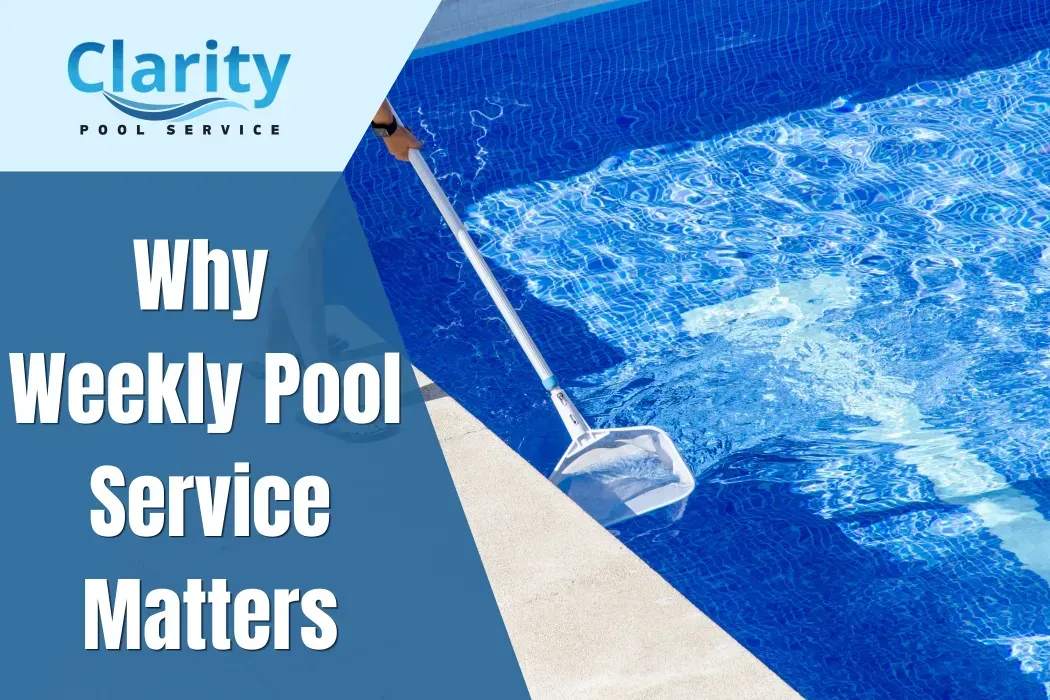
Why Weekly Pool Service Matters
A Complete Homeowner's Guide to Consistent Pool Maintenance in East County San Diego
A swimming pool can look perfectly clean today and begin developing problems only a few days later.
That's because pools are constantly changing.
Sunlight consumes sanitizer.
Water evaporates.
Leaves and pollen enter the pool.
Swimmers introduce sunscreen, body oils, and other contaminants.
Water chemistry shifts.
Filters collect debris.
Equipment continues operating.
For homeowners, this creates an important distinction:
A clean-looking pool isn't necessarily a properly maintained pool.
Weekly pool service is designed to manage these small, continuous changes before they become visible problems.
Instead of waiting for algae, cloudy water, poor circulation, or equipment failure, consistent maintenance focuses on prevention.
That usually means testing and balancing the water, removing debris, brushing surfaces, monitoring filtration, checking circulation, and inspecting equipment every week.
Whether you own a swimming pool in Santee, El Cajon, Lakeside, Rancho San Diego, Fletcher Hills, Mt. Helix, Spring Valley, Lemon Grove, San Carlos, Allied Gardens, Del Cerro, Casa de Oro, or elsewhere in East County San Diego, consistent maintenance can make the difference between a pool that's predictable to own and one that constantly requires corrective work.
In this guide you'll learn:
Why weekly pool maintenance is recommended
What changes inside a pool between service visits
How consistent maintenance helps prevent algae
Why water chemistry needs regular attention
How weekly inspections can protect pool equipment
Why year-round maintenance matters
What can happen when maintenance becomes inconsistent
How preventative maintenance can reduce long-term ownership costs
By the end, you'll understand why weekly pool service isn't simply about keeping the water looking clean.
It's about keeping the entire swimming pool system stable.
Quick Answer
Weekly pool service matters because pool conditions change continuously.
Between visits, your swimming pool is affected by:
Sunlight
Temperature
Evaporation
Swimmer use
Organic debris
Water chemistry changes
Filter loading
Equipment operation
Regular weekly maintenance allows small changes to be corrected before they develop into larger problems.
A comprehensive weekly maintenance routine typically helps:
Maintain balanced water chemistry
Prevent algae
Remove debris
Support healthy circulation
Maintain filtration
Identify equipment problems early
Protect pool surfaces
Reduce unexpected corrective maintenance
The real value of weekly service isn't simply what happens during one visit.
It's the consistency created across 52 weeks of pool ownership.
At a Glance
Key Takeaways
✔ Swimming pools change every day, even when nobody is swimming.
✔ Weekly maintenance is preventative rather than reactive.
✔ Clear water doesn't always mean properly balanced water.
✔ Small chemistry adjustments are generally easier than major corrections.
✔ Routine brushing and debris removal help reduce algae risk.
✔ Weekly equipment inspections can identify small problems before complete failure.
✔ Maintaining the pool year-round is usually easier than repeatedly recovering it after periods of neglect.
✔ The biggest benefit of weekly service is consistency.
What Happens to Your Pool Between Weekly Visits?
A swimming pool never really sits still.
Even when nobody uses it, several processes continue happening.
Understanding those changes explains why regular maintenance is important.
Chlorine Is Continuously Being Used
Chlorine doesn't remain at the same level indefinitely.
Every day, sanitizer is consumed as it responds to:
Sunlight
Organic debris
Swimmers
Bacteria
Environmental contamination
During East County's warmer months, strong sunlight and higher water temperatures can increase sanitizer demand.
Without routine testing, chlorine can gradually fall below effective levels.
Once sanitation becomes inadequate, algae and other water-quality problems become more likely.
pH and Water Chemistry Continue Changing
Water chemistry isn't something you balance once and forget.
pH, alkalinity, sanitizer, calcium, and other measurements interact and change over time.
Factors influencing chemistry include:
Evaporation
Makeup water
Rain
Aeration
Chemical additions
Swimmer activity
A pool may still look clear while these measurements are moving away from desirable conditions.
Weekly testing allows smaller adjustments before the imbalance becomes significant.
Debris Continues Entering the Pool
Leaves don't wait for service day.
Neither does:
Pollen
Dust
Insects
Grass
Blossoms
Fine dirt
Organic debris eventually breaks down in the water.
As it decomposes, it can increase sanitizer demand and place additional workload on the filtration system.
Removing debris consistently helps prevent those contaminants from creating larger water-quality problems.
Filters Continue Collecting Contaminants
Every hour the circulation system operates, the filter is capturing material from the water.
Over time, this increases resistance through the filtration system.
If the filter becomes excessively restricted, homeowners may notice:
Reduced circulation
Higher filter pressure
Weaker return flow
Poorer skimming
Declining water clarity
Weekly monitoring helps identify changing filter conditions before circulation becomes significantly affected.
Equipment Continues Operating
Pumps, filters, heaters, salt systems, valves, and automation equipment continue working whether you're actively thinking about them or not.
Small equipment changes may develop gradually.
Examples include:
Minor leaks
Changing filter pressure
Air entering the circulation system
New pump noises
Salt system warnings
Heater errors
Automation problems
Weekly inspection provides repeated opportunities to identify those changes before complete equipment failure occurs.
Why Consistency Matters More Than an Occasional Deep Cleaning
Imagine two pools.
Pool A
Receives consistent weekly maintenance.
Small chemistry adjustments are made when necessary.
Debris is removed regularly.
Equipment is inspected.
Filter conditions are monitored.
Pool B
Receives attention only when something looks wrong.
The homeowner waits until:
Water becomes cloudy
Algae appears
Baskets overflow
Circulation declines
Equipment stops working
Pool B may receive more intensive cleaning when problems occur, but that doesn't necessarily mean it's being maintained better.
Pool maintenance works best when problems are prevented rather than repeatedly corrected.
Consistency usually beats intensity.
Why Weekly Service Helps Prevent Green Pool Water
Green pool water rarely appears without warning.
Conditions usually develop gradually.
Sanitizer declines.
Water chemistry drifts.
Debris accumulates.
Circulation may become less effective.
Then algae gains an opportunity to establish itself.
Weekly service interrupts that progression.
By testing water, maintaining sanitizer, brushing surfaces, removing debris, and monitoring circulation, maintenance addresses several of the conditions algae needs to grow.
This doesn't mean a professionally maintained pool can never experience algae.
Extreme weather, equipment failures, unusual swimmer loads, or other conditions can still create problems.
But consistent maintenance substantially improves the opportunity to identify those conditions early.
Why Weekly Service Protects More Than the Water
One of the biggest misconceptions about professional pool service is that homeowners are paying someone to clean water.
Water quality is only part of the job.
A comprehensive maintenance visit also helps protect:
Pool finish
Tile
Pumps
Filters
Heaters
Salt chlorine generators
Plumbing
Valves
Automation systems
Balanced water chemistry reduces unnecessary scale and corrosion.
Healthy circulation supports equipment operation.
Clean filters reduce restrictions.
Routine inspections help identify leaks and mechanical changes.
That's why weekly maintenance should be viewed as whole-pool preventative care rather than simply cleaning.
What We Commonly See in East County Pools
East County's climate makes consistency particularly valuable.
During summer, prolonged heat and strong sunlight can increase chlorine demand and evaporation.
Spring brings pollen and blossoms.
Fall introduces leaves and organic debris.
Santa Ana winds can transform a clean pool within hours by introducing:
Dust
Leaves
Fine dirt
Small branches
Organic material
A weekly maintenance schedule creates a regular opportunity to respond to these changing conditions.
And during unusual weather events, homeowners can provide additional basic attention between visits when necessary.
The maintenance schedule remains consistent.
The work adapts to what the pool actually needs.
Weekly Service Is a Maintenance Rhythm — Not Just an Appointment
This is an important way to think about professional pool care.
Weekly service isn't valuable simply because someone arrives every seven days.
Its value comes from creating a consistent maintenance rhythm.
Every week:
Test.
Adjust.
Clean.
Inspect.
Observe.
Over months and years, that rhythm creates something valuable:
a history of how the pool normally behaves.
A technician familiar with the same pool can begin recognizing changes more easily.
Filter pressure looks different.
The pump sounds different.
Chlorine demand suddenly increases.
A particular area begins developing algae.
That familiarity can make preventative maintenance much more effective than isolated service visits.
The Preventative Value of Weekly Pool Service
The biggest benefits of weekly pool service are often the problems that never happen.
A homeowner notices clear water and functioning equipment, but doesn't necessarily see the small corrections happening behind the scenes.
A technician adjusts water chemistry before algae develops.
A full basket is emptied before circulation becomes restricted.
Rising filter pressure is noticed before water flow significantly declines.
A small equipment leak is identified before it becomes a larger repair.
This is the difference between preventative maintenance and reactive maintenance.
Reactive maintenance waits for symptoms.
Preventative maintenance looks for the conditions that create those symptoms.
1. Weekly Water Testing Catches Small Changes Early
Pool water chemistry changes continuously.
Weekly testing creates regular checkpoints that allow small changes to be identified before they become larger problems.
Professional testing commonly monitors:
Free chlorine
pH
Total alkalinity
Calcium hardness
Cyanuric acid
Salt concentration when applicable
Not every measurement requires adjustment every week.
That's important.
Professional water care isn't about adding chemicals during every visit simply because chemicals are available.
It's about testing first and adding only what the water actually needs.
2. Consistent Sanitizer Helps Prevent Algae
Algae prevention is much easier than algae recovery.
Once algae becomes established, restoring the pool may require:
Additional chemicals
Extensive brushing
Longer filtration
Vacuuming
Filter cleaning
Multiple days of treatment
Weekly maintenance focuses on preventing the conditions that allow algae to gain a foothold.
That includes maintaining appropriate sanitation, balanced chemistry, healthy circulation, clean surfaces, and effective filtration.
A properly maintained pool doesn't need to repeatedly recover from algae.
The goal is to prevent the outbreak in the first place.
3. Weekly Brushing Helps Control Problems Before They're Visible
Homeowners sometimes question why a pool that already looks clean needs brushing.
The answer is that not everything developing on pool surfaces is immediately visible.
Routine brushing helps disturb:
Early algae growth
Biofilm
Fine dirt
Organic buildup
Developing deposits
Certain areas deserve particular attention because they may receive less circulation.
These include:
Steps
Corners
Benches
Tanning ledges
Behind ladders
Around water features
Brushing helps expose contaminants to sanitized circulating water and moves loosened material toward the filtration system.
4. Debris Removal Reduces the Workload on the Entire Pool
Leaves and insects are obvious.
Pollen, fine dust, sunscreen residue, and other contaminants are less noticeable.
All of them add workload to the pool.
Organic debris can consume sanitizer as it breaks down.
Fine particles increase filtration demand.
Large debris can fill baskets and reduce circulation.
Weekly cleaning helps remove contaminants before they create additional problems elsewhere in the system.
This is a recurring principle in pool maintenance:
Small maintenance tasks protect larger systems.
5. Basket Cleaning Protects Circulation
Skimmer and pump baskets may seem like minor components.
They aren't.
They help protect the circulation system from larger debris.
As baskets fill, water flow can become restricted.
That can affect:
Surface skimming
Pump performance
Filtration
Sanitizer distribution
Overall circulation
During normal conditions, weekly attention may be sufficient.
During periods of heavy leaves or Santa Ana winds, homeowners may need to empty baskets between professional visits.
Professional weekly service doesn't eliminate homeowner awareness.
It gives the pool a consistent maintenance foundation.
6. Filter Monitoring Helps Maintain Healthy Water Flow
Filters continuously collect contaminants whenever the circulation system operates.
Over time, filter conditions change.
Weekly maintenance provides an opportunity to monitor:
Filter pressure
Return flow
Water clarity
Overall circulation
The filter doesn't necessarily need cleaning every week.
In fact, filter maintenance should generally be based on actual condition, filter type, operating pressure, and manufacturer guidance rather than an arbitrary calendar.
The weekly inspection simply helps identify when that maintenance is becoming necessary.
7. Equipment Inspections Can Catch Problems Before Failure
Pool equipment often provides warning signs before it stops working completely.
During weekly service, a technician may notice:
Small leaks
New pump noises
Excessive vibration
Air inside the pump basket
Changing filter pressure
Salt system warnings
Heater errors
Automation problems
Reduced circulation
None of these automatically means expensive equipment needs replacement.
Often, the value comes from recognizing that something has changed.
Early diagnosis usually provides more options than waiting for complete failure.
Weekly Service vs. Reactive Pool Care
The difference becomes clearer when the two approaches are compared directly.
The question is whether repeatedly allowing problems to develop is the most efficient way to own one.
For most homeowners, prevention creates a much more predictable experience.
Why Weekly Service Helps Protect Pool Surfaces
Water chemistry doesn't only affect water clarity.
It also interacts with the materials surrounding the water.
Improperly balanced water may contribute over time to:
Scale
Surface deterioration
Staining conditions
Tile buildup
Corrosion of certain components
Weekly testing and chemical balancing help maintain water conditions that are more appropriate for both swimmers and the physical pool.
This is one reason a pool can look clean while still requiring attention.
Appearance alone doesn't reveal the complete chemical condition of the water.
Why Weekly Service Helps Protect Pool Equipment
Pumps, filters, heaters, salt systems, valves, and plumbing all operate in the same water you're maintaining.
Poor chemistry can contribute to scale or corrosion.
Restricted filters can reduce circulation.
Full baskets can affect water flow.
Reduced flow can interfere with heaters and salt systems.
This is why professional maintenance should never be viewed as separate tasks performed independently.
The pool operates as one system.
Weekly service helps maintain the conditions that allow those systems to work together properly.
Why Consistent Service Creates Better Diagnostic Information
One overlooked benefit of regular maintenance is history.
Suppose a technician services the same pool every week.
Over time, they become familiar with:
Normal filter pressure
Typical chlorine demand
Normal pump sound
Usual return flow
Seasonal debris patterns
Equipment behavior
Areas prone to algae
How quickly baskets fill
Then something changes.
Filter pressure increases faster than usual.
The pump begins sounding different.
Chlorine demand suddenly rises.
A small leak appears.
That change is easier to recognize because there is a baseline.
This is one reason consistent service can provide more value than a series of unrelated one-time cleanings.
Does Weekly Pool Service Mean Exactly Every Seven Days?
Weekly service generally means the pool receives consistent maintenance on a recurring weekly schedule.
The purpose is to prevent long gaps between evaluations.
Weather, holidays, route schedules, or unusual conditions may occasionally affect timing.
What's important is maintaining a predictable rhythm that prevents the pool from going extended periods without:
Water testing
Cleaning
Equipment observation
Circulation checks
The maintenance principle is consistency—not watching a stopwatch between visits.
What Happens If You Skip One Week?
Missing one maintenance visit doesn't automatically turn a healthy pool green.
Pools don't operate on an exact seven-day failure clock.
However, the risk depends on conditions.
A skipped visit during mild weather may have little immediate impact.
A skipped visit during:
Extreme summer heat
Heavy swimmer use
Strong winds
Falling leaves
Existing chemistry problems
Equipment issues
can create a very different situation.
The concern isn't one isolated missed visit.
It's allowing inconsistent maintenance to become the normal pattern.
What Happens When Several Weeks Are Missed?
The longer a pool goes without proper maintenance, the greater the opportunity for several small issues to develop simultaneously.
For example:
Sanitizer declines.
Debris accumulates.
Baskets begin filling.
Filter loading increases.
Circulation becomes less effective.
Algae begins developing.
Water clarity declines.
At that point, the homeowner isn't simply catching up on routine maintenance.
They're correcting a pool that has moved into a different condition.
This is why preventative maintenance generally requires less effort than recovery.
Does a Pool Need Weekly Service During Winter?
For most East County pools, maintenance should continue throughout the year.
The work may change, but the need for oversight remains.
During winter:
Water chemistry continues changing.
Equipment continues operating.
Filters continue collecting contaminants.
Rain can alter water conditions.
Storms introduce debris.
Swimming frequency isn't what determines whether a pool needs maintenance.
The pool system continues operating regardless of whether anyone is swimming.
Does a Pool Need More Attention During Summer?
Often, yes.
Summer can create some of the most demanding conditions of the year.
Higher temperatures and stronger sunlight may increase sanitizer demand.
More swimming introduces:
Sunscreen
Body oils
Organic contaminants
Additional debris
Evaporation also increases.
Weekly maintenance remains the foundation, but the amount of adjustment required during each visit may change significantly compared with cooler months.
What We Commonly See After Heavy Pool Use
A large pool party can change water conditions quickly.
The water may still look clear immediately afterward, but swimmer load introduces contaminants that sanitizer and filtration must process.
After unusually heavy use, the pool may benefit from:
Additional water testing
Chemistry adjustment
Debris removal
Basket inspection
Circulation monitoring
This doesn't mean every pool party requires an emergency service call.
It means homeowners should understand that maintenance needs respond to conditions, not simply the calendar.
What We Commonly See After Strong Winds
Strong East County winds can dramatically increase the amount of debris entering a pool.
After a significant wind event, homeowners may find:
Leaves covering the surface
Full skimmer baskets
Dirt on the floor
Fine dust suspended in the water
Increased filter loading
Waiting several days with packed baskets or heavy debris can affect circulation and water quality.
This is one situation where simple homeowner maintenance between weekly visits can make a meaningful difference.
Professional Weekly Service Doesn't Mean Ignoring Your Pool for Six Days
Hiring a professional doesn't mean homeowners should never look at the pool between visits.
You don't need to perform a second full maintenance service.
But basic awareness is valuable.
If you notice:
A large amount of storm debris
Rapid water loss
A significant equipment leak
Pump shutdown
Green or cloudy water
Unusual equipment noise
don't wait simply because service day is approaching.
Weekly professional service provides consistent preventative maintenance.
Homeowner observation provides another layer of protection between visits.
The Real Value Is Stability
The biggest benefit of weekly pool service isn't a perfectly clean pool for one afternoon.
It's maintaining stability over time.
Stable chemistry.
Stable circulation.
Stable filtration.
Stable equipment operation.
A predictable maintenance rhythm.
That stability reduces the number of times homeowners have to recover from preventable problems.
And over years of pool ownership, that can be far more valuable than simply judging service by how many leaves were removed during one visit.
DIY Pool Maintenance vs. Professional Weekly Service
Many homeowners are perfectly capable of maintaining their own swimming pools.
Professional weekly service isn't the only way to keep a pool healthy.
The real requirement is consistent, competent maintenance.
If you're willing to test the water, understand chemistry, clean the pool, monitor filtration, inspect equipment, and respond when conditions change, DIY maintenance can work very well.
The challenge is consistency.
Pool maintenance doesn't stop when you're busy, traveling, working long hours, or simply don't feel like dealing with the pool that weekend.
That's one of the biggest differences between maintaining a pool yourself and hiring professional weekly service.
Comparing DIY and Professional Weekly Pool Maintenance
The better approach is whichever one results in the pool receiving the maintenance it actually needs every week.
When DIY Pool Maintenance Makes Sense
Maintaining your own pool may be a good fit if you:
Enjoy learning how the pool works
Have time for consistent maintenance
Are comfortable testing water
Understand basic water chemistry
Know how to monitor filtration and circulation
Are willing to inspect equipment
Can recognize when professional help is necessary
Some homeowners genuinely enjoy maintaining their pools.
They learn how their water behaves throughout the seasons and become very familiar with their equipment.
For those homeowners, DIY maintenance can be both practical and rewarding.
When Professional Weekly Service Makes Sense
Professional service may be a better fit if you:
Have limited time
Travel frequently
Prefer predictable maintenance
Don't want to store and manage pool chemicals
Aren't comfortable balancing water chemistry
Want routine equipment inspections
Prefer professional monitoring of circulation and filtration
Simply want to enjoy the pool rather than maintain it
Convenience is a legitimate part of the value.
Owning a swimming pool doesn't require enjoying pool maintenance.
The Hidden Cost of Inconsistent DIY Maintenance
DIY pool care can save the cost of professional weekly service.
But the comparison changes if maintenance becomes inconsistent.
Suppose a homeowner skips several weeks because of work or vacation.
During that time:
Chlorine declines.
Debris accumulates.
Baskets fill.
Filter loading increases.
Algae begins developing.
The homeowner may then spend additional money on:
Corrective chemicals
Green pool treatment
Filter cleaning
Additional equipment operation
Professional cleanup
That doesn't mean DIY maintenance is inherently more expensive.
It means the savings depend on actually performing the maintenance consistently.
Common Mistakes That Make Weekly Pool Care Less Effective
Whether a pool is maintained professionally or by the homeowner, certain habits can undermine otherwise good maintenance.
Focusing Only on Water Appearance
Clear water is encouraging.
But it doesn't confirm that the water is chemically balanced.
A pool can appear clean while:
Chlorine is declining
pH is drifting
Calcium conditions are becoming problematic
Stabilizer needs attention
Water testing should guide maintenance—not appearance alone.
Treating Weekly Service as Just Cleaning
Skimming and brushing are visible.
Water chemistry and equipment inspections are less obvious.
But a comprehensive maintenance program should consider:
Water + Cleaning + Filtration + Circulation + Equipment
together.
If the pool looks clean but the filter is restricted or the water chemistry is poorly balanced, the maintenance isn't complete.
Skipping Brushing Because the Pool Looks Clean
Brushing is preventative.
Waiting until algae is visible defeats much of its purpose.
Routine brushing helps disturb early growth and buildup before it becomes obvious.
Ignoring Filter Pressure
Filter conditions change gradually.
Monitoring pressure and circulation helps identify when maintenance may be needed.
Waiting until return flow becomes extremely weak means the system may have been operating under restricted conditions for some time.
Ignoring Small Equipment Changes
A minor leak.
A new noise.
A little more air in the pump basket.
A warning light that wasn't there last week.
These observations may not indicate major failure.
But they provide useful early information.
Preventative maintenance depends on noticing changes before they become emergencies.
What Weekly Pool Service Should Not Become
There's an important distinction between consistent service and simply completing the same checklist mechanically every week.
Pools change.
Maintenance should adapt.
One week may require more debris removal.
Another may require more chemistry attention.
After heavy winds, baskets and filters may need additional attention.
During extreme heat, sanitizer demand may increase.
A quality maintenance program shouldn't treat every visit as though pool conditions are identical.
The schedule is consistent.
The maintenance responds to the pool.
Why Faster Service Isn't Automatically Better—or Worse
Homeowners sometimes judge pool service by how long the technician remains at the property.
Time alone isn't a reliable measure of quality.
A clean, well-maintained pool with stable chemistry may require less attention during one visit than a pool recovering from heavy winds or unusual swimmer use.
Likewise, a technician spending a long time at the property doesn't automatically mean better maintenance is being performed.
The better questions are:
Was the water properly evaluated?
Was necessary cleaning completed?
Were baskets checked?
Was filtration monitored?
Was the equipment inspected?
Were developing problems identified?
Quality should be judged by the work the pool needed—not simply minutes on site.
Why the Same Technician Can Be Valuable
When possible, consistency in the person servicing the pool can provide an additional advantage.
A technician who regularly sees the same swimming pool becomes familiar with:
Normal equipment sounds
Typical filter pressure
Seasonal chemistry patterns
Areas prone to debris
Areas prone to algae
Normal pump operation
Previous equipment concerns
That familiarity creates context.
A technician seeing the pool for the first time may notice a filter pressure reading.
A technician who has serviced the pool for months may notice that the reading is different from normal.
That difference can be valuable.
Digital Service Reports and Maintenance History
Many professional pool companies provide service documentation after visits.
Depending on the company, reports may include:
Service date
Water chemistry readings
Chemicals added
Maintenance performed
Equipment observations
Photos
Repair recommendations
Digital reports provide homeowners with transparency, but they also create something valuable over time:
a maintenance history.
That history can help identify recurring chemistry patterns, equipment problems, or changes in pool conditions.
Questions to Ask a Weekly Pool Service Company
Before hiring a professional maintenance company, ask exactly what the service includes.
Useful questions include:
What maintenance is performed during a typical weekly visit?
Are routine balancing chemicals included?
How is filter condition monitored?
Are equipment inspections part of weekly service?
How are equipment problems communicated?
Will I receive service reports?
How are filter cleanings handled?
What services cost extra?
What happens after major storms or unusual pool conditions?
Will the same technician generally service my pool?
The answers help you compare actual service rather than simply comparing monthly prices.
Weekly Pool Service vs. Occasional Pool Cleaning
These are not the same service.
Occasional cleaning may be useful when:
Preparing a pool for an event
Recovering from unusual debris
Addressing a temporary maintenance issue
Weekly maintenance has a different purpose.
It creates continuity.
But occasional cleaning isn't a substitute for consistent maintenance when the goal is long-term pool health.
Why Preventative Maintenance Can Reduce Long-Term Ownership Costs
Weekly pool service has an obvious monthly cost.
The financial benefits of preventative maintenance are less obvious because many involve avoiding future expenses.
Consistent maintenance may help reduce the likelihood of:
Green pool cleanup
Severe algae treatment
Scale-related problems
Corrosion
Premature equipment wear
Major chemistry corrections
Emergency service
It cannot eliminate every repair.
Pumps eventually wear out.
Salt cells eventually need replacement.
Heaters eventually develop problems.
But good maintenance can help homeowners avoid creating unnecessary problems on top of normal equipment aging.
The Difference Between Maintenance and Repair
Weekly service is preventative.
Repair is corrective.
Understanding that distinction helps homeowners maintain realistic expectations.
Weekly service may identify:
A leaking pump
Heater error
Aging equipment
Salt system problem
But identifying a problem doesn't necessarily mean repairing it is included with weekly maintenance.
Likewise, routine maintenance doesn't guarantee equipment will never fail.
Its value comes from maintaining proper operating conditions and providing opportunities to identify problems earlier.
Why Year-Round Maintenance Matters in East County
East County pools don't experience a true shutdown season like pools in colder climates.
Even during winter:
Water chemistry changes.
Pumps operate.
Filters collect contaminants.
Storms introduce debris.
Equipment ages.
Summer may require more chemistry attention.
Fall may require more debris removal.
Winter may involve storm cleanup.
Spring may bring pollen.
The work changes.
The need for consistent maintenance remains.
A Better Way to Think About the Cost of Weekly Service
Instead of viewing professional maintenance only as:
"What does someone charge to clean my pool?"
consider what the service is actually managing:
Water chemistry
Sanitation
Cleaning
Filtration
Circulation
Equipment observation
Preventative maintenance
Maintenance history
That doesn't mean every pool service company provides the same value.
They don't.
It means homeowners should evaluate the complete maintenance program rather than comparing price alone.
Continue Learning
Weekly maintenance connects nearly every major topic in the Pool Owner Learning Center.
Continue with these related guides:
Pool Service Cost in East County San Diego
What Does Weekly Pool Service Include?
Why Do Pools Turn Green?
Saltwater Pool Maintenance Guide
How Often Should a Pool Filter Be Cleaned?
Pool Water Chemistry Explained
Pool Equipment Owner's Guide
Pool Circulation Explained
Pool Equipment Repair vs. Replacement
New Pool Owner Guide
Complete Pool Owner Learning Center
Together, these guides explain how consistent maintenance protects the entire swimming pool system—not simply the appearance of the water.
Frequently Asked Questions About Weekly Pool Service
Weekly pool maintenance is easy to think of as simply keeping the water clean.
In reality, consistent service helps manage water chemistry, sanitation, filtration, circulation, debris, and equipment conditions throughout the year.
Below are answers to some of the most common questions homeowners have about why weekly maintenance matters.
Is weekly pool service really necessary?
For most residential swimming pools, weekly maintenance is a practical and effective schedule.
Pool conditions change continuously because of:
Sunlight
Temperature
Swimmer use
Organic debris
Evaporation
Weather
Chemical consumption
Equipment operation
Weekly maintenance creates regular opportunities to test the water, remove debris, monitor circulation and filtration, and identify developing problems.
The purpose isn't simply to make the pool look clean once a week.
It's to maintain stability over time.
Why does my pool need service if the water already looks clean?
Clear water is only one sign of pool condition.
A pool can look perfectly clear while:
Sanitizer is declining
pH is drifting
Filter pressure is increasing
Baskets are filling
Equipment is beginning to leak
Circulation is changing
Professional maintenance evaluates conditions that aren't always visible from the backyard.
That's why appearance alone isn't a reliable maintenance plan.
What should happen during weekly pool service?
A comprehensive weekly maintenance visit typically includes:
Water testing
Chemical balancing
Surface skimming
Brushing
Basket cleaning
Vacuuming as needed
Filter pressure monitoring
Circulation observation
Equipment inspection
Service documentation when provided
The exact work may change from week to week because the pool's condition changes.
Does every pool need exactly the same weekly maintenance?
No.
Pools differ based on:
Size
Water volume
Landscaping
Equipment
Attached spas
Water features
Swimmer use
Sun exposure
Seasonal conditions
A pool surrounded by mature trees may require significantly more debris removal than one with minimal landscaping.
A heavily used pool may require different chemistry adjustments than a pool receiving very little swimmer activity.
The maintenance schedule can remain consistent while the work adapts to the pool.
What happens if I skip one week of pool service?
Missing one visit doesn't automatically create a serious problem.
The impact depends on existing pool conditions, weather, swimmer use, equipment operation, and water chemistry.
A skipped week during mild conditions may have little immediate effect.
A skipped week during extreme summer heat, heavy swimmer use, or significant wind and debris can create more risk.
The larger concern is allowing missed maintenance to become a recurring pattern.
Can I have my pool serviced every other week instead?
Some homeowners successfully use less frequent professional service while performing maintenance themselves between visits.
However, water chemistry, debris, filtration, and equipment conditions continue changing during the time between professional visits.
If professional visits occur every other week, the homeowner may still need to:
Test water
Maintain sanitizer
Remove debris
Empty baskets
Monitor circulation
Observe equipment
For homeowners who want professional service to handle most routine maintenance, weekly service generally provides better continuity.
Does my pool need weekly maintenance during winter?
For most East County San Diego pools, maintenance should continue year-round.
Winter doesn't stop:
Water chemistry changes
Filtration
Equipment operation
Storm debris
Organic contamination
The amount and type of maintenance may change, but the pool still requires attention.
Does my pool need more maintenance during summer?
Summer often creates greater maintenance demands.
Higher temperatures and stronger sunlight may increase chlorine demand.
More swimmers introduce:
Sunscreen
Body oils
Organic contaminants
Evaporation also increases.
The weekly schedule may remain the same, but the amount of chemical adjustment and maintenance required during each visit may increase.
Does weekly service prevent algae?
Consistent maintenance can significantly reduce the conditions that allow algae to grow.
Weekly service helps maintain:
Sanitizer
Water balance
Circulation
Filtration
Clean surfaces
Debris control
However, no maintenance program can guarantee algae will never occur.
Equipment failures, unusual weather, extreme swimmer loads, or other conditions can still create water-quality problems.
The advantage of consistent maintenance is identifying and correcting those conditions earlier.
Why is brushing necessary every week?
Brushing helps disturb contaminants and early growth that may not yet be visible.
It is particularly useful in areas with limited circulation, including:
Steps
Corners
Benches
Tanning ledges
Behind ladders
Waiting until algae is clearly visible means brushing has shifted from preventative maintenance to corrective treatment.
Does weekly pool service include filter cleaning?
Not necessarily.
The filter should be monitored regularly, but filter cleaning is often a separate maintenance service because it requires additional time and depends on the filter's actual condition.
Cleaning frequency varies based on:
Filter type
Pool use
Landscaping
Seasonal debris
Filter pressure
Manufacturer recommendations
Always ask your pool service company how filter cleaning is handled.
Are pool chemicals included with weekly service?
That depends on the maintenance company and service plan.
Some companies include routine balancing chemicals.
Others charge separately for some or all chemical products.
Homeowners should ask specifically:
Which chemicals are included?
Which chemicals cost extra?
Are specialty treatments separate?
This makes price comparisons much more meaningful.
Should equipment be inspected during every weekly visit?
A basic visual equipment inspection should be part of comprehensive pool maintenance.
Technicians can observe:
Pump operation
Filter pressure
Visible leaks
Equipment sounds
Salt system status
Heater or automation warnings
General circulation
Weekly service isn't a complete mechanical inspection or repair appointment.
Its value comes from repeatedly observing the equipment and recognizing when something changes.
Can weekly pool service help equipment last longer?
Consistent maintenance can help protect equipment by maintaining healthier operating conditions.
Examples include:
Balanced water reducing scale and corrosion risk
Clean baskets supporting circulation
Proper filter maintenance reducing restrictions
Early leak detection preventing additional damage
Routine inspections identifying developing problems
Pool equipment still wears out eventually.
Preventative maintenance simply helps reduce avoidable stress and neglect.
How long should a weekly pool service visit take?
There isn't one correct amount of time.
Visit length depends on:
Pool size
Debris
Water condition
Equipment
Weather
Seasonal conditions
Maintenance required that week
A well-maintained pool during calm weather may require less time than the same pool after a major wind event.
Quality should be evaluated based on whether the necessary maintenance was completed—not simply the number of minutes spent at the property.
Is a longer pool service visit always better?
No.
Time alone doesn't measure quality.
A technician could spend a long time at a property and still overlook water chemistry or equipment conditions.
Another technician familiar with a well-maintained pool may complete the necessary work efficiently.
The better measure is whether the pool received appropriate:
Testing
Balancing
Cleaning
Filtration monitoring
Circulation checks
Equipment observation
Should I still check my pool between professional visits?
Yes.
Professional weekly service provides a maintenance foundation, but homeowners should still notice obvious changes.
Check the pool after:
Strong winds
Heavy rain
Large pool parties
Extreme heat
And don't wait for the next service visit if you notice:
Green or cloudy water
Major equipment leak
Pump shutdown
Rapid water loss
Significant circulation loss
Unusual equipment noise
Basic homeowner awareness complements professional maintenance.
Is weekly pool service worth the cost?
For many homeowners, the value comes from a combination of:
Convenience
Consistent water chemistry
Regular cleaning
Equipment monitoring
Preventative maintenance
Reduced homeowner workload
It may also help reduce the likelihood of avoidable corrective services such as green pool cleanup or severe chemistry recovery.
Whether professional service is worthwhile ultimately depends on how much maintenance you want to perform yourself and the level of service the company provides.
How do I compare weekly pool service companies?
Don't compare monthly price alone.
Compare:
What's included
Chemical policy
Filter cleaning policy
Equipment inspections
Communication
Service reports
Technician consistency
Additional charges
Repair recommendations
Two companies can both advertise "weekly pool service" while providing substantially different levels of maintenance.
Final Thoughts
Weekly pool service isn't really about one weekly cleaning.
It's about what happens over time.
Every week, the swimming pool changes.
Sanitizer is consumed.
Water chemistry shifts.
Debris enters the water.
Filters collect contaminants.
Equipment continues operating.
Most of these changes are small.
That's exactly why consistent maintenance works.
A small chemistry adjustment today may prevent algae next week.
An emptied basket may prevent restricted circulation.
A filter-pressure change may indicate upcoming maintenance.
A small leak may be discovered before it damages equipment.
A new pump noise may be noticed before complete failure.
None of these actions seems dramatic.
Together, they create stability.
And stability is one of the most valuable things a homeowner can have in a swimming pool.
The goal isn't constantly fixing problems.
The goal is creating conditions where fewer problems develop in the first place.
That's why weekly maintenance should be viewed as:
Test.
Adjust.
Clean.
Inspect.
Prevent.
Repeated consistently throughout the year.
Continue Exploring the Pool Owner Learning Center
Continue building your understanding of professional pool maintenance with these related homeowner guides:
Pool Service Cost in East County San Diego
What Does Weekly Pool Service Include?
Why Do Pools Turn Green?
Saltwater Pool Maintenance Guide
How Often Should a Pool Filter Be Cleaned?
Pool Water Chemistry Explained
Pool Equipment Owner's Guide
Pool Circulation Explained
Pool Equipment Repair vs. Replacement
New Pool Owner Guide
Complete Pool Owner Learning Center
Together, these guides explain how weekly maintenance connects water chemistry, sanitation, circulation, filtration, cleaning, and equipment into one complete preventative maintenance system.
Keep Your Pool Consistent Week After Week
Most homeowners don't want to spend their free time recovering green water, troubleshooting circulation problems, or wondering whether their equipment is operating correctly.
They want their pool to be ready when they want to use it.
Consistent weekly maintenance helps create that predictability.
At Clarity Pool Service, we believe professional pool care should involve more than making the water look clean on service day.
It should help maintain balanced water, healthy circulation, effective filtration, clean surfaces, and awareness of developing equipment problems throughout the year.
For homeowners throughout East County San Diego, the value of weekly service isn't simply what gets cleaned today.
It's the problems consistent maintenance may help prevent tomorrow.