
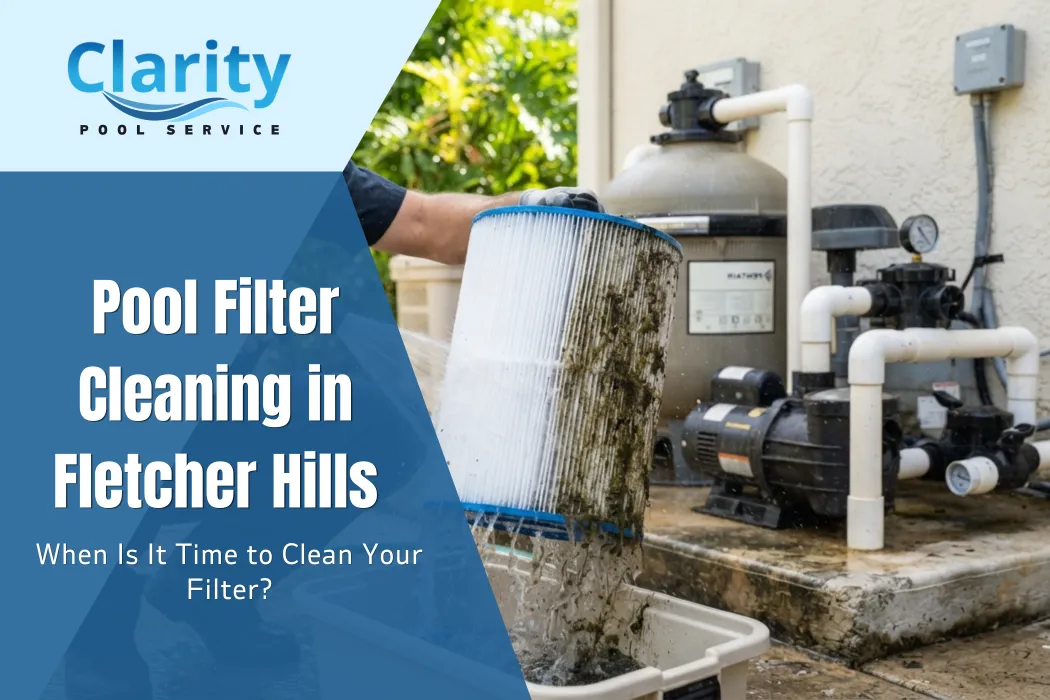
Pool Filter Cleaning in Fletcher Hills: When Is It Time to Clean Your Filter?
A Homeowner's Guide to Filter Pressure, Cleaning Frequency, and Professional Pool Filter Maintenance in Fletcher Hills, CA
Your pool filter works every day, but most homeowners don't think about it until something changes.
Maybe the return jets aren't pushing water as strongly.
The water starts looking slightly cloudy.
Or the pressure gauge is reading higher than usual.
For homeowners in Fletcher Hills, mature landscaping, seasonal winds, and varying pool equipment can influence how quickly filters collect debris.
But here's something important:
A pool filter doesn't need cleaning simply because another month has passed.
The correct cleaning schedule depends on the filter type, its normal operating pressure, water conditions, and manufacturer recommendations.
Understanding those factors can help homeowners avoid unnecessary maintenance while recognizing when their filter genuinely needs attention.
Quick Answer: How Often Should You Clean a Pool Filter?
Pool filters should be monitored regularly and cleaned according to their operating condition and manufacturer guidance.
Many manufacturers recommend cleaning when filter pressure rises approximately 8–10 PSI above the clean operating pressure, although the correct threshold varies by equipment.
For example, if your filter normally operates at 12 PSI after cleaning, a reading of 20–22 PSI at the same pump speed may indicate that cleaning is appropriate.
However, pressure isn't the only factor.
Reduced return flow, persistent cloudiness, or unusually heavy debris may also justify inspecting the filtration system.
The best cleaning schedule is based on your filter's condition—not a universal calendar interval.
Pool Filter Cleaning at a Glance
Filter type | Typical maintenance | Important consideration |
Cartridge | Remove and rinse elements | Inspect pleats and cartridge condition |
DE | Backwash or clean grids as appropriate | Correct DE recharge and grid condition |
Sand | Backwash according to pressure and manufacturer guidance | Inspect media and internal components when necessary |
All three filters can maintain excellent pool water when properly sized and maintained.
Their servicing methods are different.
1. Why Fletcher Hills Pools Can Load Filters Faster
Fletcher Hills includes residential properties with different landscaping, terrain, and pool environments.
Some pools are surrounded by mature trees and flowering plants.
Others have more open backyards exposed to dust and wind.
Leaves, blossoms, pollen, and fine dirt can increase the amount of material entering the filtration system.
During Santa Ana wind events, debris accumulation may increase substantially within hours.
A heavily landscaped pool may therefore require more frequent filter attention than a relatively sheltered pool.
But landscaping alone doesn't determine the cleaning interval.
The filter's size, type, operating pressure, and actual debris loading still matter.
2. What Your Filter Pressure Gauge Is Telling You
The pressure gauge is one of the most useful tools for monitoring filter condition.
When the filter is clean, record its normal pressure with the pump running at a consistent speed.
That becomes your baseline.
As contaminants accumulate, resistance through the filter may increase.
A significant pressure rise can indicate that cleaning is necessary.
However, pressure readings must be interpreted correctly.
A variable-speed pump operating at a higher RPM may produce a different pressure reading even when the filter hasn't become dirtier.
Always compare readings under similar operating conditions.
And remember:
High pressure may indicate filter loading. Low pressure may indicate reduced water flow.
Neither reading identifies every possible problem by itself.
3. Cartridge Filter Cleaning
Cartridge filters are common in residential swimming pools.
They use pleated filter elements to capture suspended particles.
When cleaning is necessary, the technician typically:
Shuts down the pump.
Safely releases filter pressure.
Opens the filter according to manufacturer instructions.
Removes the cartridges.
Rinses accumulated debris from the pleats.
Inspects the cartridges and accessible components.
Reassembles the filter and restores normal operation.
Cartridges should also be evaluated for damage, deterioration, or loss of filtration performance.
A cartridge that is torn, damaged, or no longer functioning properly may require replacement rather than another cleaning.
4. DE Filter Cleaning
Diatomaceous earth filters use a fine powder coating on internal grids or elements to capture small particles.
Depending on the model, maintenance may include backwashing, disassembly, grid cleaning, and recharging with the correct amount of DE.
The amount of DE required depends on the filter's specifications and whether the service involved backwashing or complete cleaning.
Adding too little or too much DE can affect performance.
Damaged grids or internal components may also allow DE powder to return to the swimming pool.
Because DE filters involve internal components and specific reassembly requirements, proper servicing is important.
5. Sand Filter Maintenance
Sand filters capture contaminants as water passes through specialized filter media.
Many sand filters are maintained through backwashing.
Backwashing reverses water flow through the filter to remove accumulated debris.
The procedure should follow the manufacturer's instructions for the installed equipment.
Sand filters don't normally require opening and washing individual elements like cartridge or DE systems.
However, media and internal components can eventually require attention if filtration performance deteriorates.
The correct response depends on the actual condition—not simply the age of the sand.
6. Why a Dirty Filter Can Affect Circulation
Your pool pump moves water through the filtration system.
As a filter becomes increasingly restricted, water flow may decline.
That can affect:
Surface skimming
Return flow
Filtration
Salt chlorine generation
Heater operation
Overall circulation
A heavily restricted filter can make an otherwise healthy pump appear to be underperforming.
That's why a technician should evaluate filtration before recommending expensive pump repairs based solely on weak flow.
A circulation problem isn't automatically a pump problem.
7. When Cloudy Water Isn't a Filter Problem
Cloudy water is often blamed on the filter.
Sometimes that's correct.
But cloudiness may also result from:
Inadequate sanitizer
Developing algae
Water chemistry imbalance
Fine suspended debris
Poor circulation
Heavy swimmer use
Cleaning the filter won't correct every water-quality problem.
Before recommending repeated filter service, evaluate the chemistry, sanitation, and circulation.
For a deeper explanation, see Why Is My Pool Water Cloudy?
8. Filter Cleaning After Santa Ana Winds
Strong winds can introduce significant debris into Fletcher Hills pools.
After a major wind event, start by removing large debris before relying entirely on the filter.
Check:
Surface leaves
Skimmer baskets
Pump basket
Pool floor
Return flow
Filter pressure
Fine dust may require additional vacuuming and filtration.
If filter pressure rises significantly during cleanup, service may be necessary sooner than normal.
However, don't automatically open the filter after every wind event.
Check actual operating conditions first.
9. How Much Does Pool Filter Cleaning Cost in Fletcher Hills?
Professional filter-cleaning prices vary according to the equipment and work required.
Factors may include:
Filter type
Filter size
Number of cartridges or grids
Accessibility
Degree of contamination
Condition of internal components
Additional repairs or replacement parts
A straightforward cartridge rinse may involve different labor and materials than a DE filter disassembly and cleaning.
When requesting an estimate, ask whether the quoted price includes:
Filter disassembly when applicable
Element cleaning
Inspection of accessible components
Reassembly
Required DE recharge when applicable
Operational check afterward
Also ask whether replacement cartridges, damaged grids, seals, or other repairs are billed separately.
A clear filter-cleaning quote should explain what work is included.
10. Is Filter Cleaning Included With Weekly Pool Service?
Not necessarily.
Weekly pool service should generally include monitoring filtration and circulation.
Actual filter cleaning is often billed separately because it requires additional time and labor.
Some companies include periodic filter service in their maintenance plans.
Others charge for each cleaning.
Before hiring a pool company, ask:
Is filter cleaning included in the monthly price?
If not, what does it cost?
How do you determine when cleaning is needed?
Understanding the policy helps homeowners compare the real annual cost of pool maintenance.
11. When Should a Filter Be Replaced Instead of Cleaned?
Not every filtration problem can be corrected through cleaning.
Cartridges may eventually become damaged or lose effectiveness.
DE grids can develop tears or other defects.
Sand filter components and media can deteriorate or require replacement.
Warning signs may include:
Damaged filter elements
Material returning to the pool
Persistent filtration problems
Components that cannot be cleaned effectively
Repeated problems after proper service
A technician should identify the failed component before recommending replacement.
In some cases, replacing a cartridge or grid is sufficient.
Replacing the entire filter isn't always necessary.
12. Why Professional Filter Cleaning Matters
Pool filters are pressurized vessels.
Improper opening or reassembly can create serious safety risks.
Professional service should include proper shutdown, depressurization, cleaning, inspection, and reassembly according to manufacturer instructions.
Afterward, the technician should confirm that the system is operating normally.
That may include checking:
Filter pressure
Return flow
Visible leaks
Proper equipment operation
The objective isn't simply making the filter look clean.
It's restoring reliable filtration and circulation.
A Simple Filter Maintenance Checklist
Homeowners can monitor filter performance without opening the equipment.
What to check | What to look for |
Filter pressure | Significant change from clean baseline |
Return jets | Reduced water flow |
Water clarity | Persistent cloudiness |
Equipment pad | Leaks around filter or plumbing |
Filter history | Date and pressure after last cleaning |
Debris conditions | Heavy leaves, dust, or contamination |
If several conditions change together, professional evaluation may be appropriate.
Frequently Asked Questions About Pool Filter Cleaning
How often should a pool filter be cleaned in Fletcher Hills?
There isn't one universal interval. Filter type, pressure, debris, water conditions, and manufacturer guidance determine when cleaning is appropriate.
Can a dirty pool filter cause green water?
Restricted filtration and circulation can contribute to algae problems, but inadequate sanitizer is usually a key factor. Cleaning the filter alone may not correct the underlying problem.
Should I clean my filter after every Santa Ana wind event?
Not automatically. Remove debris, check baskets, monitor pressure, and evaluate circulation first.
Why is my filter pressure high after cleaning?
Possible causes include incorrect reassembly, a restriction, valve settings, or another operating issue. If pressure remains abnormal, have the system evaluated.
Can I clean my pool filter myself?
Some homeowners can perform filter maintenance by following the manufacturer's procedures. However, filters contain pressurized components and must be safely depressurized before opening. If you're unfamiliar with the equipment, professional service is the safer choice.
Professional Pool Filter Cleaning in Fletcher Hills, CA
At Clarity Pool Service, we focus on maintaining effective filtration and healthy circulation as part of complete pool care.
For Fletcher Hills homeowners, that means recognizing how landscaping, debris, water chemistry, and equipment condition affect filtration.
Whether your pool uses a cartridge, DE, or sand filter, the goal is to determine when maintenance is needed and restore proper operation.
We serve Fletcher Hills and surrounding East County San Diego communities.
Learn more about our pool services or contact Clarity Pool Service to discuss filter-cleaning needs.
Final Thoughts
Pool filter cleaning shouldn't be based on guesswork.
A filter that is cleaned too infrequently can become restricted.
But cleaning unnecessarily doesn't automatically improve pool maintenance.
The better approach is:
Monitor pressure.
Observe circulation.
Consider debris conditions.
Follow manufacturer guidance.
Clean when the equipment needs it.
For Fletcher Hills homeowners, that approach helps maintain clear water, reliable circulation, and better equipment performance without unnecessary service.
The goal isn't the cleanest-looking filter. It's a filtration system that works correctly.