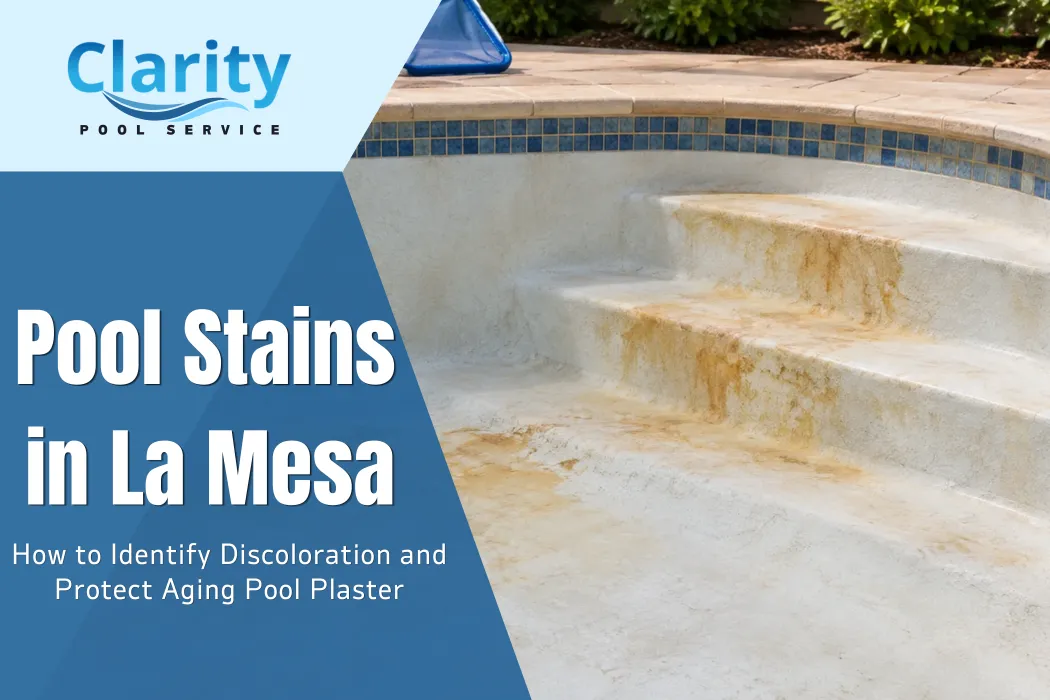
Pool Stains in La Mesa: How to Identify Discoloration and Protect Aging Pool Plaster
A La Mesa Homeowner's Guide to Black Spots, Brown Stains, Calcium Deposits, and Swimming Pool Surface Care
You brush your swimming pool, but the dark spots don't disappear.
Maybe brown stains have developed along the steps. White deposits are forming near the waterline. Or sections of the plaster look discolored even though the water is perfectly clear.
For La Mesa homeowners, these problems can be frustrating because not every pool stain is caused by algae—and not every stain can be removed with chlorine or brushing.
Swimming pools develop discoloration for different reasons. Organic debris, dissolved metals, mineral deposits, algae, and aging interior finishes can all create marks that look similar at first.
The appropriate treatment depends on identifying the cause.
Using the wrong chemicals or cleaning methods can waste money and potentially damage the pool surface.
The goal is to determine whether you're dealing with removable contamination, a water-chemistry problem, or deterioration of the finish itself.
Quick Answer: What Causes Stains on Swimming Pool Surfaces?
Pool stains generally fall into several categories:
Organic stains: Discoloration from leaves, berries, and other plant material.
Metal stains: Deposits associated with iron, copper, or other dissolved metals.
Calcium deposits: Mineral buildup caused by scale-forming water conditions.
Algae: Living growth attached to pool surfaces, including some persistent dark growth.
Surface deterioration: Discoloration, exposed aggregate, etching, or damage to the pool finish.
The appearance and location of the stain provide clues, but they don't always establish the cause.
Before applying a treatment, identify the stain and evaluate the condition of the pool surface.
Common Pool Stains at a Glance
Appearance | Possible cause | Important consideration |
Brown or tan marks | Leaves, organic material, iron | Test before treating |
Greenish discoloration | Algae, copper, other deposits | Color alone isn't diagnostic |
Black spots | Algae, metals, embedded staining | May require closer inspection |
White crust | Calcium or other mineral deposits | Check water balance |
Rough white patches | Scale or deteriorating plaster | Evaluate surface condition |
Uneven gray areas | Aging finish, staining, or etching | May not be removable |
Rust-colored marks | Iron or corroding metal | Identify the source |
Some stains have multiple contributing causes. A professional evaluation may be necessary before selecting a cleaning method.
1. Why Established La Mesa Pools Can Develop Surface Problems
La Mesa includes established residential neighborhoods with pools of different ages, finishes, and equipment configurations.
Some pools have relatively recent plaster or pebble finishes. Others may have older interiors that have experienced years of chemical exposure, brushing, mineral accumulation, and normal wear.
Local conditions can also influence surface maintenance.
Mature landscaping may introduce leaves and organic material. Warm weather and evaporation can contribute to increasing mineral concentrations. Seasonal winds may carry dirt and debris into the water.
These factors don't mean every La Mesa pool will develop stains.
They do mean homeowners should pay attention to how water chemistry, debris, and the condition of the interior finish interact.
An older pool with rough or deteriorating plaster may require a different cleaning approach from a newer pool with a smooth, intact surface.
2. Organic Pool Stains: Leaves, Berries, and Landscaping Debris
Organic stains develop when plant material or other contaminants remain in contact with pool surfaces.
Leaves, berries, blossoms, and similar debris can leave brown, tan, or yellowish discoloration.
These marks often appear where material settles, including steps, benches, corners, and the deep end.
How to Recognize Organic Staining
Possible clues include:
Stains appearing beneath fallen leaves
Discoloration after heavy landscaping debris
Marks concentrated where organic material collects
Staining that changes as debris is removed and normal sanitation continues
Some organic stains fade with proper sanitation and time.
Others may require targeted treatment.
The first step is removing the source of contamination and evaluating the water chemistry.
Avoid applying concentrated chemicals directly to a finish without confirming that the method is appropriate.
3. Metal Stains: Iron and Copper
Metal staining is different from ordinary organic discoloration.
Dissolved metals may enter pool water through fill water, certain chemical products, corroding components, or other sources.
When conditions favor precipitation or deposition, metals can create stains on pool surfaces.
Iron Staining
Iron may produce yellow, brown, or rust-colored marks.
Copper Staining
Copper may contribute to blue-green, dark, or other discoloration depending on its chemical form and conditions.
A stain's color alone doesn't reliably identify the metal.
Before using stain-removal products, a technician may evaluate the water, staining pattern, possible metal sources, and surface compatibility.
Removing an existing stain without addressing its source may allow the discoloration to return.
Successful stain treatment should consider both removal and prevention.
4. Black Spots: Is It Black Algae or Something Else?
Black spots are among the most concerning forms of pool discoloration.
They can appear on plaster walls, steps, or the floor.
Homeowners sometimes assume every black mark is black algae.
However, dark spots can also involve metal deposits, embedded contamination, or changes in the finish.
Black algae is particularly associated with porous cementitious pool surfaces and may develop persistent colonies.
It can be difficult to eliminate because growth may extend into surface irregularities.
Warning Signs Worth Investigating
Dark spots that appear to spread
Persistent growth after ordinary brushing
Clusters of spots in rough plaster
Recurring dark patches in the same locations
A professional should evaluate the surface and water conditions before recommending aggressive treatment.
Repeatedly applying strong chemicals or using an inappropriate brush may damage already weakened plaster.
5. Why Rough or Deteriorating Plaster Makes Cleaning Harder
Pool plaster doesn't remain in perfect condition forever.
Over time, certain finishes can become rough, etched, stained, or worn.
Some older surfaces develop small pits or areas where the finish begins deteriorating.
These irregularities can collect dirt and provide places where algae is more difficult to remove.
The important distinction is between material attached to the surface and damage that has become part of the surface itself.
A stain may be removable.
But exposed aggregate, missing plaster, or significant etching cannot be corrected simply by adding chlorine or brushing harder.
For homeowners with aging pools, recognizing that difference can prevent unnecessary chemical treatments.
6. Calcium Scale vs. Plaster Deterioration
White or rough deposits may be calcium carbonate scale.
But not every rough white area is a removable mineral deposit.
Calcium scale develops when water conditions favor calcium carbonate precipitation.
Contributing factors include:
pH
Calcium hardness
Total alkalinity
Water temperature
Overall saturation balance
Scale may appear on tile, spillways, and pool surfaces.
Deteriorating plaster, however, may have a different texture or appearance.
A technician should evaluate whether the surface has accumulated material or has actually lost part of its finish.
This matters because aggressive scale-removal techniques can worsen an already damaged surface.
7. Water Balance Helps Protect Pool Plaster
Maintaining proper water balance is one of the most important ways to protect cementitious pool finishes.
Water that is excessively aggressive can contribute to deterioration.
Water that is excessively scale-forming can encourage calcium deposits.
Professionals often evaluate calcium carbonate saturation using a water-balance index rather than relying on a single chemistry reading.
Important measurements include:
pH
Total alkalinity
Calcium hardness
Water temperature
Cyanuric acid
The appropriate balance depends on the pool's finish and water conditions.
A pool shouldn't be managed by automatically adding acid every week or attempting to keep calcium hardness as low as possible.
Protecting plaster requires balanced water, not extreme chemical adjustments.
8. Can Pool Stains Be Removed Without Draining?
Many stains can be evaluated and treated without completely draining the swimming pool.
Depending on the cause, options may include:
Correcting water chemistry
Removing organic debris
Appropriate brushing
Specialized stain treatment
Managing dissolved metals
Controlled mineral-deposit removal
However, some discoloration is associated with permanent surface changes rather than removable staining.
A drain-and-clean procedure may be considered in selected circumstances, but it isn't automatically the best solution.
Draining introduces potential risks involving groundwater, pool structure, finish exposure, water disposal, and refilling.
A qualified professional should evaluate those risks before recommending a complete drain.
9. When Does a Pool Need Resurfacing Instead of Cleaning?
Resurfacing becomes a consideration when the interior finish has deteriorated beyond what normal maintenance or localized repairs can reasonably address.
Possible warning signs include:
Extensive plaster loss
Significant etching
Persistent roughness
Widespread finish deterioration
Exposed underlying material
Repeated surface problems associated with failing plaster
A stain by itself doesn't necessarily justify resurfacing.
Likewise, an older pool doesn't automatically need a new interior finish.
The decision should consider the actual condition, remaining serviceability, repair options, and cost.
For homeowners, a proper evaluation helps distinguish cosmetic staining from structural or finish-related concerns.
10. Why Aggressive Brushing Can Make Problems Worse
Brushing is an important part of routine pool maintenance.
But the correct brush depends on the pool finish.
Certain brushes are appropriate for durable cementitious surfaces, while other finishes require gentler tools.
Aggressive brushing on weakened plaster may loosen deteriorating material or create additional damage.
Specialty finishes may also have manufacturer-specific cleaning requirements.
If a surface is already crumbling, flaking, or severely etched, repeatedly scrubbing harder isn't necessarily the solution.
The objective should be to remove contamination while preserving the remaining finish.
11. How to Prevent Stains in La Mesa Swimming Pools
Not every stain can be prevented, but consistent maintenance can reduce several common causes.
Remove Organic Debris Promptly
Leaves and plant material shouldn't remain on the pool floor unnecessarily.
Maintain Appropriate Sanitizer
Proper sanitation helps control algae and organic contamination.
Monitor Water Balance
Balanced water helps reduce scaling and aggressive conditions.
Investigate Metal Sources
If staining repeatedly returns, evaluate possible iron or copper contamination.
Use Surface-Appropriate Cleaning Equipment
Avoid brushes or chemical treatments that may damage the finish.
Observe Changes Over Time
Photographs can help document whether a stain is spreading, fading, or remaining unchanged.
Address Equipment Problems
Corroding components or unusual water chemistry may contribute to recurring staining.
Preventative maintenance is generally easier than correcting extensive discoloration after it develops.
12. What Should Homeowners Do When New Stains Appear?
If you notice a new stain, don't immediately apply concentrated chlorine, acid, or a stain remover.
Start by documenting the problem.
Take a photograph and note:
Where the stain appeared
Its approximate size
Whether it is spreading
Whether the surface feels rough
Whether leaves or other material were present
Whether the pool recently received chemical treatment
Then have the water chemistry and surface condition evaluated.
These details can help a pool professional distinguish between contamination, mineral deposits, algae, and finish deterioration.
The correct diagnosis can save considerable time and unnecessary expense.
Frequently Asked Questions About Pool Stains in La Mesa
Why are black spots appearing on my pool plaster?
Black spots may be caused by algae, metal deposits, embedded staining, or surface deterioration. Their appearance and behavior should be evaluated before treatment.
Can chlorine remove brown pool stains?
Some organic stains may respond to proper sanitation, but iron and other metal stains require different approaches. Chlorine isn't a universal stain remover.
Does rough plaster mean my pool needs resurfacing?
Not necessarily. Roughness may result from scale, surface wear, or deterioration. The underlying cause and extent of damage determine the appropriate response.
Can high calcium hardness stain my pool?
Calcium hardness can contribute to scale formation when the overall water balance favors precipitation. Calcium concentration alone doesn't determine whether deposits will develop.
Will draining my pool remove all stains?
No. Some stains or discoloration are embedded in the finish or caused by deterioration. Draining also introduces additional risks and costs.
Professional Pool Maintenance in La Mesa, CA
At Clarity Pool Service, our approach focuses on maintaining properly sanitized, balanced water while protecting pool surfaces and equipment.
For La Mesa homeowners, that includes recognizing developing stains, monitoring water chemistry, removing debris, and identifying conditions that may contribute to algae or calcium buildup.
Our weekly maintenance program includes water testing, appropriate chemical adjustments, cleaning, brushing, filtration monitoring, and basic equipment observation.
When a surface problem requires specialized treatment or repair, identifying the underlying cause is an important first step.
We serve La Mesa and surrounding East County San Diego communities.
Learn more about our pool maintenance services or contact Clarity Pool Service to discuss your pool's maintenance needs.
Clarity Pool Service — 619-569-1647
Final Thoughts
Pool stains aren't all the same.
A brown mark from leaves may respond to routine cleaning.
A metal stain may require specialized treatment.
Calcium deposits may indicate scale-forming water conditions.
And rough, deteriorating plaster may need a different solution entirely.
For La Mesa homeowners, the best approach is to identify the cause before selecting a treatment.
Protect the finish. Maintain balanced water. Remove contamination early. Investigate persistent discoloration.
A clean pool matters—but preserving the condition of the pool surface is just as important.