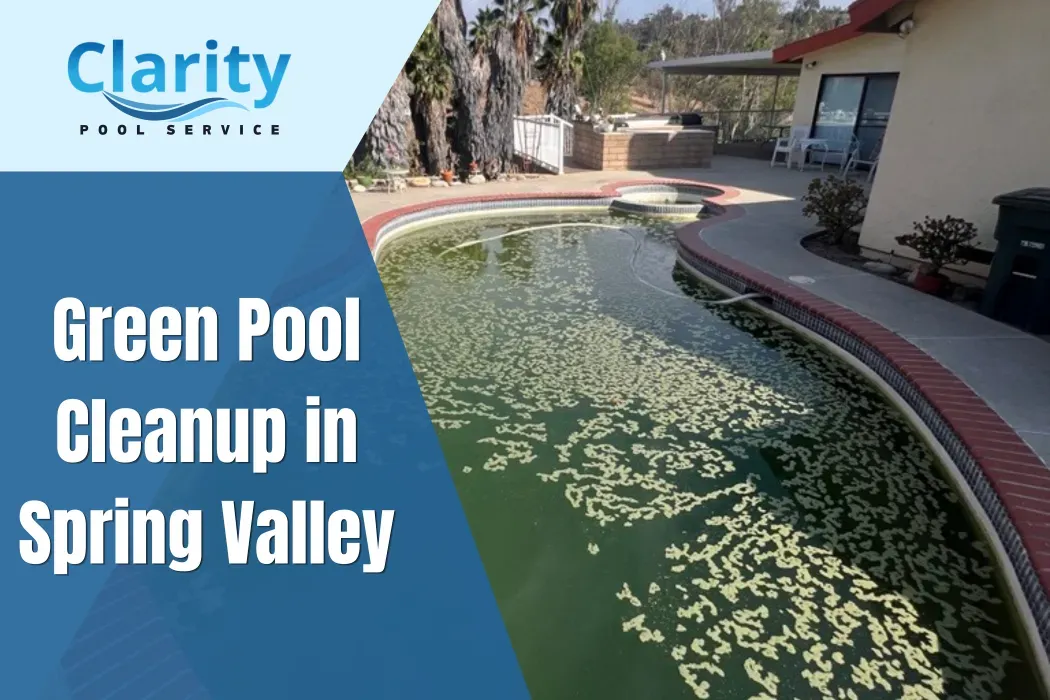
Green Pool Cleanup in Spring Valley: How to Restore a Green Swimming Pool
What Spring Valley Homeowners Should Know About Algae, Pool Recovery, and Preventing Recurring Green Water
A swimming pool can turn green surprisingly quickly.
One week, the water looks clear. A few days later, the floor is difficult to see, the walls feel slippery, and algae begins spreading across the pool.
For homeowners in Spring Valley, warm weather, strong sunlight, windblown debris, and interruptions in normal pool maintenance can contribute to conditions that allow algae to grow.
But green water isn't simply a cleaning problem.
It's usually a sign that sanitation, water chemistry, circulation, filtration, or maintenance has fallen behind the pool's needs.
And once algae becomes established, restoring the pool may require more than a normal weekly service visit.
The good news is that many green pools can be recovered without draining them.
The key is identifying the cause, choosing the appropriate treatment, and restoring the entire pool system—not just making the water look clear again.
Quick Answer: How Do You Clean a Green Pool?
Professional green pool cleanup generally involves:
Testing the water and evaluating the pool's condition.
Removing leaves and heavy organic debris.
Checking circulation and filtration.
Correcting water chemistry and treating algae.
Brushing affected surfaces.
Removing settled debris and dead algae.
Cleaning or servicing the filter when necessary.
Retesting and confirming that water conditions have stabilized.
The exact recovery process depends on the severity of the algae, pool surfaces, equipment condition, and water chemistry.
A green pool should be treated as a complete water-quality problem—not simply a pool that needs more chlorine.
Why Swimming Pools Turn Green in Spring Valley
Spring Valley pools can experience several conditions that increase maintenance demands.
During warmer months, strong sunlight, elevated water temperatures, and increased swimming may raise chlorine demand.
Landscaping can introduce leaves, blossoms, and other organic debris.
Santa Ana winds may deposit significant amounts of dust and dirt in a short period.
None of these conditions automatically causes algae.
The problem develops when sanitizer and other maintenance conditions are no longer sufficient to control growth.
Common contributing factors include:
Inadequate free chlorine
Improper water chemistry
Circulation restrictions
Poor filtration
Heavy organic contamination
Equipment shutdowns
Inconsistent maintenance
A pool may have more than one contributing problem.
That's why successful recovery begins with diagnosis.
How Bad Is the Algae Problem?
Not every green pool requires the same treatment.
Pool condition | What it may indicate | Typical recovery considerations |
Slight green tint | Early algae or another water issue | Confirm cause, test, treat promptly |
Green surfaces | Established surface algae | Chemistry correction and brushing |
Cloudy green water | Significant algae growth | Sustained treatment and filtration |
Dark green water | Heavy algae and contamination | More intensive recovery |
Heavy debris and green water | High organic load | Debris removal before and during treatment |
Recurring green water | Underlying maintenance problem | Investigate sanitation and equipment |
Water color alone cannot determine the exact chemical treatment required.
A pool that appears green because of dissolved metals, for example, may need a different response from one containing active algae.
Confirm the problem before beginning treatment.
Step 1: Test the Water Before Adding Chemicals
One of the most common mistakes during green pool recovery is adding large amounts of chlorine without knowing the existing chemistry.
Before treatment, a technician should evaluate relevant measurements such as free chlorine, pH, cyanuric acid, and other water-balance factors.
Cyanuric acid is especially important because it affects chlorine availability and the chlorine concentration required for effective algae treatment.
Pool volume also matters.
A chemical dose suitable for a 10,000-gallon pool may be inadequate for a 25,000-gallon pool.
Proper treatment requires measured adjustments rather than guessing.
Step 2: Remove Leaves and Organic Debris
Heavy debris should be removed as early as practical.
Leaves, dirt, branches, and other organic material can increase chlorine demand and interfere with recovery.
In Spring Valley, pools surrounded by mature landscaping may accumulate substantial debris after strong winds or periods without maintenance.
Removing that material helps reduce the workload on sanitation and filtration.
Large debris can be removed using appropriate nets or vacuum equipment.
Skimmer and pump baskets should also be checked so water flow isn't restricted.
A pool filled with leaves won't recover efficiently if the circulation system is struggling to move water.
Step 3: Restore Circulation and Filtration
Before expecting chemical treatment to work effectively, confirm that the circulation system is operating properly.
Check the pump, baskets, return flow, filter pressure, and visible equipment conditions.
A restricted filter may require cleaning during recovery.
In heavily contaminated pools, filter maintenance may be needed more than once as suspended material accumulates.
The filter's job is to remove contaminants from the water.
But it cannot perform effectively without adequate circulation.
If the pump is failing or water movement is severely restricted, that problem must be addressed as part of the recovery.
Step 4: Treat the Algae
Chlorine is commonly used to eliminate algae in residential swimming pools.
However, the appropriate treatment concentration depends on the pool's water chemistry, particularly cyanuric acid, as well as the severity of contamination.
Successful treatment may require maintaining an elevated chlorine concentration while algae is being eliminated, rather than adding one large dose and assuming the problem is solved.
Water should be retested and treatment adjusted as necessary.
Chemical products must be applied according to their labels and appropriate safety procedures.
Never mix pool chemicals together, and keep swimmers out until the water meets safe swimming conditions.
Step 5: Brush the Pool Surfaces
Brushing is an important part of algae recovery.
Algae can attach to plaster, tile, steps, benches, corners, and other surfaces.
Brushing helps disturb established growth and expose it to properly sanitized water.
The appropriate brush depends on the pool finish.
A rough plaster pool may tolerate different cleaning tools than a fiberglass, vinyl, or specialized interior finish.
Using the wrong brush or aggressive cleaning method can damage surfaces.
Professional recovery should account for the actual pool finish.
Step 6: Remove Dead Algae and Settled Debris
As algae is eliminated, the water may change from green to cloudy blue or gray.
That doesn't necessarily mean the treatment failed.
Dead algae and fine particles may remain suspended or settle on the pool floor.
Those contaminants still need to be removed.
Depending on the pool and equipment, removal may involve filtration, vacuuming, or vacuuming to waste.
Vacuuming to waste can be particularly useful when large amounts of fine material would otherwise overload the filter, but not every pool system has that capability.
The correct approach depends on the filtration system, plumbing, available equipment, and water conditions.
How Long Does Green Pool Cleanup Take?
There isn't one recovery timeline that applies to every swimming pool.
A pool with early algae and functioning equipment may improve relatively quickly.
A severely neglected pool with heavy debris, poor filtration, or extensive algae can require multiple treatment and cleaning visits.
Recovery time depends on:
Severity of algae
Water chemistry
Pool size
Organic debris
Circulation
Filter performance
Pool surfaces
Equipment condition
Water clarity may improve before the chemistry and sanitation are fully stabilized.
The pool isn't recovered simply because it no longer looks green.
Does a Green Pool Need to Be Drained?
Not always.
Many green pools can be recovered through chemical treatment, cleaning, circulation, and filtration.
Draining may be considered when other conditions make normal recovery impractical, such as severe water-balance problems, excessive dissolved contaminants, or certain renovation needs.
However, draining introduces additional risks and costs.
Depending on pool construction and groundwater conditions, improper draining can damage the pool structure or finish.
Water disposal and refilling also require consideration.
A complete drain should therefore be evaluated carefully rather than treated as the automatic solution to green water.
How Much Does Green Pool Cleanup Cost in Spring Valley?
Green pool cleanup is generally priced separately from normal weekly maintenance because recovery may require additional labor, chemicals, equipment service, and return visits.
The cost depends on factors such as:
Pool size and water volume
Severity of algae
Amount of debris
Filter condition
Equipment operation
Number of visits required
Whether specialized vacuuming is necessary
A lightly green pool and a heavily neglected pool shouldn't automatically receive the same recovery quote.
A professional estimate should explain the condition of the pool, the recommended work, and what is included in the recovery service.
Preventing the Pool From Turning Green Again
The most important part of recovery is identifying why algae developed.
If the pool repeatedly turns green, the problem may involve inadequate sanitizer, circulation, filtration, or inconsistent maintenance.
Once recovery is complete, ongoing maintenance should focus on stable water chemistry, effective filtration, routine brushing, and debris removal.
Saltwater pools also require verification that the chlorine generator is producing enough sanitizer for the pool's current demand.
The objective is to return the pool to a predictable maintenance routine rather than repeatedly paying for corrective treatment.
Frequently Asked Questions About Green Pool Cleanup
Can I swim in a green pool?
No. Avoid swimming until the cause has been corrected, sanitizer and water balance are appropriate, and the pool is clear enough to see the bottom.
Will adding shock clear a green pool overnight?
Not necessarily. Effective algae recovery may require sustained chlorine treatment, brushing, filtration, and removal of dead algae. One chemical addition may not complete the process.
Can a saltwater pool turn green?
Yes. A salt chlorine generator can fail to keep up with demand or stop producing adequate chlorine because of operating or equipment problems.
Why is my pool cloudy after the green disappears?
Dead algae and suspended particles may remain after treatment. Continued filtration or appropriate vacuuming may be necessary.
Will algae return after professional cleanup?
It can if the underlying cause remains unresolved. Maintaining adequate sanitizer, circulation, filtration, and cleaning helps prevent recurrence.
Professional Green Pool Cleanup in Spring Valley, CA
At Clarity Pool Service, our green pool cleanup approach focuses on restoring water quality while identifying the conditions that allowed algae to develop.
That means evaluating water chemistry, removing debris, addressing algae, monitoring filtration, and checking circulation rather than relying on chemical treatment alone.
We serve homeowners in Spring Valley and surrounding East County San Diego communities.
Whether your pool has recently developed a green tint or has been neglected for an extended period, the first step is understanding its condition and determining the appropriate recovery plan.
Learn more about our pool services or contact Clarity Pool Service to discuss a green pool cleanup estimate.
Final Thoughts
A green swimming pool is frustrating, but it doesn't automatically mean the pool needs to be drained or completely rebuilt.
Many pools can be restored through proper testing, algae treatment, cleaning, circulation, and filtration.
The most important distinction is between making the water look better and restoring the pool to stable, maintainable conditions.
Professional recovery should accomplish both.
And once the pool is clear again, consistent maintenance is what helps keep it that way.