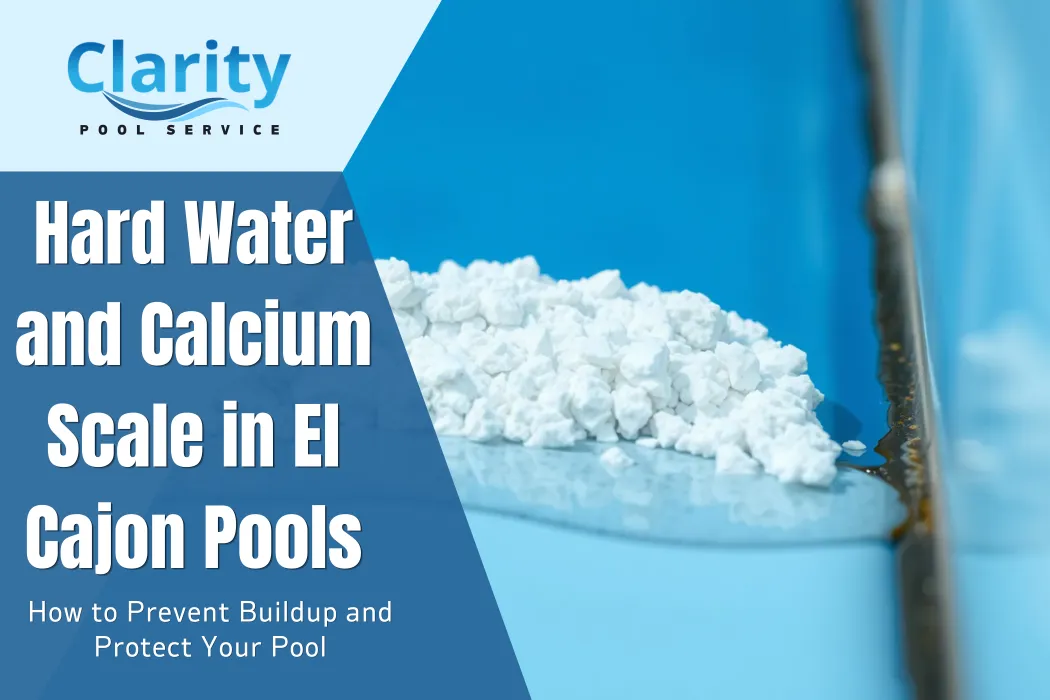
Hard Water and Calcium Scale in El Cajon Pools: How to Prevent Buildup and Protect Your Pool
A Homeowner's Guide to Calcium Hardness, White Pool Deposits, and Water Balance in El Cajon, California
White buildup around your pool tile can start as a thin line along the water's edge.
Over time, it may become thicker, rougher, and more difficult to remove.
You might also notice white deposits on spillways, pool surfaces, or inside your salt chlorine generator.
For El Cajon homeowners, calcium scale is an important maintenance concern, particularly when pool water contains significant dissolved minerals and experiences repeated evaporation and refilling.
But hard water doesn't automatically mean your swimming pool will develop scale.
Calcium buildup depends on the overall water balance—not simply how much calcium is present.
Understanding that difference can help prevent unnecessary chemical treatments, surface damage, and expensive cleaning.
Quick Answer: Why Does Calcium Build Up in Swimming Pools?
Calcium scale forms when water conditions favor calcium carbonate precipitation.
The main factors include:
Calcium hardness
pH
Total alkalinity
Water temperature
Overall water balance
Evaporation and replacement-water chemistry
As water evaporates, dissolved minerals remain behind. Refilling the pool can introduce additional calcium.
Over time, this may increase calcium hardness and contribute to scale-forming conditions.
The best prevention is accurate water testing and maintaining balanced water—not simply adding acid whenever white deposits appear.
Common Calcium Problems at a Glance
What you notice | Possible explanation | What to evaluate |
White crust on waterline tile | Calcium scale or other mineral deposits | Water balance and deposit type |
Rough white deposits on plaster | Scale-forming conditions | pH, alkalinity, calcium, temperature |
Salt cell scaling | Calcium precipitation on cell plates | Water balance and cell condition |
Cloudy water after pH rises | Possible calcium precipitation | Chemistry and filtration |
Rising calcium hardness | Mineral-rich refill water and water replacement patterns | Fill water and pool CH |
White streaks near spillways | Evaporation and mineral deposits | Water features and water balance |
Not every white deposit is calcium carbonate. Identifying the material matters before selecting a treatment.
1. Why El Cajon Pool Water Can Become Hard
Swimming pool water contains dissolved minerals, including calcium.
The amount depends partly on the water source used to fill and replenish the pool.
El Cajon properties may receive water with varying mineral concentrations depending on their supplier and supply conditions.
That means homeowners shouldn't assume every pool in El Cajon starts with identical calcium hardness.
The most reliable approach is to test both the pool water and, when necessary, the fill water.
What Happens During Evaporation?
When water evaporates, calcium remains in the pool.
Replacement water introduces additional dissolved minerals.
Over time, calcium concentration may increase, particularly when water is repeatedly topped off without much water being removed through splash-out, backwashing, draining, or other processes.
This is one reason calcium hardness deserves periodic monitoring in inland San Diego pools.
2. What Is Calcium Hardness?
Calcium hardness measures the concentration of dissolved calcium in pool water, typically expressed in parts per million (ppm) as calcium carbonate.
Calcium is an important part of maintaining appropriate water balance, especially in plaster and other cementitious pools.
Too little calcium, combined with aggressive overall water conditions, may contribute to deterioration of certain finishes.
Excessive calcium, combined with scale-forming conditions, can contribute to deposits.
But calcium hardness should never be evaluated alone.
A pool with relatively high calcium may remain manageable when the overall water balance is appropriate.
Another pool with lower calcium may develop scale if pH, alkalinity, and temperature create strongly scale-forming conditions.
The complete water balance determines the risk—not one isolated measurement.
3. Understanding the Langelier Saturation Index
Pool professionals often use a saturation index to evaluate whether water tends to dissolve or deposit calcium carbonate.
One commonly used method is the Langelier Saturation Index (LSI).
LSI considers factors including:
pH
Calcium hardness
Carbonate alkalinity
Water temperature
Dissolved solids
The objective is to maintain water within an appropriate balance range for the pool's surface and operating conditions.
Why This Matters
Water that is excessively scale-forming can encourage calcium deposits.
Water that is excessively aggressive may contribute to deterioration of certain cementitious surfaces.
A balanced saturation index helps technicians evaluate these risks more accurately than relying on pH or calcium hardness alone.
For homeowners, the important takeaway is simple:
A calcium reading isn't a complete water-balance assessment.
4. Why High pH Can Contribute to Scale
pH is one of the most influential factors in calcium carbonate saturation.
When pH rises, water generally becomes more likely to form calcium carbonate scale, assuming other conditions remain similar.
This is why a pool with elevated calcium hardness may require careful pH management.
However, adding acid without testing can create other problems.
Excessive acid additions can lower pH and alkalinity too far, potentially creating aggressive water conditions.
A technician should evaluate pH, alkalinity, calcium hardness, and overall saturation balance before making corrections.
The objective isn't to keep pH as low as possible.
It's to maintain appropriate water balance.
5. Total Alkalinity Also Matters
Total alkalinity influences pH behavior and contributes to calcium carbonate saturation.
When alkalinity is excessive, it can contribute to scale-forming conditions, particularly when pH is also elevated.
But reducing alkalinity too aggressively can create unstable or undesirable water conditions.
The correct target depends on the pool's chemistry and operating characteristics.
A professional should evaluate alkalinity together with pH, calcium hardness, and temperature.
Pool chemistry works as a system. Adjusting one measurement affects others.
6. Saltwater Pools Can Develop Calcium Scale
Salt chlorine generators are particularly vulnerable to calcium deposits on their internal plates.
During chlorine generation, localized chemical conditions near the cell plates can encourage scale formation.
If deposits accumulate, chlorine production or equipment operation may be affected.
Homeowners may notice:
White deposits inside the cell
Reduced chlorine production
Cell inspection warnings
Flow-related or system alerts
However, low chlorine doesn't automatically prove the cell is scaled or defective.
Before cleaning or replacing a salt cell, evaluate the actual water chemistry, salt concentration, flow, settings, and cell condition.
Excessive acid cleaning can shorten cell life.
Inspect and clean according to the manufacturer's instructions rather than automatically performing acid treatments on a fixed schedule.
7. Calcium Scale vs. Other Pool Stains
Not every white mark or discolored area is calcium scale.
Pool surfaces can develop several different types of deposits and stains.
Calcium Carbonate Scale
Often appears as white or light-colored mineral buildup.
Calcium Silicate Scale
May appear as harder, more persistent deposits that require different removal methods.
Metal Stains
Iron, copper, and other metals can cause discoloration that may be mistaken for other surface problems.
Organic Stains
Leaves, berries, and other organic materials can leave marks on pool surfaces.
Before applying aggressive cleaning products, identify the likely deposit.
The wrong treatment may fail to remove the problem or damage the finish.
8. Can Calcium Scale Damage Pool Surfaces?
Calcium scale is often first noticed as a cosmetic issue.
But heavy deposits can make surfaces rough and difficult to clean.
Scale may accumulate around:
Tile
Spillways
Pool finishes
Salt cells
Other equipment exposed to water
Some removal methods can damage delicate surfaces if performed incorrectly.
For plaster and specialty finishes, aggressive chemical or abrasive cleaning should be evaluated carefully.
Preventing scale through water-balance management is generally preferable to removing extensive buildup later.
9. How to Prevent Calcium Scale in El Cajon Pools
Preventative maintenance should focus on consistent water testing and balanced chemistry.
Test Calcium Hardness
Monitor calcium periodically and after significant water replacement.
Maintain Appropriate pH
Avoid allowing pH to remain excessively high.
Monitor Total Alkalinity
Evaluate alkalinity as part of the overall water balance.
Consider Water Temperature
Warmer water can increase calcium carbonate scaling tendency.
Evaluate Fill Water
If calcium continues rising, test the replacement water to understand its contribution.
Monitor Salt Cells
Inspect for scale according to manufacturer recommendations.
Track Water-Balance Trends
Repeated measurements are more useful than reacting only after deposits appear.
The goal is preventing strongly scale-forming conditions before visible deposits develop.
10. What If Calcium Hardness Is Already High?
High calcium hardness doesn't automatically require draining the pool.
The appropriate response depends on the complete water chemistry and whether the pool can be maintained within a suitable saturation balance.
Possible management approaches may include:
Adjusting pH and alkalinity appropriately
Monitoring saturation balance
Evaluating replacement-water hardness
Considering partial water replacement when justified
In some situations, specialized treatment or controlled water replacement may be considered.
However, replacing pool water with similarly hard fill water may provide limited benefit.
That's why testing the replacement water is important before recommending a major water change.
11. Should You Drain a Pool to Remove Calcium?
Not automatically.
A complete pool drain introduces additional costs and potential risks.
Depending on pool construction, groundwater conditions, and surface materials, improper draining can cause structural or finish damage.
Water disposal and refilling also need to follow applicable local requirements.
If calcium hardness or other dissolved contaminants require substantial water replacement, a qualified professional should evaluate the safest practical method.
A full drain shouldn't be the default response to calcium scale.
How Weekly Pool Service Helps Prevent Scale
A professional maintenance program can help identify changing water balance before significant deposits form.
Routine service should include:
Water testing
Appropriate chemical adjustments
Monitoring water clarity
Observing pool surfaces
Watching for calcium deposits
Checking salt-system condition when applicable
Evaluating filtration and circulation
Not every chemistry measurement requires adjustment during every visit.
The objective is consistent water balance and early recognition of developing problems.
For El Cajon homeowners, this can be especially valuable when evaporation and mineral-rich replacement water contribute to increasing calcium hardness.
Frequently Asked Questions About Hard Water in El Cajon Pools
Is El Cajon pool water hard?
Water hardness varies by water supplier and source conditions. Some pools may receive mineral-rich fill water, but actual calcium hardness should be verified through testing rather than assumed.
Does high calcium always cause scale?
No. Scale formation depends on the overall water balance, including pH, alkalinity, calcium hardness, and temperature.
Can I remove calcium scale with acid?
Some calcium carbonate deposits can respond to appropriate acid-based treatments, but acids can damage pool finishes and create safety risks. The deposit and surface should be identified before treatment.
Do saltwater pools develop more calcium buildup?
Salt chlorine generators can develop calcium deposits on cell plates because of localized conditions during chlorine production. Proper water balance and manufacturer-recommended maintenance help manage the problem.
Should I drain my pool if calcium hardness is high?
Not automatically. The decision depends on overall water balance, fill-water hardness, pool construction, and whether less invasive management options are practical.
Professional Pool Maintenance in El Cajon, CA
At Clarity Pool Service, our maintenance approach focuses on maintaining balanced water, protecting pool surfaces, and recognizing developing chemistry or equipment problems.
For El Cajon homeowners, that includes monitoring calcium hardness, pH, alkalinity, sanitation, and the conditions that may contribute to scale.
Our weekly service also includes cleaning, filtration monitoring, circulation checks, and basic equipment observation.
We serve El Cajon and surrounding East County San Diego communities.
Learn more about our El Cajon pool service or explore our pool maintenance services.
Final Thoughts
Hard water doesn't automatically mean your swimming pool will develop calcium scale.
The real issue is how calcium hardness interacts with pH, alkalinity, temperature, and overall water balance.
For El Cajon homeowners, evaporation and replacement-water chemistry can make calcium management an important part of long-term pool care.
The best approach is to test accurately, monitor trends, and maintain appropriate saturation balance.
Preventing scale is generally easier, safer, and less expensive than removing extensive deposits after they form.