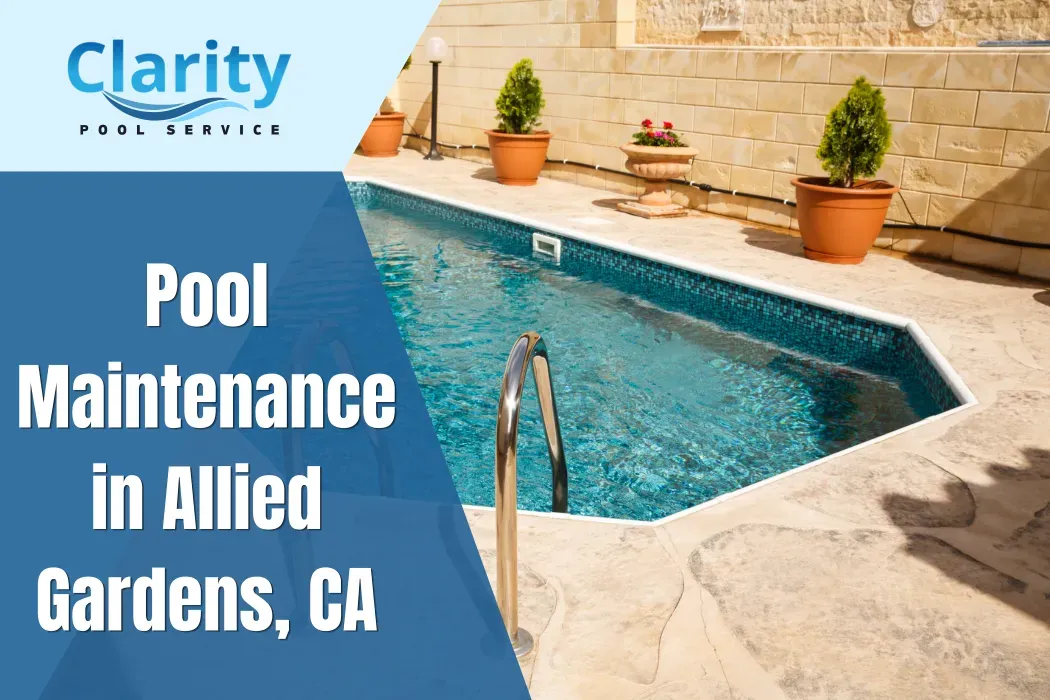
Pool Maintenance in Allied Gardens, CA: Preventing Costly Pool Problems
A Homeowner's Guide to Water Chemistry, Equipment Care, and Year-Round Pool Maintenance
A swimming pool can look perfectly clean while a maintenance problem is developing.
The water may be clear, but chlorine could be dropping too low between service visits.
A filter may be collecting more debris than usual.
A small pump leak might go unnoticed.
Or a change in circulation could be making certain areas of the pool harder to maintain.
For homeowners in Allied Gardens, preventative pool maintenance means identifying these changes before they become larger problems.
Allied Gardens is an established San Diego neighborhood near Mission Trails Regional Park. Residential pools vary in age, equipment configuration, landscaping, and exposure to sunlight.
Some properties have mature trees that contribute leaves and organic debris. Others have open backyards where sunlight and seasonal winds create different maintenance demands.
The most effective approach isn't to perform every possible maintenance task every week.
It's to maintain the pool consistently while recognizing what changes over time.
Quick Answer: What Is Preventative Pool Maintenance?
Preventative pool maintenance is the routine testing, cleaning, inspection, and monitoring that helps reduce avoidable water-quality and equipment problems.
For Allied Gardens homeowners, a comprehensive program should include:
Water chemistry testing and adjustment
Consistent sanitation
Surface skimming and brushing
Vacuuming when needed
Skimmer and pump basket cleaning
Filter-pressure monitoring
Circulation checks
Basic equipment observation
Periodic filter and equipment service
The objective is to maintain healthy water and recognize developing problems before major corrective work becomes necessary.
Pool Maintenance Warning Signs at a Glance
What you notice | Possible cause | What to check |
Chlorine repeatedly drops | Increased demand or inadequate dosing | Chemistry and sanitizer system |
Cloudy water | Chemistry, algae, filtration, or circulation | Water testing and filter operation |
Weak return flow | Restriction or equipment problem | Baskets, filter, valves, pump |
Rising filter pressure | Filter loading or changing operating conditions | Clean-pressure baseline |
Air inside pump basket | Low water or suction-side air intrusion | Water level and suction system |
Recurring algae | Inadequate sanitation or other maintenance issue | Chemistry, brushing, circulation |
Small equipment leak | Worn seal, fitting, or component | Equipment inspection |
These symptoms are clues—not complete diagnoses.
1. Water Chemistry Problems Often Start Before the Water Looks Bad
Clear water doesn't automatically mean balanced water.
Chlorine is continuously consumed by sunlight, swimmers, and contaminants.
Other measurements, including pH, alkalinity, calcium hardness, and cyanuric acid, also affect pool health.
A pool may look normal while one or more readings are moving outside the appropriate range.
That's why preventative maintenance begins with testing.
A technician should evaluate the water and make adjustments based on actual conditions rather than adding the same chemicals every week.
For homeowners, the most important principle is simple:
Test before treating.
If chlorine repeatedly falls too low, investigate the cause instead of relying on larger and larger chemical additions.
2. Filter Pressure Can Reveal Developing Problems
Your pool filter collects suspended contaminants from circulating water.
As material accumulates, pressure may change.
The useful reference is the filter's normal clean operating pressure at a consistent pump speed.
If pressure rises significantly, the filter may need cleaning according to manufacturer guidance.
If pressure becomes unusually low, the system may be experiencing reduced water flow.
Possible causes include:
Full baskets
Air entering the suction side
Valve changes
Pump problems
Filter pressure should be considered together with return flow and water clarity.
A pressure gauge provides information. It doesn't identify every problem by itself.
3. Small Equipment Leaks Shouldn't Become Normal
A few drops of water around pool equipment may not seem important.
But persistent leaks deserve attention.
Common areas to observe include:
Pump housing
Plumbing connections
Filter fittings
Valves
Heater connections
Some leaks involve relatively simple serviceable components.
Others may indicate more significant deterioration.
The goal is to identify the source before water damages nearby equipment or the problem worsens.
Homeowners don't need to disassemble anything to recognize a change.
A quick visual inspection can provide useful information.
4. Circulation Problems Can Affect the Entire Pool
The circulation system moves water through the pump, filter, and other equipment before returning it to the pool.
When circulation becomes restricted, several maintenance functions may suffer.
Reduced flow can affect:
Filtration
Surface skimming
Sanitizer distribution
Heater operation
Salt chlorine generation
If return flow becomes noticeably weaker, start with the basic conditions.
Check water level, baskets, filter pressure, and valve positions.
Don't automatically assume the pump needs replacement.
A dirty filter or overloaded basket can create symptoms that resemble equipment failure.
5. Brushing Prevents More Than Visible Dirt
Brushing helps disturb early algae and buildup before it becomes established.
This is especially important around:
Steps
Corners
Benches
Tanning ledges
Areas with weaker circulation
A pool doesn't need visible green algae for brushing to be useful.
The appropriate brush should match the pool's surface material.
For older plaster or specialized finishes, using the wrong cleaning equipment can cause damage.
Preventative brushing should protect the pool—not wear down the finish unnecessarily.
6. Landscaping Can Change Maintenance Requirements
Allied Gardens properties can have very different landscaping conditions.
Some pools are surrounded by mature trees and gardens.
Others receive direct sunlight with relatively little debris.
Leaves, blossoms, pollen, and fine dirt can increase:
Skimming
Vacuuming
Basket loading
Filter loading
Sanitizer demand
A pool with heavy landscaping may require additional cleaning between professional visits.
For example, after a Santa Ana wind event, skimmer baskets may fill much faster than usual.
Removing excessive debris promptly helps prevent circulation restrictions.
7. Older Equipment Doesn't Automatically Need Replacement
Established pools may contain equipment that has operated for many years.
Age alone isn't a reason to replace a functioning pump, filter, or valve.
Instead, evaluate:
Operating condition
Repair history
Energy efficiency
Parts availability
Repair cost
Expected remaining life
A leaking seal may be worth repairing.
A pump with repeated major failures may justify replacement.
Good preventative maintenance should provide information that helps homeowners make those decisions.
For a deeper explanation, see Pool Equipment Repair vs. Replacement.
8. Pump Scheduling Matters
A pool pump needs to operate long enough to support circulation, filtration, and connected equipment.
But running at maximum speed for unnecessary periods can waste energy.
Variable-speed pumps allow different speeds for different functions.
However, the schedule must still support:
Filtration
Surface skimming
Salt chlorine production
Heating
Other equipment requirements
Before changing pump programming, document the existing settings.
If water quality or equipment performance changes after an adjustment, review the schedule before assuming something has failed.
9. Seasonal Maintenance in Allied Gardens
Pool maintenance requirements can change throughout the year.
Summer
Higher temperatures, strong sunlight, and increased swimming may raise chlorine demand.
Fall
Leaves and landscaping debris may increase basket and filter loading.
Winter
Rain and wind can introduce debris even when the pool isn't being used frequently.
Santa Ana Wind Events
Strong winds may deposit dust, leaves, and organic material within hours.
The service schedule can remain consistent while the maintenance responds to conditions.
10. What Should Weekly Professional Maintenance Include?
A comprehensive weekly service should generally address:
Water care: Test chemistry and make appropriate adjustments.
Cleaning: Skim, brush, and vacuum when needed.
Baskets: Remove debris before it restricts flow.
Filtration: Monitor pressure and performance.
Circulation: Observe return flow and pump operation.
Equipment: Look for leaks, unusual noises, and warnings.
Communication: Inform the homeowner about meaningful concerns.
Not every visit requires a repair or major chemical adjustment.
In fact, a stable pool may require relatively little corrective work.
That's the objective of preventative maintenance.
When Does a Pool Need More Than Routine Service?
Some problems require additional work beyond a normal weekly visit.
Examples include:
Green pool recovery
Major algae treatment
Filter cleaning
Equipment repairs
Leak detection
Severe chemistry corrections
A professional should explain the problem, recommended work, and additional cost before performing separately billed services when approval is appropriate.
Routine maintenance and specialized repairs should have clear boundaries.
A Five-Minute Homeowner Equipment Check
Even with weekly professional service, homeowners can recognize unusual conditions between visits.
Check | What to look for |
Water | Cloudiness or green discoloration |
Water level | Unexpected drop |
Baskets | Excessive debris |
Return jets | Weak flow |
Pump | Unusual sounds or air |
Equipment pad | New leaks or warnings |
You don't need to perform a complete service.
You're simply looking for changes that shouldn't wait until the next scheduled visit.
Frequently Asked Questions About Pool Maintenance in Allied Gardens
How often should my pool be maintained?
For homeowners relying on professional service for most routine care, weekly maintenance generally provides a practical schedule. Additional attention may be necessary after storms, heavy debris, or equipment problems.
Can regular maintenance prevent expensive repairs?
It can help identify developing problems and maintain appropriate operating conditions, but it cannot prevent every equipment failure or guarantee lower repair costs.
Should my pool filter be cleaned every month?
Not automatically. Filter maintenance depends on type, pressure, circulation, debris, and manufacturer recommendations.
Do saltwater pools need preventative maintenance?
Yes. Saltwater systems generate chlorine but still require water testing, cleaning, filtration, circulation monitoring, and equipment observation.
What pool problems shouldn't wait?
Pump failure, major leaks, significant circulation loss, electrical concerns, rapid water loss, or rapidly deteriorating water conditions deserve prompt attention.
Professional Pool Maintenance in Allied Gardens, CA
At Clarity Pool Service, our approach focuses on consistent water care, cleaning, filtration monitoring, circulation checks, and basic equipment observation.
We serve homeowners in Allied Gardens and surrounding East County San Diego communities.
Whether your pool has established equipment, mature landscaping, or recurring water-quality challenges, preventative maintenance helps keep the system operating as intended.
Our goal is to identify meaningful changes early and communicate concerns clearly so homeowners can make informed maintenance decisions.
Learn more about our pool maintenance services or contact Clarity Pool Service for a weekly maintenance estimate.
Final Thoughts
A swimming pool doesn't need constant repairs to remain healthy.
It needs consistent attention to the fundamentals.
Water chemistry.
Cleaning.
Circulation.
Filtration.
Equipment condition.
For Allied Gardens homeowners, preventative maintenance means recognizing changes while they're still manageable.
A clear pool is important.
But a clear pool with healthy circulation, properly balanced water, and reliable equipment is the real objective.
Maintain the entire system—not just the appearance of the water.