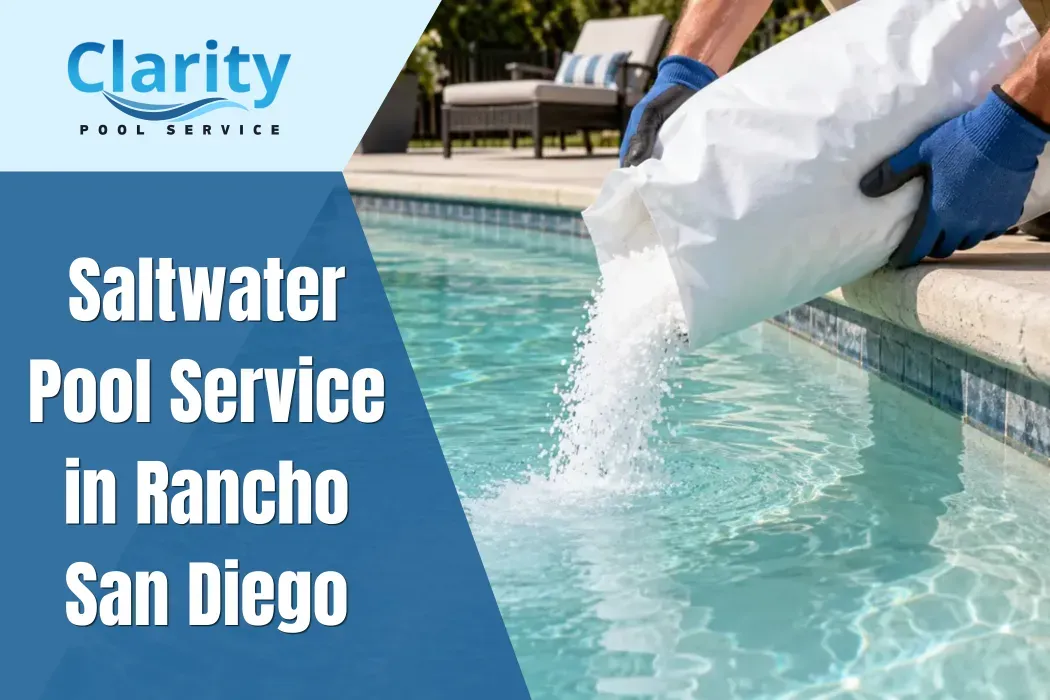
Saltwater Pool Service in Rancho San Diego: What Homeowners Should Know
A Local Guide to Saltwater Pool Maintenance, Chlorine Production, and Equipment Care
Saltwater swimming pools offer a convenient way to maintain chlorine without relying entirely on frequent manual additions.
But owning a saltwater pool in Rancho San Diego doesn't mean the water takes care of itself.
Hot summer afternoons, strong sunlight, changing swimmer use, and mineral balance can all affect how well a salt chlorine generator keeps up with a pool's needs.
And when a salt system begins producing less chlorine than expected, the problem isn't always the cell itself.
Sometimes the issue involves water chemistry, circulation, pump scheduling, or system settings.
For homeowners in Rancho San Diego, understanding how these systems work together can help prevent unnecessary equipment replacements and recurring water-quality problems.
A saltwater pool still needs complete pool maintenance. The salt system simply changes how chlorine is supplied.
Quick Answer
Professional saltwater pool service in Rancho San Diego should focus on:
Maintaining appropriate chlorine levels
Testing and balancing water chemistry
Monitoring salt concentration
Checking salt-system operation
Watching for cell scale or warning messages
Maintaining proper circulation
Monitoring filter performance
Cleaning and brushing pool surfaces
Recognizing developing equipment problems
A properly functioning salt system can reduce manual chlorine additions, but it cannot replace regular maintenance.
Saltwater Pool Maintenance at a Glance
Maintenance area | Why it matters |
Chlorine production | Keeps sanitizer available |
Salt concentration | Supports proper generator operation |
Water chemistry | Protects surfaces and equipment |
Pump scheduling | Determines available chlorine-production time |
Water flow | Allows the generator to operate correctly |
Salt cell condition | Helps identify scale or deterioration |
Filtration | Removes suspended contaminants |
Equipment inspection | Identifies developing problems |
1. Saltwater Pools Still Use Chlorine
One of the biggest misconceptions about saltwater pools is that they don't contain chlorine.
They do.
A salt chlorine generator uses an electrolytic process to produce chlorine from dissolved salt.
That chlorine sanitizes the swimming pool just as chlorine added through traditional methods does.
The difference is how the sanitizer enters the water.
A traditional chlorine pool receives chlorine through manual additions or another dosing method.
A saltwater pool produces much of its chlorine through the generator.
Saltwater is a chlorine-production system—not an alternative to chlorine sanitation.
2. Summer Heat Can Increase Chlorine Demand
Rancho San Diego experiences warm inland weather that can place greater demands on swimming pools during summer.
Strong sunlight, warmer water, and increased swimming can raise chlorine demand.
A salt system that maintains adequate chlorine during spring may require different settings during hotter months.
Homeowners should monitor actual chlorine readings rather than assuming the generator will automatically compensate.
Depending on the equipment, maintaining appropriate chlorine may involve adjusting:
Chlorine output percentage
Pump operating schedule
Water chemistry
Other system conditions
The correct adjustment depends on the pool and equipment.
Increasing output without testing isn't a substitute for understanding why chlorine is low.
3. Pump Run Time Affects Chlorine Production
Salt chlorine generators generally produce chlorine only while the circulation system is operating under appropriate flow conditions.
That makes pump programming important.
For example, reducing pump run time to save electricity may also reduce the number of hours available for chlorine generation.
A homeowner may notice chlorine declining even though the salt system's output percentage hasn't changed.
Before assuming the cell has failed, check:
Pump schedule
Pump speed
Water flow
Generator settings
Actual chlorine readings
A saltwater pool's pump and chlorine generator need to operate as a coordinated system.
For a deeper explanation, see How Long Should You Run Your Pool Pump?
4. Low Salt Doesn't Always Mean You Need More Salt
When a salt system displays a low-salt warning, the natural reaction is to add another bag.
But the displayed reading should be evaluated before adding large amounts.
Depending on the system, apparent low-salt conditions can involve:
Actual low salt concentration
Water temperature
Cell condition
Scale
Sensor or electronic problems
A separate salt test can help verify the actual concentration.
Adding salt repeatedly without confirming the level may create an excessively high salt concentration.
Test the water before adding salt.
Follow the manufacturer's recommended operating range for the installed generator.
5. Salt Cells Can Develop Calcium Scale
Salt cells operate in conditions that can encourage calcium deposits on their internal plates.
Scale buildup may interfere with chlorine production or contribute to system warnings.
However, not every salt cell requires frequent acid cleaning.
Excessive cleaning can shorten cell life, especially when aggressive acid treatments are used unnecessarily.
A better approach is to:
Monitor water balance.
Inspect the cell according to manufacturer guidance.
Clean only when needed.
Follow the manufacturer's approved procedure.
Maintaining appropriate water balance can also help reduce scale-related problems.
6. Water Chemistry Still Requires Attention
A salt system produces chlorine.
It doesn't automatically maintain every other aspect of pool chemistry.
Routine testing may include:
Free chlorine
pH
Total alkalinity
Calcium hardness
Cyanuric acid
Salt concentration
Some saltwater pools also experience a tendency for pH to rise, depending on aeration, water chemistry, and system operation.
That's why saltwater maintenance should include complete water testing rather than checking only chlorine and salt.
For a detailed explanation, see Pool Water Chemistry Explained.
7. Circulation Problems Can Affect the Salt System
A salt chlorine generator depends on adequate water flow.
If circulation becomes restricted, the generator may stop producing chlorine or display a flow warning.
Possible causes include:
Full baskets
Dirty filter
Incorrect valve position
Low pump speed
Air entering the system
Plumbing restrictions
Before replacing a salt cell or flow sensor, confirm that circulation is operating normally.
A low-flow warning may be telling you something about the broader pool system rather than the generator itself.
8. When a Salt System Stops Producing Chlorine
Low chlorine doesn't automatically mean the salt cell has failed.
Start with the complete picture.
Check whether:
The generator has power
The system displays an error
The salt concentration is appropriate
Water flow is adequate
The cell is scaled
Pump scheduling has changed
Chlorine demand has increased
If the system isn't producing adequate chlorine, the pool still needs sanitation while the problem is being diagnosed.
Appropriate manually added chlorine may be necessary to maintain safe water conditions until normal generator operation is restored.
Don't allow the pool to turn green while waiting for a salt-system repair.
9. Saltwater Pools Still Need Cleaning
Saltwater doesn't eliminate leaves, dirt, algae, or organic debris.
A complete weekly service should still include:
Skimming
Brushing
Vacuuming as needed
Basket cleaning
Filter monitoring
Equipment observation
The generator handles chlorine production.
The rest of the pool still requires maintenance.
This distinction is especially important for homeowners who purchased a saltwater system expecting a nearly maintenance-free swimming pool.
10. Why Salt-System Problems Should Be Diagnosed Before Replacement
Salt cells are expensive components.
They eventually wear out, but replacement shouldn't be the first response to every warning.
For example:
A low-salt warning doesn't automatically prove the salt concentration is low.
A flow warning doesn't automatically mean the flow sensor is defective.
Low chlorine doesn't automatically mean the cell is exhausted.
The correct process is:
Verify water chemistry → Check circulation → Review system settings → Inspect equipment → Diagnose the failure
That approach can prevent unnecessary replacement and help identify the real problem.
What Good Saltwater Pool Service Should Accomplish
For Rancho San Diego homeowners, a professional saltwater maintenance program should do more than add salt and clean the pool.
It should help maintain:
Consistent sanitation.
Balanced water.
Appropriate salt concentration.
Reliable chlorine generation.
Healthy circulation and filtration.
Clean pool surfaces.
Early awareness of equipment problems.
When those fundamentals remain stable, saltwater ownership becomes much more predictable.
Why Local Experience Matters
A pool service company familiar with Rancho San Diego should understand how inland weather, sun exposure, water chemistry, and seasonal swimming activity can affect saltwater pool operation.
But local knowledge should also involve understanding the actual equipment installed at the property.
Different salt chlorine generators have different operating ranges, control systems, warnings, and maintenance procedures.
The best service combines local environmental awareness with equipment-specific knowledge.
That's how saltwater maintenance becomes preventative rather than reactive.
—--------------------------------------
Saltwater Pool Service in Rancho San Diego: Maintenance, Troubleshooting, and Professional Care
Keeping Your Saltwater Pool Healthy Throughout the Year
A properly functioning saltwater system can make chlorine management more convenient, but the equipment still needs monitoring.
For Rancho San Diego homeowners, the most important consideration isn't how much salt is in the pool on any particular day.
It's whether the entire system is consistently maintaining properly sanitized, balanced water.
That requires attention to chlorine production, circulation, filtration, water chemistry, and equipment condition.
How Often Should a Saltwater Pool Be Serviced?
For homeowners who prefer professional maintenance, weekly pool service is generally the most practical schedule.
A weekly visit provides an opportunity to test the water, confirm sanitizer levels, evaluate salt-system performance, clean surfaces, monitor filtration, and identify developing equipment concerns.
Some conditions may require attention between visits, particularly during extreme heat, heavy swimmer use, or equipment failures.
A salt chlorine generator can produce chlorine automatically, but it cannot identify and correct every water-quality or equipment problem.
What Should a Professional Check During Saltwater Service?
A comprehensive saltwater maintenance visit should address both the pool and the chlorine-generation system.
Maintenance area | What should be evaluated |
Water chemistry | Chlorine, pH, and relevant water-balance measurements |
Salt concentration | Actual salt level compared with manufacturer requirements |
Chlorine generator | Output settings, operation, and warnings |
Circulation | Return flow, pump operation, and flow restrictions |
Filtration | Filter pressure and performance |
Pool surfaces | Debris, buildup, and early algae |
Equipment | Leaks, unusual sounds, and visible problems |
Not every measurement requires adjustment during every visit.
The goal is stable operation—not unnecessary chemical additions or equipment servicing.
When Your Saltwater Pool Has Low Chlorine
Low chlorine is one of the most common reasons homeowners begin questioning their salt system.
But low chlorine doesn't automatically mean the cell has failed.
Consider three possibilities.
The Pool Needs More Chlorine Than the System Is Producing
Hot weather, heavy swimming, or organic contamination can increase chlorine demand.
The System Isn't Operating Long Enough
Pump scheduling and chlorine-generator output settings affect production.
The Equipment Isn't Producing Chlorine Properly
Flow restrictions, cell condition, control problems, or other faults may reduce or stop production.
Testing and diagnosis should determine which situation applies.
Adding more salt without verifying the actual concentration isn't an appropriate first response.
When the Salt System Displays an Error
Different manufacturers use different warning messages and diagnostic procedures.
Common categories include:
Low salt
High salt
Low flow
Cell inspection
Temperature-related warnings
General system faults
Record the exact message or error code.
Then verify the relevant operating conditions.
For example, a low-flow warning should prompt an evaluation of circulation before automatically replacing the cell.
An apparent low-salt condition should be checked against an independent salt measurement before adding large quantities of salt.
If the display is completely blank, electrical power and control-system operation may require diagnosis.
Electrical repairs should be handled by appropriately qualified professionals.
When Should a Salt Cell Be Cleaned?
Salt cells should be inspected according to manufacturer recommendations and cleaned when scale or other conditions justify it.
Cleaning too frequently can damage the cell's coating and reduce its useful life.
If scale repeatedly develops, water balance should also be evaluated.
Simply cleaning the cell again and again without investigating why scale forms may leave the underlying problem unresolved.
Should You Replace an Aging Salt Cell?
Salt cells eventually wear out.
However, age alone doesn't prove replacement is necessary.
Before approving a new cell, consider:
Confirmed chlorine-production performance
Actual salt concentration
Cell condition
System diagnostics
Water flow
Equipment compatibility
Remaining warranty coverage
A properly diagnosed failure provides a much stronger basis for replacement than a warning light alone.
Saltwater Maintenance During Rancho San Diego Summers
Warm inland conditions can increase pool-maintenance demands.
During periods of high chlorine consumption, homeowners may need to monitor sanitizer more frequently.
A salt system that maintains adequate chlorine during cooler months may require different output settings or operating time during summer.
But increasing chlorine production isn't always the solution.
If the pool contains developing algae or substantial organic contamination, the underlying water-quality problem must also be addressed.
The objective is to match chlorine production with actual demand while maintaining balanced water.
What Should Homeowners Check Between Weekly Visits?
Even with professional service, a quick visual check can be valuable.
Pay attention to:
Water clarity: Is the pool becoming cloudy or green?
Salt-system display: Are new warnings appearing?
Circulation: Do return jets appear normal?
Water level: Has evaporation lowered the pool significantly?
Equipment: Are there new leaks, unusual noises, or shutdowns?
If the salt system stops producing chlorine, don't wait several days while sanitizer becomes inadequate.
Contact your pool professional so the water can be maintained while the equipment is evaluated.
How Much Does Saltwater Pool Service Cost in Rancho San Diego?
Saltwater pool-service pricing depends on more than the presence of a salt chlorine generator.
Factors may include:
Pool size
Attached spa
Landscaping and debris
Water condition
Equipment complexity
Chemical requirements
Included maintenance services
Routine weekly maintenance and major salt-system repairs are generally different services.
When comparing quotes, ask whether the company includes routine chemicals, filter monitoring, salt-system checks, and basic equipment observation.
Also ask how cell cleaning, equipment diagnosis, and replacement are billed.
For a broader pricing explanation, see How Much Does Pool Service Cost in San Diego?
Choosing a Saltwater Pool Service Company
A provider maintaining saltwater pools should understand both water chemistry and equipment operation.
Ask whether the company:
Tests water rather than relying only on generator readings
Understands different salt-system manufacturers
Checks circulation before diagnosing flow-related errors
Verifies salt levels before recommending large additions
Inspects cells according to manufacturer guidance
Explains repair recommendations
Communicates equipment problems promptly
A company shouldn't recommend replacing an expensive salt cell simply because chlorine is low.
Good saltwater service starts with accurate diagnosis.
Frequently Asked Questions About Saltwater Pools in Rancho San Diego
Do saltwater pools need weekly service?
Saltwater pools still need regular testing, cleaning, filtration, circulation monitoring, and equipment observation. Weekly professional service is generally practical for homeowners who don't perform those tasks themselves.
Why is my saltwater pool low on chlorine?
Possible causes include increased chlorine demand, inadequate generator output, insufficient operating time, flow restrictions, or equipment problems. Testing helps determine the cause.
Should I add salt whenever the system says low salt?
No. Verify the actual salt concentration with an appropriate independent test and compare it with the manufacturer's requirements before adding salt.
Does a saltwater pool need acid?
Some saltwater pools require periodic pH adjustment, which may involve acid. The need and amount depend on actual water chemistry—not simply the presence of a salt generator.
Can a saltwater pool turn green?
Yes. Saltwater pools still rely on chlorine. If sanitation becomes inadequate, algae can develop.
Final Thoughts
Saltwater pool ownership can be convenient when the system is properly configured and maintained.
But convenience shouldn't be confused with maintenance-free operation.
The best results come from maintaining:
Appropriate chlorine production.
Balanced water chemistry.
Healthy circulation.
Effective filtration.
Clean surfaces.
Reliable equipment.
When a salt system develops problems, the correct approach is to investigate the cause rather than automatically add salt or replace the cell.
That's how preventative saltwater maintenance helps protect both the swimming pool and the equipment investment.
Saltwater Pool Service in Rancho San Diego, CA
At Clarity Pool Service, our approach to saltwater maintenance emphasizes consistent water testing, chemical balancing, cleaning, filtration monitoring, and basic equipment observation.
We serve Rancho San Diego and surrounding East County communities, helping homeowners maintain their pools through changing weather, seasonal chlorine demand, and equipment conditions.
Whether your pool uses a Hayward, Pentair, Jandy, or another compatible salt chlorine system, the objective is the same:
Keep the pool properly sanitized and identify developing problems before they become major repairs.
Learn more about Clarity Pool Service and our saltwater pool service.