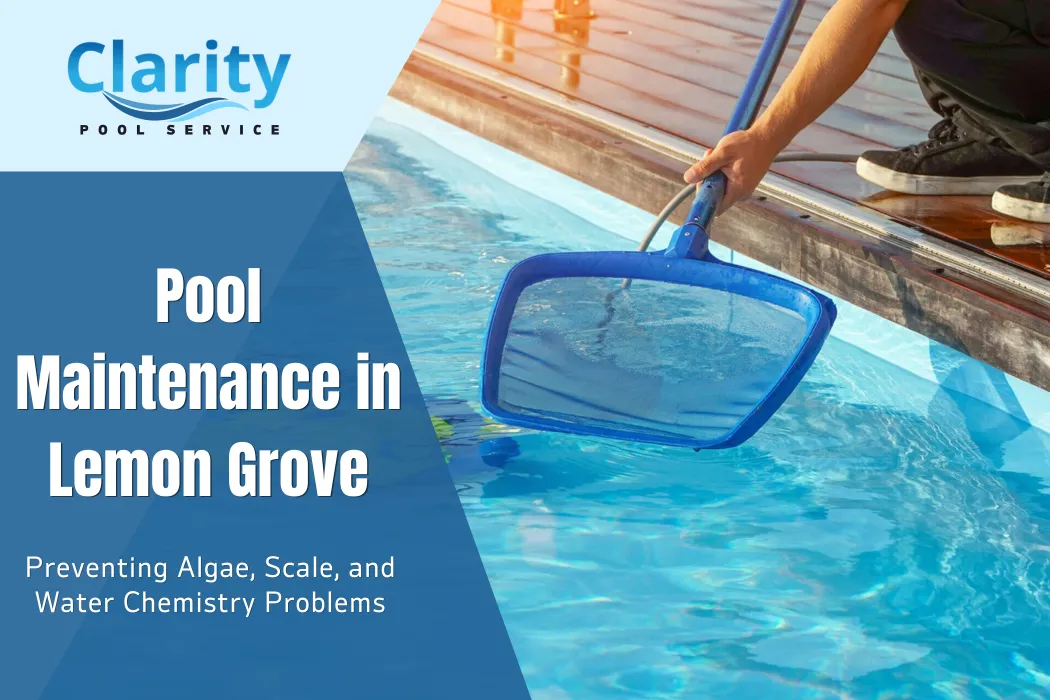
Pool Maintenance in Lemon Grove: Preventing Algae, Scale, and Water Chemistry Problems
A Homeowner's Guide to Balanced Pool Water, Calcium Buildup, and Preventative Pool Care in Lemon Grove, CA
Your swimming pool can look crystal clear while its water chemistry is slowly moving out of balance.
Chlorine may be dropping too low between maintenance visits. Calcium deposits may begin appearing around the waterline. Or a small patch of algae may repeatedly develop on the same step.
These problems don't always appear overnight.
For Lemon Grove homeowners, understanding the relationship between water chemistry, sanitation, circulation, and pool surfaces can help prevent expensive corrective treatments.
Warm weather, sunlight, evaporation, and landscaping debris can all influence how swimming pools behave throughout the year.
But good maintenance isn't about adding more chemicals every week.
It's about maintaining the right water conditions consistently—and recognizing when something changes.
Quick Answer: How Do You Prevent Pool Chemistry Problems?
Preventing common pool-water problems starts with five fundamentals:
Maintain adequate chlorine to control algae and harmful microorganisms.
Keep water chemistry balanced to protect pool surfaces and equipment.
Monitor calcium hardness and scale potential rather than judging calcium levels alone.
Maintain circulation and filtration so water treatment remains effective.
Test consistently and make chemical adjustments based on actual readings.
For homeowners who rely on professional pool maintenance, weekly service provides a practical foundation.
However, unusually high chlorine demand, equipment failures, or developing algae may require attention between visits.
Common Pool Chemistry Problems at a Glance
Problem | Possible contributing factors | What to evaluate |
Green water | Inadequate sanitizer, algae | Chlorine, CYA, circulation |
Cloudy water | Chemistry, filtration, suspended particles | Water testing and filter operation |
White calcium scale | Scale-forming water conditions | pH, alkalinity, calcium, temperature |
Recurring algae | Low sanitizer, circulation, brushing | Chlorine and maintenance |
Rapid chlorine loss | Sunlight, contamination, inadequate stabilization | FC, CYA, chlorine demand |
Rising pH | Aeration, water chemistry, chemical additions | pH and alkalinity |
Staining | Metals, organic debris, other sources | Stain identification and chemistry |
The appearance of a problem provides clues, but testing is necessary before choosing the appropriate treatment.
1. Why Clear Pool Water Can Still Be Out of Balance
One of the biggest misconceptions about pool ownership is that clear water automatically means healthy water.
It doesn't.
A pool may look perfectly clean while chlorine is inadequate or water balance is moving toward scale formation or surface deterioration.
Important measurements include:
Free chlorine (FC)
pH
Total alkalinity (TA)
Calcium hardness (CH)
Cyanuric acid (CYA)
Water temperature
Saltwater pools also require monitoring of salt concentration and chlorine-generator operation.
These measurements interact.
For example, the amount of free chlorine needed for effective sanitation depends partly on cyanuric acid concentration.
Similarly, calcium hardness alone doesn't determine whether water will form scale.
Good pool maintenance evaluates the complete water chemistry—not just whether the water looks blue.
2. Chlorine and Cyanuric Acid Must Work Together
Chlorine is the primary sanitizer in most residential swimming pools.
It helps control bacteria, algae, and other contaminants.
However, outdoor pools also need to manage chlorine loss from sunlight.
Cyanuric acid, commonly called stabilizer, helps protect chlorine from ultraviolet degradation.
But excessive CYA can reduce the effectiveness of a given free chlorine concentration.
This means a pool with high stabilizer may require a higher free chlorine level to maintain adequate sanitation.
Simply adding more chlorine without understanding the CYA level can lead to recurring problems.
For Lemon Grove homeowners, especially during sunny summer conditions, monitoring both FC and CYA is important.
The goal is to maintain an appropriate relationship between sanitizer and stabilizer.
3. Why Algae Keeps Returning
A recurring patch of algae is more than a cosmetic issue.
It may indicate that sanitation or another maintenance condition isn't being maintained consistently.
Algae commonly appears on:
Steps
Corners
Benches
Walls
Areas with weaker circulation
If algae repeatedly develops in the same location, consider:
Free chlorine levels
Cyanuric acid
Brushing frequency
Water circulation
Filtration
Organic contamination
Increasing chlorine may be necessary, but it shouldn't replace investigating the underlying cause.
A pool that repeatedly develops algae needs a maintenance correction—not simply another temporary cleanup.
For a complete explanation, see Why Do Pools Turn Green?
4. Understanding Calcium Scale
White deposits around the waterline are a common concern for swimming pool owners.
These deposits may be calcium carbonate scale, although other mineral deposits can also occur.
Scale formation depends on the overall water balance.
Important factors include:
pH
Total alkalinity
Calcium hardness
Water temperature
Dissolved solids and other chemistry conditions
When water becomes excessively scale-forming, calcium carbonate may deposit on surfaces.
Homeowners may notice buildup around:
Tile
Waterline
Spillways
Pool finishes
Salt chlorine generator cells
Scale is often easier to prevent than remove.
That's why maintaining appropriate water balance is more effective than waiting until heavy deposits become visible.
5. Why Evaporation Can Affect Calcium Hardness
During warm, dry weather, swimming pools lose water through evaporation.
When water evaporates, dissolved calcium and other minerals remain behind.
As the pool is refilled, additional minerals may enter through the replacement water.
Over time, this can increase calcium hardness, depending on the mineral content of the fill water and how water is otherwise removed or replaced.
For Lemon Grove homeowners, water hardness should be monitored as part of routine chemistry management.
However, not every property receives identical water chemistry.
The actual fill-water source and measured hardness matter more than assuming all pools in the area have the same conditions.
Test the water before recommending calcium-related treatment.
6. pH and Total Alkalinity Affect Water Balance
pH measures how acidic or basic the water is.
Total alkalinity helps describe the water's ability to resist rapid pH changes.
Both influence overall water balance.
If pH becomes excessively high, scale-forming conditions may become more likely.
If water becomes excessively aggressive, certain pool surfaces and equipment may be affected.
Some pools experience a gradual upward pH trend because of aeration, chemical additions, or other operating conditions.
The correct approach is to monitor pH and alkalinity together rather than automatically adding acid every week.
A stable pool may need different adjustments from one visit to the next.
7. Saltwater Pools Have Additional Chemistry Considerations
Saltwater pools use chlorine generators to produce sanitizer from dissolved salt.
They still require complete water balancing.
Salt systems may also experience calcium-scale buildup on cell plates when water conditions favor precipitation.
If a salt cell repeatedly develops scale, the technician should evaluate water balance rather than simply clean the cell more frequently.
Excessive acid cleaning can shorten cell life.
Low chlorine production should also be diagnosed before replacing the cell.
Possible causes include:
Inadequate operating time
Incorrect output settings
Flow restrictions
Water chemistry
Cell condition
Equipment problems
Saltwater simplifies chlorine production.
It doesn't eliminate the need for professional chemistry management.
8. Filtration and Circulation Support Water Chemistry
Proper water chemistry alone doesn't remove leaves, dust, or fine suspended particles.
The circulation system moves water through the filter and distributes sanitizer throughout the pool.
If circulation becomes restricted, maintenance problems may develop.
Possible warning signs include:
Weak return flow
Poor surface skimming
Full baskets
Rising filter pressure
Air inside the pump basket
A technician should investigate these conditions before assuming the pump needs replacement.
Similarly, cloudy water doesn't automatically mean additional chlorine is necessary.
The actual problem may involve filtration or suspended debris.
Water chemistry, circulation, and filtration must work together.
9. How Lemon Grove Weather Affects Pool Chemistry
Lemon Grove experiences seasonal conditions that can change pool-maintenance demands.
Summer Heat and Sunlight
Strong sunlight, warm water, and increased swimming can increase sanitizer demand.
Santa Ana Winds
Windblown dust, leaves, and organic material can increase contamination and filtration loading.
Winter Rain
Rain and runoff may introduce debris or alter water conditions.
Seasonal Landscaping
Leaves, pollen, blossoms, and other organic debris can increase cleaning and sanitizer demand.
These conditions don't mean every pool needs more chemicals.
They mean testing and maintenance should respond to what actually changed.
10. Why Consistent Testing Matters More Than Chemical Quantity
A pool shouldn't receive the same chemical dose every week simply because that was the previous routine.
Chemical demand changes with weather, swimmer use, debris, and water conditions.
Some weeks may require more chlorine.
Other weeks may need pH adjustment.
And sometimes the pool may need very little chemical correction.
The objective is stable water balance.
Professional maintenance should use measured readings to determine the appropriate treatment.
The best pool care isn't adding the most chemicals. It's adding what the water actually needs.
A Simple Homeowner Water-Chemistry Checklist
Even with weekly professional service, homeowners can watch for visible changes between visits.
What to check | Warning sign |
Water clarity | Cloudiness or green tint |
Pool surfaces | New scale or discoloration |
Waterline | White mineral deposits |
Steps and corners | Recurring algae |
Water level | Unusual evaporation or loss |
Salt system | Warning messages |
Equipment | Leaks or reduced circulation |
If a problem develops rapidly, contact your pool professional rather than waiting automatically for the next visit.
Frequently Asked Questions About Pool Chemistry in Lemon Grove
Why does my pool keep turning green?
Recurring algae often indicates inadequate sanitizer relative to the pool's conditions. Water chemistry, circulation, filtration, and brushing should all be evaluated.
Why is white calcium forming on my pool tile?
White deposits may be caused by scale-forming water conditions. pH, alkalinity, calcium hardness, and temperature influence calcium carbonate precipitation.
Does my pool need acid every week?
Not necessarily. Acid additions should be based on actual pH and water-balance measurements rather than a fixed schedule.
Can a saltwater pool develop calcium scale?
Yes. Salt cells and other surfaces can develop calcium deposits when water conditions favor scale formation.
Can balanced water help protect pool plaster?
Yes. Maintaining appropriate water balance helps reduce the risk of aggressive or scale-forming conditions that may affect cementitious pool finishes.
Professional Pool Maintenance in Lemon Grove, CA
At Clarity Pool Service, our maintenance approach focuses on accurate water testing, appropriate chemical adjustments, cleaning, filtration monitoring, and basic equipment observation.
We serve homeowners in Lemon Grove and surrounding East County San Diego communities.
Whether your pool struggles with recurring algae, calcium buildup, unstable pH, or changing sanitizer demand, the objective is to identify the cause and maintain more consistent water conditions.
Our goal is to help homeowners enjoy clean, balanced water while protecting pool surfaces and equipment.
Learn more about our pool maintenance services or contact Clarity Pool Service to discuss your pool's maintenance needs.
Final Thoughts
Good pool maintenance isn't measured by how many chemicals are added.
It's measured by how consistently the water remains properly sanitized and balanced.
For Lemon Grove homeowners, understanding chlorine, stabilizer, pH, alkalinity, calcium hardness, and circulation can help prevent recurring algae and scale problems.
The best approach is straightforward:
Test accurately.
Maintain appropriate sanitizer.
Balance the water.
Monitor circulation and filtration.
Recognize changes early.
When those fundamentals remain consistent, the pool becomes easier to maintain—and costly corrective work may be less likely.