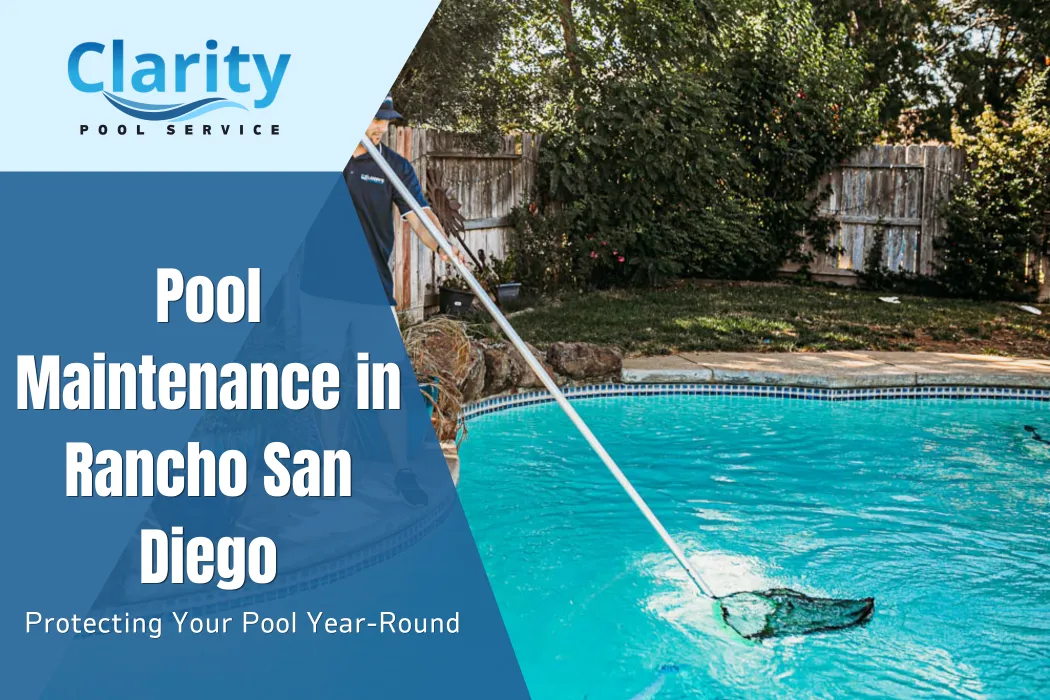
Pool Maintenance in Rancho San Diego: Protecting Your Pool Year-Round
A Homeowner's Guide to Water Balance, Pool Surfaces, Seasonal Care, and Preventative Maintenance
A swimming pool is one of the largest ongoing maintenance responsibilities in a Rancho San Diego backyard.
Keeping the water clear is important, but appearance alone doesn't tell you whether the pool is being maintained correctly.
Water chemistry can gradually move out of balance. Calcium deposits may begin forming along the tile. A pool surface may develop staining, and a small equipment problem can go unnoticed until it affects circulation.
For homeowners in Rancho San Diego, the goal of professional pool maintenance should be more than keeping the water looking good.
It should help protect the pool's surfaces, water quality, and equipment throughout the year.
Warm inland weather, strong sunlight, seasonal winds, and changing swimmer use can all affect how a pool behaves.
The best maintenance approach combines consistent weekly care with long-term protection of the swimming pool itself.
Quick Answer: What Does Proper Pool Maintenance Protect?
Complete pool maintenance helps protect five important parts of your swimming pool:
Water quality: Maintaining appropriate sanitizer and balanced chemistry.
Pool surfaces: Reducing the risk of scale, staining, and chemically aggressive water.
Circulation: Keeping water moving through the system effectively.
Filtration: Removing suspended contaminants before water clarity deteriorates.
Equipment: Recognizing leaks, unusual operation, and developing problems.
For homeowners who rely on professional maintenance, weekly service generally provides a practical foundation.
However, certain conditions—such as major weather events, equipment failures, or unusual water chemistry—may require additional attention between visits.
Rancho San Diego Pool Maintenance at a Glance
Maintenance concern | What homeowners should watch |
Water chemistry | Chlorine, pH, alkalinity, calcium, stabilizer |
Pool surfaces | Scale, stains, discoloration, deterioration |
Summer heat | Changing sanitizer demand and evaporation |
Landscaping | Leaves, pollen, and organic debris |
Filtration | Pressure changes and reduced water flow |
Circulation | Weak returns or recurring problem areas |
Equipment | Leaks, unusual noises, or warnings |
Salt systems | Chlorine production and cell condition |
Not every pool experiences all these conditions. Maintenance should reflect the actual property and equipment.
1. Water Balance Protects More Than Water Clarity
One of the most important aspects of pool maintenance is keeping the water chemically balanced.
A pool can look perfectly clear while its water balance creates conditions that encourage scaling or damage to certain surfaces and equipment.
Important measurements include:
Free chlorine
pH
Total alkalinity
Calcium hardness
Cyanuric acid
Water temperature
These measurements interact.
For example, calcium hardness alone doesn't determine whether a pool will develop scale.
pH, alkalinity, temperature, and other factors also influence calcium carbonate saturation.
That's why professional maintenance should consider the complete water balance rather than treating every measurement independently.
Clear water is desirable. Properly balanced water is essential.
2. Why Calcium Buildup Deserves Attention
Some homeowners first notice calcium-related problems as white deposits around the waterline.
Others see buildup on tile, spillways, or salt chlorine generator cells.
Calcium deposits can develop when water conditions favor scale formation.
Evaporation may also contribute to increasing dissolved mineral concentrations as water is repeatedly replaced.
The correct approach isn't simply adding acid whenever white deposits appear.
A technician should evaluate:
pH
Total alkalinity
Calcium hardness
Water temperature
Overall saturation balance
Preventing scale is generally easier than removing extensive buildup after it becomes established.
3. Pool Surfaces Need Appropriate Chemistry and Cleaning
Residential pools may have plaster, pebble, fiberglass, vinyl, or specialty interior finishes.
Each surface has different maintenance considerations.
For plaster and other cementitious finishes, prolonged aggressive water conditions can contribute to surface deterioration.
Excessive scale-forming conditions may create rough deposits.
Staining may develop from metals, organic material, or other sources.
Brushing should also be appropriate for the finish.
An aggressive brush that works on one surface may damage another.
The goal is to protect the finish while maintaining clean, sanitary water.
Good pool maintenance should extend beyond appearance to the condition of the pool itself.
4. Summer Heat Changes Pool Maintenance
Rancho San Diego's inland location can bring warm summer conditions that increase maintenance demands.
Strong sunlight and increased swimming can affect chlorine consumption.
Higher temperatures can also increase evaporation.
During summer, homeowners should pay particular attention to:
Sanitizer levels
Water balance
Water level
Circulation
Filter performance
A pool that remains stable during cooler months may require different chemical adjustments during July or August.
That doesn't mean automatically adding larger amounts of chlorine.
It means testing the water and responding to actual conditions.
5. Landscaping Can Affect Water Quality
Rancho San Diego properties vary in landscaping and backyard design.
Some pools are surrounded by mature trees, palms, and gardens.
Others have more open areas with direct sunlight.
Leaves, blossoms, pollen, and other organic material can enter the pool and increase maintenance demands.
Debris may:
Fill skimmer baskets
Settle on the pool floor
Increase filtration loading
Consume sanitizer as it breaks down
Removing debris early helps reduce the workload on the circulation and filtration system.
During Santa Ana wind events, homeowners may need to empty overloaded baskets between scheduled service visits.
6. Circulation Helps Maintain the Entire Pool
Water circulation supports filtration and sanitizer distribution.
When circulation becomes restricted, the pool may develop problems even if the pump continues running.
Warning signs include:
Weak return flow
Poor surface skimming
Persistent air inside the pump basket
Unusual filter-pressure changes
Recurring problems in areas with limited water movement
Possible causes include full baskets, dirty filters, valve settings, air intrusion, or equipment problems.
A technician should evaluate the complete circulation system before recommending pump replacement.
Weak circulation is a symptom—not a diagnosis.
7. Filtration Should Be Monitored, Not Over-Serviced
Pool filters collect suspended contaminants as water moves through the system.
As material accumulates, operating pressure and flow may change.
Filter maintenance depends on:
Filter type
Filter size
Debris conditions
Pressure changes
Water clarity
Manufacturer guidance
A filter doesn't need cleaning every week simply because the pool is being serviced weekly.
However, a filter that becomes significantly restricted should be addressed before circulation deteriorates further.
For more detail, see How Often Should a Pool Filter Be Cleaned?
8. Saltwater Pools Need Complete Water Balance
Saltwater pools are common alternatives to manually chlorinated systems, but they still use chlorine.
The salt chlorine generator produces sanitizer from dissolved salt.
It doesn't automatically maintain calcium hardness, alkalinity, pH, or every other chemistry measurement.
Salt systems also require appropriate circulation and operating conditions.
If a saltwater pool develops low chlorine, the problem may involve production settings, pump scheduling, water chemistry, or equipment.
Before replacing a salt cell, the system should be evaluated.
Our Saltwater Pool Service in Rancho San Diego guide covers that equipment in greater detail.
9. Why Equipment Observation Matters
A technician regularly servicing the same pool may recognize small changes before they become major failures.
These might include:
New pump noises
Persistent leaks
Air entering the circulation system
Changing filter pressure
Salt-system warnings
Unexpected equipment shutdowns
Weekly service isn't a complete mechanical inspection.
But routine observation can provide valuable information about the equipment's condition.
Age alone shouldn't determine whether equipment needs replacement.
Repair decisions should consider actual condition, repair history, parts availability, and cost.
10. Seasonal Pool Maintenance in Rancho San Diego
Maintenance requirements change throughout the year.
Spring
Watch for pollen, blossoms, and changing water temperatures.
Summer
Monitor sanitizer demand, evaporation, and increased swimmer use.
Fall
Pay attention to leaves, landscaping debris, and regional Santa Ana winds.
Winter
Continue water testing, circulation, filtration, and storm-debris removal.
Even when swimming decreases, pool equipment and water chemistry still require attention.
Year-round maintenance helps avoid major recovery work when warmer weather returns.
How to Recognize Problems Before They Become Expensive
Homeowners don't need to become pool technicians to notice changes.
A quick visual inspection between service visits can help.
What to check | Warning sign |
Water clarity | Cloudiness or green discoloration |
Pool surfaces | New scale or stains |
Water level | Unusual loss |
Skimmer baskets | Heavy debris |
Return flow | Reduced circulation |
Equipment | Leaks, noises, or warnings |
If something changes significantly, contact your pool professional rather than automatically waiting until the next scheduled visit.
How Much Does Pool Maintenance Cost in Rancho San Diego?
Monthly maintenance pricing depends on the individual pool and service agreement.
Factors may include:
Pool size
Attached spa
Landscaping and debris
Equipment complexity
Chemical requirements
Cleaning needs
Included services
Specialty services such as filter cleaning, green pool recovery, equipment repair, or major chemistry corrections may be billed separately.
When comparing providers, ask exactly what's included in the monthly price.
For a broader explanation, see How Much Does Pool Service Cost in San Diego?
Frequently Asked Questions About Rancho San Diego Pool Maintenance
Does my pool need weekly maintenance?
For homeowners who rely on professional service for most routine care, weekly maintenance generally provides a practical schedule. Additional attention may be needed after unusual weather or equipment problems.
Can poor water balance damage pool plaster?
Yes. Prolonged aggressive or scale-forming water conditions can contribute to surface deterioration or calcium deposits, depending on the pool finish and water chemistry.
Why does my pool develop white calcium deposits?
Scale may form when water conditions favor calcium carbonate precipitation. pH, alkalinity, calcium hardness, and temperature all influence the process.
Do saltwater pools need different maintenance?
Saltwater pools require the same basic cleaning, filtration, circulation, and water-balance care as traditionally chlorinated pools, plus monitoring of the chlorine generator.
Can regular pool maintenance prevent expensive repairs?
Consistent maintenance can help identify developing problems and maintain proper operating conditions, but it cannot eliminate normal equipment wear or guarantee that repairs won't be necessary.
Professional Pool Maintenance in Rancho San Diego, CA
At Clarity Pool Service, our approach to maintenance focuses on protecting the complete swimming pool system.
That includes consistent water testing, chemical balancing, cleaning, brushing, filtration monitoring, circulation checks, and basic equipment observation.
We serve homeowners throughout Rancho San Diego and surrounding East County San Diego communities.
Whether your pool has a plaster or pebble finish, a saltwater system, or established equipment, the objective is the same:
Maintain clean, balanced water while recognizing problems before they become major corrections.
Learn more about our pool maintenance services or contact Clarity Pool Service to request a weekly maintenance estimate.
Final Thoughts
A swimming pool is more than the water you see.
Its surfaces, plumbing, filtration, circulation, and equipment all depend on consistent maintenance.
For Rancho San Diego homeowners, protecting that investment starts with understanding how water chemistry and equipment conditions affect the entire system.
The best maintenance program doesn't wait until scale covers the tile, algae appears, or equipment stops operating.
It identifies changing conditions early and responds appropriately.
Clean water matters. Protecting the entire pool matters more.