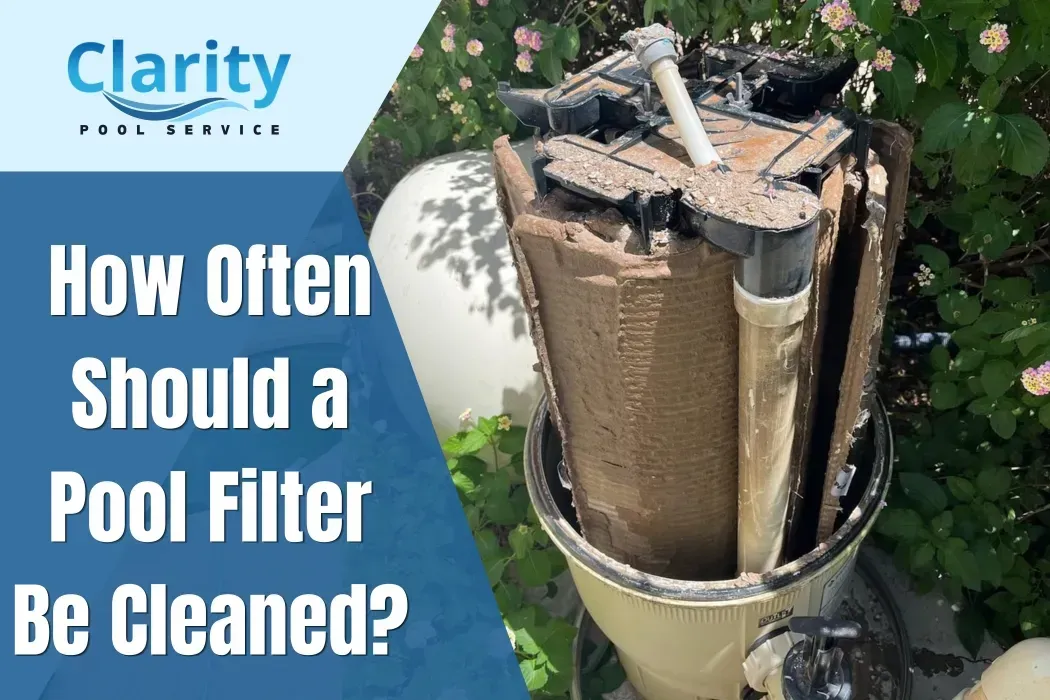
How Often Should a Pool Filter Be Cleaned?
A Complete Homeowner's Guide to Pool Filter Maintenance in East County San Diego
Your pool filter is one of the hardest-working pieces of equipment in your entire swimming pool system.
Every day it removes dirt, debris, pollen, oils, sunscreen, insects, and other contaminants that would otherwise remain suspended in the water.
Yet it's also one of the most overlooked maintenance items.
Many homeowners don't think about their filter until water becomes cloudy, circulation slows, or the pressure gauge starts climbing.
Unfortunately, waiting until problems become obvious often means the filter has already been working inefficiently for quite some time.
Routine filter maintenance helps improve water clarity, protect expensive equipment, maintain healthy circulation, and reduce unnecessary strain on your pump.
However, one of the biggest misconceptions is that every pool filter should be cleaned on the same schedule.
That's simply not true.
The correct cleaning frequency depends on:
Filter type
Pool usage
Tree coverage
Seasonal debris
Water conditions
Overall maintenance habits
Whether you own a pool in Santee, El Cajon, Lakeside, Rancho San Diego, Fletcher Hills, Mt. Helix, Spring Valley, Lemon Grove, San Carlos, Allied Gardens, Del Cerro, Casa de Oro, or elsewhere in East County San Diego, understanding how your filter works can help extend equipment life while keeping your pool cleaner throughout the year.
In this guide you'll learn:
How often different pool filters should be cleaned
Signs your filter needs attention
Why filter maintenance is important
Common homeowner mistakes
When to clean your filter
When professional service is recommended
By the end of this guide, you'll understand why a properly maintained filter is one of the most important parts of a healthy swimming pool.
Quick Answer
Most residential pool filters should be inspected regularly and cleaned based on manufacturer recommendations, filter type, operating conditions, and pressure readings—not simply the calendar.
Different filter systems have different maintenance needs:
Cartridge filters generally require periodic cleaning as debris accumulates.
DE (diatomaceous earth) filters require routine maintenance and periodic full cleanings.
Sand filters require periodic backwashing (where applicable) and occasional deeper maintenance.
The correct schedule depends on how quickly debris accumulates and how efficiently the filtration system is operating.
Routine inspections are often more valuable than cleaning on a fixed timetable.
At a Glance
Key Takeaways
✔ Every pool filter requires routine maintenance.
✔ Cleaning frequency depends on filter type and operating conditions.
✔ A dirty filter reduces circulation and places additional strain on your equipment.
✔ Cleaning too late reduces efficiency—but cleaning too frequently isn't always beneficial either.
✔ Monitoring filter pressure helps determine when maintenance may be needed.
✔ Consistent inspections often prevent larger equipment problems.
Why Your Pool Filter Is So Important
Many homeowners think chlorine does all the work.
In reality, chlorine and filtration work together.
Your sanitizer destroys bacteria and algae.
Your filter physically removes contaminants from the water.
Without proper filtration, dirt, pollen, dead algae, sunscreen, body oils, and other particles remain suspended in the pool much longer.
A clean filter helps:
Improve water clarity
Increase circulation
Reduce sanitizer demand
Protect pumps and other equipment
Support healthier water chemistry
When filtration suffers, the entire pool system becomes less efficient.
The Three Most Common Pool Filter Types
Although every filter performs the same basic job, they do so in different ways.
Cartridge Filters
Cartridge filters trap contaminants using a pleated filter element.
They offer excellent filtration while avoiding the need for routine backwashing.
Instead, cartridges are removed and cleaned as maintenance requires.
DE (Diatomaceous Earth) Filters
DE filters provide some of the finest filtration available for residential pools.
They use diatomaceous earth powder to capture extremely small particles.
These systems require periodic maintenance and full cleanings to maintain peak performance.
Sand Filters
Sand filters remove contaminants by passing water through specially graded filter sand.
They generally require periodic backwashing (where applicable) and occasional deeper maintenance to maintain efficient filtration.
Why East County Pools Often Need More Filter Attention
Throughout East County San Diego, seasonal conditions can significantly increase the workload placed on pool filters.
During spring, pollen and blossoms increase the amount of fine debris entering the water.
Summer often brings:
Increased swimmer use
Sunscreen
Dust
Higher chlorine demand
Fall introduces:
Leaves
Organic debris
Additional filter loading
Following Santa Ana wind events, filters often capture significantly more dirt and fine particles than during calmer periods.
These changing conditions explain why filter maintenance should be based on actual operating conditions rather than a fixed calendar schedule.
How Do You Know When Your Pool Filter Needs Cleaning?
One of the biggest questions homeowners ask isn't "How often should I clean my filter?"
It's:
"How do I know when it's actually time?"
That's the better question.
Every pool collects debris at a different rate.
A pool surrounded by mature trees may load the filter much faster than one with minimal landscaping. Likewise, heavy pool use during the summer places much greater demands on filtration than light winter use.
Rather than relying solely on a calendar, experienced pool professionals monitor several indicators that reveal how efficiently the filter is performing.
1. Rising Filter Pressure
The pressure gauge is one of the most valuable tools for evaluating filter performance.
As the filter captures dirt, pollen, insects, body oils, sunscreen, and other contaminants, water has a harder time flowing through the filter media.
As resistance increases, filter pressure rises.
When pressure climbs noticeably above the filter's normal clean operating pressure, it often indicates the filter needs maintenance.
Monitoring pressure weekly allows homeowners to identify changes before circulation becomes significantly restricted.
2. Reduced Water Circulation
Healthy circulation is essential for:
Even sanitizer distribution
Effective filtration
Proper skimming
Cleaner water
Healthy equipment operation
As filters become restricted, circulation gradually decreases.
Common signs include:
Weaker return jets
Slower surface movement
Debris remaining on the surface longer
Reduced skimming performance
Because these changes usually happen gradually, homeowners often don't notice them until circulation has declined significantly.
Routine inspections help catch these issues early.
3. Cloudy Water
Cloudy water doesn't always mean the filter is dirty.
However, poor filtration is often one of several contributing factors.
When contaminants remain suspended in the water longer than normal, clarity begins to suffer.
Possible causes include:
Dirty filter
Poor circulation
Heavy swimmer use
Organic contamination
A professional evaluation considers all of these factors together instead of assuming the filter is the only cause.
4. Increased Debris After Storms
Throughout East County San Diego, seasonal weather can dramatically increase the workload placed on a pool filter.
Following periods of:
Strong winds
Heavy pollen
Rainstorms
Falling leaves
Nearby landscaping work
your filter may collect significantly more debris than usual.
These situations often justify inspecting the filter sooner than you normally would.
5. Slower Water Clarity After Vacuuming
After vacuuming, properly functioning filtration should gradually restore excellent water clarity.
If fine particles continue circulating for an extended period, the filter may not be operating as efficiently as it should.
Possible causes include:
Dirty filter media
Reduced circulation
Equipment issues
Water chemistry problems
Again, the filter may be part of the problem—but not necessarily the only one.
How Each Filter Type Is Maintained
Although cartridge, DE, and sand filters all perform the same job, maintenance looks different for each system.
Understanding these differences helps homeowners know what to expect.
Cartridge Filters
Cartridge filters capture debris within pleated filter elements.
Routine maintenance generally involves:
Removing the cartridge
Rinsing accumulated debris
Inspecting for damage
Reinstalling or replacing when necessary
Over time, cartridges naturally wear out and eventually require replacement.
Proper cleaning helps maximize their lifespan.
DE Filters
DE filters provide exceptionally fine filtration by coating internal grids with diatomaceous earth.
Maintenance commonly includes:
Monitoring filter pressure
Backwashing when appropriate
Recharging with fresh DE powder after backwashing
Performing periodic complete cleanings
Because DE systems are more complex, many homeowners prefer professional maintenance.
Sand Filters
Sand filters use specially graded filter sand to capture contaminants.
Routine maintenance generally includes:
Monitoring filter pressure
Backwashing when recommended
Inspecting equipment
Periodic deep cleaning
Replacing filter sand at the appropriate service interval
Although sand filters require less frequent internal maintenance, they still benefit from regular inspections.
What We Commonly See Throughout East County
One of the biggest differences between East County pools and pools in other environments is the amount of seasonal debris entering the water.
Throughout the year we commonly see filters working harder because of:
Spring
Pollen
Blossoms
Seed pods
Summer
Dust
Sunscreen
Increased swimmer load
Fall
Leaves
Organic debris
Fine dirt
After Santa Ana Winds
Dust
Fine sand
Small branches
Heavy basket accumulation
These seasonal conditions increase filter loading, making regular inspections especially valuable.
Why Cleaning Too Often Isn't Always Better
Many homeowners assume that if cleaning is good, cleaning more frequently must be even better.
Not necessarily.
Cleaning a filter before it's actually necessary may provide little additional benefit.
For cartridge filters, unnecessary handling can also contribute to wear over time.
Instead of following an arbitrary schedule, experienced technicians combine:
Pressure readings
Water clarity
Circulation
Debris levels
Manufacturer recommendations
to determine when maintenance is actually needed.
The goal isn't to clean the filter as often as possible.
The goal is to keep the filtration system operating at peak efficiency.
Why Professional Filter Maintenance Matters
Cleaning the filter is only one part of the job.
A professional filter service also provides an opportunity to inspect the surrounding equipment.
During a typical filter maintenance visit, technicians often evaluate:
Pump operation
Filter housing
O-rings and seals
Air relief valve
Pressure gauge
Plumbing connections
Valves
Signs of leaks
Overall circulation performance
This preventative approach often identifies developing equipment problems before they become major repairs.
DIY Pool Filter Cleaning vs. Professional Filter Cleaning
Many homeowners are comfortable cleaning their own pool filter, especially if they've done it before.
For others, filter maintenance is one of those jobs that's easy to postpone until circulation problems begin affecting the entire pool.
Neither approach is necessarily wrong.
The important thing is making sure the filter is maintained correctly and at the appropriate time.
A clean filter helps protect your pump, improves circulation, supports water chemistry, and keeps your entire pool operating more efficiently.
DIY Filter Cleaning vs. Professional Service
For homeowners who enjoy maintaining their own equipment, DIY filter cleaning can be a practical option.
However, professional service provides the added benefit of inspecting the entire filtration system—not just the filter itself.
Common Pool Filter Maintenance Mistakes
Most filter problems don't happen because homeowners ignore maintenance completely.
They happen because of small habits that gradually reduce filtration efficiency.
These are some of the most common mistakes professionals see.
Waiting Until the Water Turns Cloudy
Many homeowners don't think about the filter until the water begins looking dull or cloudy.
Unfortunately, reduced filtration usually begins long before the water appearance changes.
Routine inspections and pressure monitoring help identify problems earlier.
Ignoring the Pressure Gauge
The pressure gauge is one of the simplest diagnostic tools on your equipment pad.
Many homeowners never look at it.
Watching for changes in normal operating pressure provides valuable information about filter performance and often indicates when maintenance is needed.
Cleaning the Filter Only Once a Year
Some homeowners assume an annual cleaning is sufficient.
In reality, maintenance depends on:
Pool usage
Filter type
Seasonal debris
Weather
Landscaping
Overall water conditions
Two identical filters can require maintenance at completely different intervals depending on the environment.
Forgetting to Inspect the Filter Housing
Cleaning the filter media is only part of proper maintenance.
Every filter service is also an opportunity to inspect:
Tank condition
O-rings
Lid sealing surfaces
Pressure gauge
Air relief valve
Plumbing connections
Small leaks discovered early are usually inexpensive to correct.
Ignoring them can eventually lead to more significant equipment problems.
Assuming the Filter Is Always the Problem
Cloudy water doesn't automatically mean the filter needs cleaning.
Poor water clarity can also result from:
Water chemistry imbalance
Low sanitizer
Poor circulation
Pump problems
Heavy swimmer use
A complete evaluation considers the entire circulation system—not just the filter.
Seasonal Filter Maintenance
The amount of work your filter performs changes throughout the year.
Understanding seasonal conditions helps explain why maintenance schedules naturally vary.
Spring
Spring often brings:
Heavy pollen
Blossoms
Seed pods
Fine organic debris
Filters frequently capture significantly more small particles during this season.
Summer
Summer is usually the busiest season for pool filtration.
Higher temperatures combined with increased swimming activity introduce:
Sunscreen
Body oils
Dust
Organic contaminants
These conditions increase the workload placed on the filter.
Fall
As leaves begin falling, filters often collect larger amounts of debris.
Pools with mature landscaping may require closer monitoring throughout the season.
Winter
Even during cooler weather, filtration remains important.
Storms continue introducing debris.
Water chemistry still changes.
Equipment continues operating.
Routine inspections help ensure the filtration system remains ready for the return of swim season.
When Should You Schedule Professional Filter Cleaning?
Professional service is often recommended when:
Filter pressure continues rising.
Water clarity declines despite balanced chemistry.
Circulation becomes noticeably weaker.
The filter hasn't been serviced for an extended period.
Equipment leaks are present.
The pressure gauge behaves abnormally.
The filter housing requires inspection.
You're unsure which maintenance your filter type requires.
Many homeowners also schedule professional filter cleaning as part of their regular preventative maintenance plan to help keep the entire circulation system operating efficiently.
Why Clean Filters Protect More Than Water Quality
A properly maintained filter doesn't just produce cleaner water.
It protects your entire circulation system.
When water flows efficiently through the filter:
Pumps operate under less strain.
Water circulates more effectively.
Sanitizer distributes more evenly.
Debris is removed more efficiently.
Equipment often lasts longer.
Over time, these benefits help reduce wear on expensive pool equipment while improving overall water quality.
That's why experienced pool professionals view filter maintenance as preventative equipment care—not simply another cleaning task.
Continue Learning
If you're building a better understanding of pool maintenance, these homeowner guides are a great next step:
Pool Service Cost in East County San Diego
What Does Weekly Pool Service Include?
Why Do Pools Turn Green?
Saltwater Pool Maintenance Guide
Pool Water Chemistry Explained
Signs Your Pool Equipment Needs Repair
Complete Pool Owner Learning Center
Each guide explores a different aspect of pool ownership, helping homeowners throughout East County San Diego make informed maintenance decisions while protecting their investment.
Frequently Asked Questions About Pool Filter Cleaning
Your pool filter works every day to remove dirt, debris, pollen, body oils, sunscreen, and other contaminants from the water.
Because it's always working behind the scenes, many homeowners don't think about it until something goes wrong.
Below are answers to the questions pool professionals hear most often about pool filter maintenance.
How often should I clean my pool filter?
There isn't one schedule that fits every pool.
The correct cleaning interval depends on:
Filter type
Pool usage
Tree coverage
Seasonal debris
Weather
Overall water conditions
Rather than cleaning based solely on the calendar, it's better to monitor filter pressure, water clarity, circulation, and manufacturer recommendations.
Routine inspections help determine when cleaning is actually needed.
How do I know if my filter needs cleaning?
Some of the most common warning signs include:
Rising filter pressure
Reduced circulation
Cloudy water
Weak return jets
Debris remaining in the pool longer than usual
Reduced skimming performance
These signs don't always mean the filter is the only problem, but they often indicate it's time for an inspection.
Can a dirty filter make my pool green?
Yes—but usually indirectly.
A dirty filter doesn't create algae by itself.
However, restricted filtration reduces circulation and makes it harder for sanitizer to work effectively throughout the pool.
Combined with poor water chemistry or low chlorine levels, reduced filtration can contribute to algae growth.
Should I clean my filter on a schedule?
A schedule provides a helpful reminder, but the filter's actual condition should determine when maintenance is performed.
A pool surrounded by mature trees may require attention sooner than a pool with very little debris.
Regular inspections generally produce better results than relying only on the calendar.
Does every filter type require the same maintenance?
No.
Each system is different.
Cartridge Filters
Periodic cartridge cleaning
Cartridge replacement as needed
DE Filters
Pressure monitoring
Backwashing (when appropriate)
Recharging with fresh DE after backwashing
Periodic complete cleanings
Sand Filters
Pressure monitoring
Backwashing (when appropriate)
Occasional deep maintenance
Sand replacement at recommended service intervals
Following the manufacturer's recommendations for your specific system is always the best approach.
What happens if I never clean my pool filter?
As debris continues accumulating inside the filter:
Water circulation decreases.
Filter pressure increases.
Water clarity may decline.
Pumps work harder.
Equipment experiences additional wear.
Overall pool efficiency decreases.
Routine maintenance helps prevent these problems before they begin affecting the rest of the pool system.
Can I damage my filter by cleaning it too often?
In some cases, yes.
For example, repeatedly removing and handling cartridge filters when unnecessary may contribute to premature wear.
The goal isn't cleaning as frequently as possible.
The goal is cleaning when maintenance is actually needed.
Why does my pressure gauge keep rising?
A gradual increase in pressure usually indicates the filter is capturing contaminants.
However, pressure can also be influenced by:
Heavy debris
Algae
Seasonal pollen
High swimmer use
Water quality issues
Monitoring trends over time provides more useful information than looking at one pressure reading by itself.
Is professional filter cleaning worth it?
For many homeowners, yes.
Professional service typically includes:
Complete filter cleaning
Equipment inspection
Seal and O-ring inspection
Pressure gauge evaluation
Plumbing inspection
Leak detection
Circulation evaluation
Cleaning the filter is only one part of maintaining the entire filtration system.
Does weather affect how often my filter needs cleaning?
Absolutely.
Throughout East County San Diego, seasonal conditions often increase filter loading.
Examples include:
Spring pollen
Summer dust
Heavy swimmer use
Autumn leaves
Santa Ana wind events
Rainstorms
These conditions can cause filters to collect contaminants much faster than during calmer periods.
Can poor water chemistry clog a filter?
Indirectly, yes.
Problems such as algae growth, calcium scale, and heavy organic contamination increase the amount of material your filter must remove.
Maintaining balanced water chemistry helps reduce unnecessary stress on the filtration system.
Is filter cleaning included with weekly pool service?
That depends on the maintenance plan.
Many pool companies treat filter cleaning as a separate scheduled service because it requires additional time and labor beyond routine weekly maintenance.
Always ask what services are included before comparing maintenance plans.
Final Thoughts
Your pool filter is one of the most important pieces of equipment protecting your swimming pool.
While chlorine sanitizes the water, the filter removes the contaminants that chlorine leaves behind.
Together, they keep your pool clean, healthy, and enjoyable throughout the year.
Routine filter maintenance improves circulation, supports water chemistry, protects expensive equipment, and helps maintain crystal-clear water.
Waiting until the water turns cloudy or circulation slows often means the filter has already been working inefficiently for some time.
The best approach is simple:
Inspect your filtration system regularly, monitor pressure, follow the manufacturer's recommendations, and address maintenance before small problems become larger repairs.
Consistent preventative maintenance almost always costs less than correcting problems after they develop.
Continue Exploring the Pool Owner Learning Center
Ready to become a more informed pool owner?
Continue with these homeowner guides:
Signs Your Pool Equipment Needs Repair
Complete Pool Owner Learning Center
Each guide builds on the previous one, helping homeowners throughout East County San Diego better understand pool care, equipment maintenance, and long-term pool ownership.
Keep Your Filtration System Working at Its Best
A properly maintained filter does much more than keep the water looking clean—it helps protect your entire pool system.
Regular inspections, timely maintenance, and proper water balance all contribute to healthier circulation, cleaner water, and longer equipment life.
At Clarity Pool Service, we believe homeowners make better maintenance decisions when they understand how their pool works. That's why our Learning Center focuses on practical, homeowner-friendly education instead of simply promoting services.
Whether you maintain your own pool or prefer professional care, understanding your filtration system is one of the best investments you can make in the long-term health of your swimming pool.