
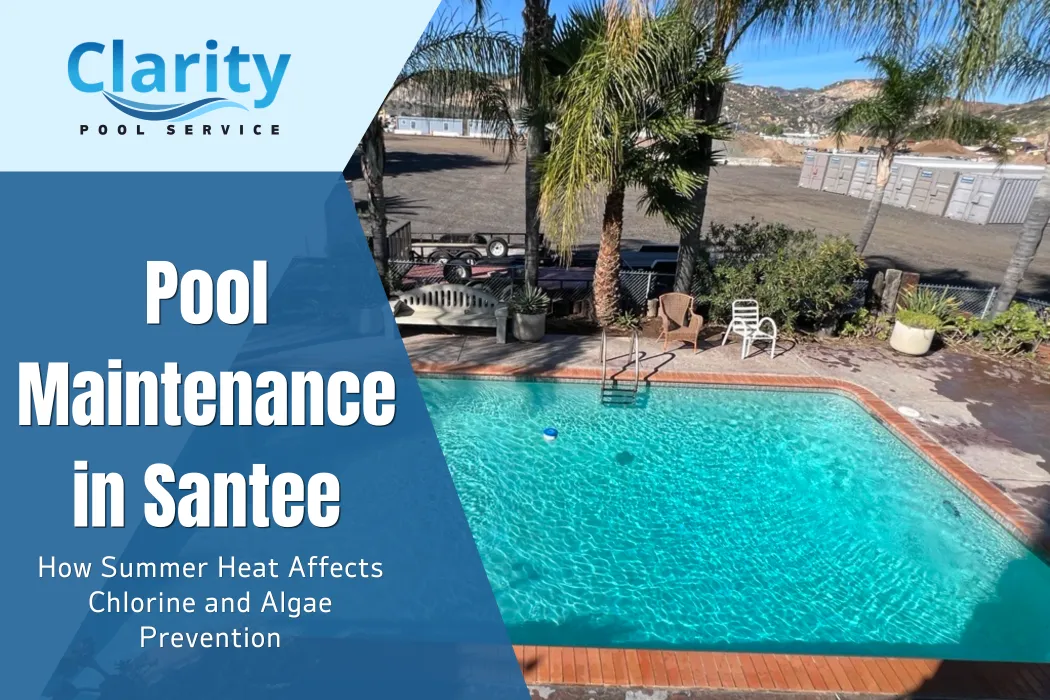
Pool Maintenance in Santee: How Summer Heat Affects Chlorine and Algae Prevention
Why Santee Swimming Pools Lose Chlorine Faster During Summer - and What Homeowners Can Do About It
Summer in Santee means long, sunny days, warm swimming pools, and plenty of opportunities to enjoy the backyard.
But those same conditions can make pool maintenance more demanding.
A pool that holds chlorine consistently during spring may suddenly struggle to maintain adequate sanitizer during July, August, or September.
The water may still look clear, even though chlorine levels are dropping faster than expected.
Then one morning, the walls feel slippery, a green patch appears on the steps, or the water begins turning cloudy.
For Santee homeowners, understanding summer chlorine demand is one of the most important parts of preventing algae.
The solution isn't necessarily adding more chlorine every week.
It's understanding why chlorine is disappearing and maintaining an appropriate sanitizer level before problems develop.
Quick Answer: Why Does Pool Chlorine Disappear Faster in Summer?
Swimming pools may consume chlorine faster during summer because of:
Strong sunlight and ultraviolet exposure
Warmer water temperatures
Increased swimmer use
Sunscreen, body oils, and organic contamination
Leaves, pollen, and windblown debris
Inadequate cyanuric acid (stabilizer)
Developing algae
Salt systems that aren't producing enough chlorine
For Santee pools, the combination of inland heat, strong sunlight, and seasonal swimming activity can increase sanitizer demand.
The key is maintaining adequate free chlorine relative to cyanuric acid—not simply adding the same amount of chlorine every week.
Summer Chlorine Problems at a Glance
What you notice | Possible cause | What to check |
Chlorine drops rapidly | Sunlight or increased demand | FC, CYA, swimmer use |
Green spots on steps | Developing algae | FC, brushing, circulation |
Cloudy water | Chemistry, algae, filtration | Full water test and filter |
Strong chlorine odor | Chloramines or contamination | Free and combined chlorine |
Salt system can't keep up | Production below demand | Output, pump time, cell condition |
Chlorine low after a party | Heavy swimmer load | Sanitizer and water balance |
Chlorine low after winds | Organic contamination | Debris, baskets, water chemistry |
These symptoms provide useful clues, but testing is necessary before choosing treatment.
1. Strong Sunlight Can Destroy Unprotected Chlorine
One of the biggest reasons outdoor pools lose chlorine is ultraviolet exposure.
Sunlight breaks down chlorine in swimming pool water.
Cyanuric acid, commonly called stabilizer, helps protect chlorine from rapid sunlight degradation.
Without adequate stabilizer, an outdoor pool may lose a substantial portion of its chlorine during sunny conditions.
But more stabilizer isn't always better.
As cyanuric acid increases, the free chlorine concentration required to maintain effective sanitation also increases.
This means chlorine and stabilizer must be considered together.
For Santee homeowners, particularly during summer, maintaining an appropriate FC-to-CYA relationship is essential.
A technician should test both measurements rather than repeatedly adding chlorine without understanding stabilizer levels.
2. Warmer Water Can Increase Chlorine Demand
Water temperature influences pool chemistry and biological activity.
During prolonged summer heat, warmer water can contribute to increased sanitizer demand, particularly when combined with swimmers and organic contamination.
A pool that remains stable in cooler weather may require more frequent chlorine adjustments during summer.
This doesn't mean every Santee pool needs the same increased dosage.
Pool size, water chemistry, swimmer use, and environmental conditions all matter.
The correct approach is to test the water and determine whether sanitizer is remaining adequate between maintenance visits.
3. Pool Parties Increase Chlorine Consumption
Summer often means more people using the swimming pool.
Swimmers introduce contaminants such as:
Sweat
Sunscreen
Body oils
Cosmetics
Other organic material
Chlorine reacts with those contaminants, increasing demand.
After a busy swimming weekend, sanitizer may be noticeably lower than normal.
For homeowners hosting frequent pool parties, checking chlorine more often can help identify changing conditions before algae develops.
Additional treatment should be based on test results rather than automatically shocking the pool after every gathering.
4. Santa Ana Winds and Organic Debris
Santee pools can be affected by regional Santa Ana winds, particularly during warmer and drier periods.
Strong winds may introduce:
Leaves
Dust
Dirt
Pollen
Organic debris
This material can increase chlorine demand and create additional cleaning requirements.
Leaves may also fill skimmer baskets and restrict circulation.
After significant wind, remove large debris, check baskets, and confirm that the filtration system is operating normally.
If water conditions have changed, test sanitizer and adjust as needed.
Removing organic debris early helps reduce the workload on chlorine and filtration.
5. Early Algae Can Consume Chlorine Before Water Turns Green
One of the most important warning signs of developing algae is unusually high chlorine demand.
A pool may still look relatively clear while algae begins establishing itself on surfaces.
Possible early signs include:
Slippery steps
Green discoloration in corners
Cloudy or dull water
Chlorine disappearing faster than usual
Recurring growth in areas with weaker circulation
If chlorine repeatedly falls too low, simply adding a normal maintenance dose may not address the underlying problem.
The pool may require a more complete evaluation of sanitation, brushing, filtration, and circulation.
For a deeper explanation, see Why Do Pools Turn Green?
6. Saltwater Pools Can Struggle During Summer Too
Saltwater pools still use chlorine.
The difference is that a salt chlorine generator produces chlorine from dissolved salt.
During summer, chlorine demand may exceed what the generator is producing.
Possible reasons include:
Output percentage set too low
Insufficient pump operating time
Low water flow
Cell scale
Equipment warnings
Increased chlorine demand
Before assuming the salt cell needs replacement, verify water chemistry, actual salt concentration, pump operation, and generator settings.
A salt system may be functioning correctly but simply producing less chlorine than the pool currently needs.
In that situation, output or operating time may need adjustment.
7. Why Adding More Chlorine Isn't Always the Complete Solution
When a pool repeatedly loses chlorine, adding more may temporarily restore sanitizer.
But if the underlying cause remains, the problem can return.
Consider the possible causes.
Inadequate Stabilizer
Chlorine may be breaking down rapidly in sunlight.
Excessive Stabilizer
The maintained free chlorine concentration may be insufficient relative to CYA.
Developing Algae
Chlorine demand may remain elevated until algae is eliminated.
Heavy Organic Debris
Leaves and contamination may continue consuming sanitizer.
Equipment Problems
Poor circulation or inadequate salt-system production may prevent stable sanitation.
The correct solution depends on identifying which condition is present.
8. How Often Should Chlorine Be Tested During Summer?
For a residential pool, weekly professional testing provides a useful maintenance baseline.
However, during periods of high chlorine demand, testing free chlorine and pH more frequently may be appropriate.
Homeowners should consider additional testing after:
Large pool parties
Extended heat waves
Equipment shutdowns
Heavy organic contamination
Unexpected changes in water clarity
A pool experiencing recurring low chlorine may require closer monitoring until conditions stabilize.
Testing frequency should reflect how quickly the pool's chemistry changes.
9. Does Running the Pump Longer Prevent Algae?
Adequate circulation supports sanitizer distribution and filtration.
But pump operation alone doesn't prevent algae.
A pool can run its pump for many hours and still develop algae if chlorine is inadequate.
Likewise, a pool with appropriate chlorine may struggle with debris or water clarity when filtration is restricted.
The objective is to maintain:
Sanitation + Water Balance + Circulation + Filtration + Brushing
together.
If circulation becomes weak, check baskets, filter condition, valve positions, and pump operation before simply increasing run time.
10. A Practical Summer Pool Maintenance Routine
For Santee homeowners, summer maintenance should emphasize the conditions that change most quickly.
Water Chemistry
Test sanitizer and pH regularly. Monitor CYA and other water-balance measurements as appropriate.
Cleaning
Remove leaves and organic debris before they accumulate.
Brushing
Pay attention to steps, corners, benches, and areas where algae tends to develop.
Filtration
Monitor filter pressure and return flow.
Water Level
Watch evaporation so the skimmer continues operating properly.
Salt Systems
Confirm that chlorine production is keeping up with demand.
The goal isn't adding unnecessary work.
It's recognizing the changes that summer conditions create.
What Should Santee Homeowners Check Between Weekly Visits?
Even with professional service, a quick check during hot weather can be valuable.
Check | Warning sign |
Water clarity | Cloudiness or green tint |
Steps and walls | Slippery surfaces |
Water level | Significant evaporation |
Skimmer baskets | Heavy debris |
Circulation | Weak return flow |
Salt-system display | Warnings or errors |
If water conditions deteriorate rapidly, contact your pool professional rather than waiting automatically for the next visit.
Frequently Asked Questions About Santee Summer Pool Maintenance
Why does my pool lose chlorine so quickly in summer?
Strong sunlight, warm water, swimmer use, organic contamination, inadequate stabilizer, or developing algae can increase chlorine loss or demand. Testing helps identify the cause.
Does hot weather automatically cause algae?
No. Heat can increase maintenance demands, but algae becomes established when sanitation and other conditions are inadequate.
Should I shock my pool every week during summer?
Not automatically. Shock treatment should be based on actual water conditions rather than a fixed weekly schedule.
Does a saltwater pool need more chlorine during summer?
It may require greater chlorine production when demand increases. The correct adjustment depends on testing, generator performance, and pool conditions.
Can a pool turn green between weekly service visits?
Yes. If chlorine becomes inadequate, equipment stops operating, or contamination increases significantly, algae can develop before the next scheduled visit.
Professional Summer Pool Maintenance in Santee, CA
At Clarity Pool Service, we focus on maintaining appropriate sanitation, balanced chemistry, consistent cleaning, healthy circulation, and effective filtration.
For Santee homeowners, summer maintenance means paying attention to changing chlorine demand, water temperature, debris, and equipment operation.
Our weekly maintenance approach is designed to recognize these conditions and make adjustments based on actual water testing.
We serve Santee and surrounding East County San Diego communities.
Learn more about our Santee pool service or explore our pool maintenance services.
Final Thoughts
Santee's summer heat doesn't have to mean constant algae problems.
The key is understanding why chlorine demand changes and responding before sanitizer becomes inadequate.
Strong sunlight, warmer water, swimmer activity, organic debris, and salt-system operation can all influence how much chlorine a pool needs.
The best approach isn't simply adding more chemicals.
It's maintaining the right chlorine level for the pool's conditions, keeping the water balanced, removing debris, and monitoring circulation and filtration.
Consistent testing and preventative maintenance are what keep summer pool care manageable.