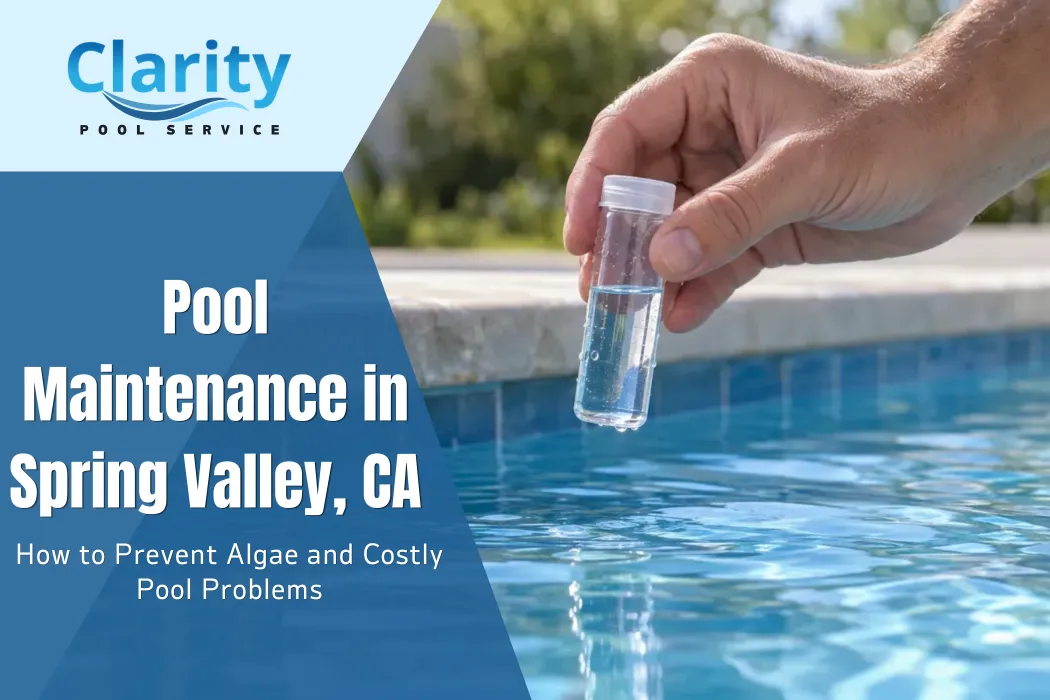
Pool Maintenance in Spring Valley, CA: How to Prevent Algae and Costly Pool Problems
A Local Homeowner's Guide to Preventative Pool Care, Water Chemistry, and Equipment Maintenance
A swimming pool doesn't have to turn green before something is wrong.
Chlorine may be dropping too low between maintenance visits. A filter may be gradually restricting water flow. A small equipment leak could go unnoticed for weeks.
By the time cloudy water, algae, or equipment failure becomes obvious, the underlying problem may have been developing for some time.
For homeowners in Spring Valley, preventative pool maintenance means recognizing these changes early.
Warm inland weather, seasonal winds, landscaping debris, and year-round pool operation can all influence maintenance requirements.
The objective isn't to perform more work than necessary.
It's to keep the water, circulation, filtration, and equipment operating properly before problems become expensive corrections.
Quick Answer: What Is Preventative Pool Maintenance?
Preventative pool maintenance is the consistent testing, cleaning, and equipment monitoring that helps reduce avoidable water-quality problems and unexpected repairs.
A comprehensive maintenance routine should include:
Regular water testing
Appropriate sanitizer levels
Balanced water chemistry
Surface skimming and brushing
Vacuuming when needed
Skimmer and pump basket cleaning
Filter-pressure monitoring
Circulation checks
Basic equipment observation
For homeowners who prefer professional maintenance, weekly pool service provides a practical schedule for maintaining these fundamentals.
The goal is prevention rather than repeatedly recovering the pool after something goes wrong.
Common Spring Valley Pool Problems at a Glance
Problem | Possible contributing factor | Preventative action |
Recurring algae | Inadequate sanitizer | Test and maintain chlorine |
Cloudy water | Chemistry or filtration | Monitor chemistry and filter |
Weak circulation | Full baskets or restrictions | Check baskets and flow |
Rising filter pressure | Debris accumulation | Monitor and service filter |
Equipment leaks | Worn seals or fittings | Inspect visible equipment |
Low saltwater chlorine | Inadequate production | Check output, flow, and chemistry |
Heavy debris | Landscaping or wind | Skim and empty baskets |
Rapid water loss | Evaporation or possible leak | Monitor water level |
These symptoms can have multiple causes. Proper diagnosis should come before major treatment or equipment replacement.
1. Prevent Algae Before the Water Turns Green
Algae prevention begins with maintaining adequate sanitizer.
Chlorine is continuously consumed by sunlight, swimmers, and organic contamination.
During warm weather, chlorine demand may increase.
If sanitizer repeatedly falls too low, algae can begin developing on pool surfaces or in the water.
Routine maintenance should include accurate water testing and appropriate chemical adjustments.
Brushing is also important, particularly around steps, corners, benches, and areas with limited circulation.
If algae repeatedly develops in the same location, evaluate circulation and brushing alongside water chemistry.
The best algae treatment is preventing growth from becoming established.
2. Keep Water Chemistry Stable
Water chemistry involves more than chlorine.
Important measurements include:
Free chlorine
pH
Total alkalinity
Calcium hardness
Cyanuric acid
Salt concentration when applicable
These measurements affect sanitation, water balance, pool surfaces, and equipment.
For example, excessive calcium-scale potential can contribute to deposits on tile, equipment, and salt cells.
Improper pH or other water-balance conditions may also increase the risk of corrosion or surface problems.
Not every chemical needs adjustment during every visit.
The correct approach is to test the water and make measured changes when necessary.
For a deeper explanation, see Pool Water Chemistry Explained.
3. Remove Debris Before It Creates Other Problems
Spring Valley properties vary considerably in landscaping.
Some pools are surrounded by mature trees and palms.
Others have open yards exposed to dust and seasonal winds.
Leaves, blossoms, dirt, and organic material can:
Fill skimmer baskets
Settle on the pool floor
Increase filtration demand
Consume sanitizer
Interfere with circulation when baskets become restricted
Removing debris early reduces the amount of material the filtration system must process.
During Santa Ana wind events, homeowners may need to empty baskets between professional visits.
A weekly service schedule can't prevent debris from entering the pool the following day.
4. Monitor Filter Pressure and Circulation
The pool filter captures suspended contaminants as water moves through the circulation system.
As debris accumulates, pressure and flow conditions may change.
Homeowners should become familiar with the filter's normal clean operating pressure at a consistent pump speed.
A meaningful increase may indicate that filter cleaning is needed.
Unusually low pressure or weak return flow may point to a different circulation issue.
Possible causes include:
Full baskets
Air entering the suction side
Valve position
Filter restriction
Pump problems
Before replacing expensive equipment, evaluate the entire circulation system.
A dirty filter can make a healthy pump appear weak.
5. Small Equipment Leaks Deserve Attention
Persistent leaks around the equipment pad shouldn't become accepted as normal.
Common areas to observe include:
Pump housing
Plumbing connections
Filter fittings
Valves
Heater connections
Some leaks involve relatively simple seals or fittings.
Others may indicate more significant deterioration.
Identifying a small leak early may provide more repair options and help prevent additional damage.
Homeowners don't need to disassemble equipment to recognize a problem.
A quick visual check is often enough to notice that something has changed.
6. Saltwater Pools Need Preventative Maintenance Too
Saltwater pools use chlorine generators to produce sanitizer from dissolved salt.
That reduces frequent manual chlorine additions, but it doesn't eliminate maintenance.
Saltwater systems still require monitoring of:
Chlorine production
Salt concentration
Water chemistry
Pump operation
Water flow
Cell condition
Equipment warnings
If chlorine becomes low, don't automatically add salt or replace the cell.
The problem may involve increased chlorine demand, inadequate pump operating time, circulation restrictions, or equipment settings.
Test and diagnose before making expensive changes.
7. Pump Scheduling Affects Pool Health
Pool pumps need to operate long enough to support circulation, filtration, and connected equipment.
However, running at maximum speed unnecessarily can increase electricity use.
Variable-speed pumps allow different speeds for different functions.
The schedule should account for:
Filtration
Surface skimming
Salt chlorine production
Heating
Automatic cleaners
Water features
If water quality begins deteriorating after pump programming changes, review the schedule before assuming the equipment has failed.
The goal is effective circulation—not simply the most operating hours.
8. Spring Valley Weather Can Change Maintenance Needs
Local conditions can influence pool maintenance throughout the year.
Summer Heat
Higher temperatures, strong sunlight, and increased swimming may raise sanitizer demand.
Seasonal Landscaping Debris
Leaves, blossoms, and organic material may increase cleaning and filtration needs.
Santa Ana Winds
Strong winds can introduce dust and debris within hours.
Winter Rain
Rain and storm runoff may introduce contaminants or change water conditions.
The maintenance schedule can remain consistent while the work responds to changing conditions.
A pool that needs minimal correction during a calm spring week may require considerably more attention after a major wind event.
9. What Should Weekly Professional Maintenance Include?
A comprehensive weekly visit should generally address:
Water care: Test and adjust chemistry based on actual conditions.
Cleaning: Skim, brush, and vacuum when needed.
Baskets: Remove debris before it restricts flow.
Filtration: Monitor pressure and circulation.
Equipment: Observe visible leaks, unusual noises, and warnings.
Communication: Inform the homeowner about meaningful concerns.
Not every visit requires major chemical corrections or equipment service.
A stable pool may require relatively little intervention.
That's the objective of preventative maintenance.
10. When Does a Pool Need More Than Weekly Service?
Some conditions require additional work beyond routine maintenance.
Examples include:
Established algae
Green pool recovery
Major filter cleaning
Equipment repair
Leak detection
Severe chemistry corrections
If a pool has already turned green, it may require a dedicated recovery plan rather than normal weekly service.
Our Green Pool Cleanup in Spring Valley guide explains that process in greater detail.
Routine maintenance and specialty services should have clearly defined boundaries.
A Five-Minute Homeowner Pool Check
Even with professional weekly service, homeowners can identify unusual conditions between visits.
What to check | What to look for |
Water | Cloudiness or green discoloration |
Water level | Unexpected drop |
Baskets | Excessive leaves or debris |
Return flow | Weak circulation |
Pump | Unusual sounds or persistent air |
Equipment | New leaks or warning messages |
These checks are particularly useful after strong winds, heavy pool use, or equipment problems.
You don't need to repeat the technician's complete maintenance routine.
You're simply looking for changes that shouldn't wait until the next visit.
Frequently Asked Questions About Pool Maintenance in Spring Valley
How often should a Spring Valley pool be serviced?
For homeowners relying on professional maintenance, weekly service generally provides a practical schedule. Additional attention may be necessary after unusual weather or equipment problems.
Can regular pool maintenance prevent algae?
Consistent sanitizer, balanced chemistry, brushing, circulation, and filtration help reduce algae risk. However, unexpected equipment failures or contamination can still create problems.
Does a saltwater pool require less maintenance?
Salt systems automate chlorine production, but water testing, cleaning, filtration, and equipment observation remain necessary.
How do I know if my filter needs cleaning?
Monitor filter pressure at a consistent pump speed, return flow, water clarity, and manufacturer recommendations.
Can preventative maintenance eliminate equipment repairs?
No. Equipment eventually wears out. Routine observation can help identify developing problems earlier, but it cannot prevent every failure.
Professional Pool Maintenance in Spring Valley, CA
At Clarity Pool Service, our maintenance approach focuses on keeping water chemistry stable, removing debris, maintaining effective filtration, and identifying developing equipment concerns.
We serve homeowners throughout Spring Valley and surrounding East County San Diego communities.
Whether your pool experiences recurring algae, heavy landscaping debris, or equipment problems, consistent preventative maintenance can make ownership easier.
Our goal is to maintain the complete pool system—not simply improve the water's appearance on service day.
Learn more about our pool maintenance services or contact Clarity Pool Service to request a weekly maintenance estimate.
Final Thoughts
The best pool maintenance doesn't begin when the water turns green.
It begins with consistent attention to the fundamentals.
Sanitation.
Water chemistry.
Cleaning.
Circulation.
Filtration.
Equipment condition.
For Spring Valley homeowners, preventative maintenance means recognizing changes before they become larger problems.
A clean pool is important.
But a clean pool with stable chemistry, healthy circulation, effective filtration, and reliable equipment is the real goal.
Prevent problems when possible. Diagnose them when they occur. Maintain the entire system.